Elif Rongen-Kaynakçı’s curated program of Istanbul films, now screening at Demirane, consists of short found-footage clips shot by European camera operators at the turn of the century, in the manner of a travelogue film. Accompanying the screenings is this essay by film writer and academic Aslı Özgen, originally published in the Toplumsal Tarih journal, which recounts the captivating history of how Istanbul and the Bosphorus came to be captured on film.
Aslı Özgen
This essay underlines the powerful role of the “fluid frame” in shaping the cinematic image of Istanbul in particular, reflecting on the translation of urban space into a cinematic element. At the same time, it sets out to trace the pre-cinematic aesthetic precursors of fluid frames. Let us also note here that one of the essential avenues for researching the aesthetic precursors of fluid frames, though beyond the scope of this essay, is to reach into the little-known and hard-to-discover corners of film history.

Istanbul is known to have been filmed for the first time in 1896 by Alexandre Promio, the camera operator whom the Lumière brothers, inventors of the cinématographe, sent to the Middle East. [1] Perfected in 1895 by Auguste and Louis Lumière, two brothers who worked as photographers and manufactured photographic supplies in France, the cinématographe could record onto a 17-meter strip of film, develop the exposed film, and, with the help of a light source, project the developed film onto a wall for a large audience. Light and versatile, and therefore easy to carry, the cinématographe was operated by a hand crank, which made it possible to film in the streets, in crowded places, at public events and in faraway lands.
The Lumière brothers asked the photographic supply agencies they already had in various cities around the world to assign camera operators, and encouraged them to film everyday life in every corner of the globe. Promio, too, had come to Istanbul in the footsteps of the travelers who preceded him. The bond between cinema and travel was a strong one from the very beginning.
To put it more precisely, it is impossible to think of cinema independently of the technological inventions that transformed the perception of space and time in the 19th century: trains, steamships, bicycles, elevators, moving walkways, accelerating trams and, later, automobiles and even airplanes gave rise to new ways of seeing. As an art capable of transforming the perception of space and time, cinema became a medium in which these new ways of seeing were put into practice, tested, and pushed to their limits to produce aesthetic experimentation. While it was praised for its closeness to reality because it showed what the human eye could not see, its power to shape perception was also being discovered. (It emerged, for instance, that a train that was actually slowing down as it pulled into a station could, owing to the lens effect, suddenly grow disproportionately larger as it approached the camera, creating the sense that it was gathering speed, and that this had the power to throw audiences into a panic.) Alongside motives such as letting viewers experience a place or archiving an event, the Lumière brothers also drew on the new perspectives, that is, the new points of view, brought by modernity as sources of inspiration in shaping the aesthetics of cinema: in the films of the Lumière catalog, one first notices an aesthetic aim of containing maximum movement within a fixed frame; later on, one sees the possibilities of the moving perspective being explored by placing the camera on trains, on ships and in elevators.
[1] Burçak Evren, “Les Premiers Pas: 1895-1923”, Le Cinema Turc, Mehmet Basutçu, ed. (Paris: Centre Georges Pompidou Editions, 1996), p. 61.
The earliest known images of Istanbul in film history fit into this context. In other words, the first filming of Istanbul is a moment in which, with the aim of letting viewers experience a place, the aesthetic limits of cinema, then a new art, were pushed, and the urban space itself gave rise to a cinematic element. But that is not all: the first filming of Istanbul also makes possible a journey back to the roots of the modern culture of spectacle that permeates the art of the Lumières.
Promio, a camera operator who reflected on and experimented with the possibilities of this new invention, filmed Istanbul from the water, from the Golden Horn. With the images of the city he recorded from a boat moving along the Golden Horn, Promio made one of the first “tracking shots” in history. [1] According to some sources, shortly before this he had made a similar tracking shot from a gondola gliding along the Grand Canal in Venice. The fluidity of these deep, broad waterways running through the heart of both cities, [2] appears to have inspired Promio to move his camera just as these waters move.


In the case of Istanbul, this way of recording the city from a moving perspective flowing over the water would later echo in many films. For example, in the films of the French documentary filmmaker Maurice Pialat, who visited Istanbul in the 1960s; of Alain Robbe-Grillet, who shot his first feature film in Istanbul with Lütfi Akad as his assistant; of Atıf Yılmaz; and of many others, the city’s shores are contemplated from a boat drifting along the Bosphorus or the Golden Horn. All these long tracking shots share a common feature: they possess a “fluidity” that comes from being filmed on the water. In these shots, the gentle or at times turbulent movement of the water also determines the aesthetics of the images entering and leaving the frame. Another element is that the image in the frame flows past just like the waters flowing beneath the camera. The new regime of time and the new perception of space brought by the moving perspective carve out a strong place for themselves in cinema. What is distinctive here, however, is that water is the most decisive element. In light of all this, it seems possible to define this aesthetic element, born of translating the movement of the waters that divide the city in two into cinematic movement, as the “fluid frame.” This essay reflects on the translation of urban space into a cinematic element, highlighting the powerful role of the fluid frame in shaping the cinematic image of Istanbul in particular. At the same time, it sets out to trace the pre-cinematic aesthetic precursors of fluid frames.
[1] A tracking shot (kaydırma plan) is a shot in which the camera moves during filming. A pan, by contrast, is a movement in which the camera rotates from one side to the other around a vertical axis. Source: Ralph S. Singleton, Amerikan Film Terimleri Sözlüğü (Istanbul: Es Yayınları, 2004).
[2] The concept of the “Fluid Frame” (Akışkan Kadraj) was first written up as a short entry for Altyazı’nın Gayrı Resmi ve Resimli Türkiye Sinema Sözlüğü (Altyazı’s Unofficial and Illustrated Dictionary of Turkish Cinema). See Altyazı’nın Gayrı Resmi ve Resimli Türkiye Sinema Sözlüğü: 150. Özel Sayı (June–September 2015): 21-22.

An important feature characterizing the new ways of seeing brought by modernity was their relationship with the notion of “movement”: new recording devices had made it possible to represent movement flawlessly, while the central, all-commanding, fixed perspective of the Renaissance had given way to the relative perspectives of the subject in motion. In Techniques of the Observer, his book on vision and modernity, Jonathan Crary notes that the rupture in classical modes of vision in the early 19th century involved far more than a visual change in images and works of art, or a break in conventions of representation. According to Crary, this rupture in ways of seeing cannot be separated from a sweeping reorganization of knowledge, nor from the social practices that altered the productive, cognitive and desiring capacities of the subject in myriad ways. [1]
Cinema’s bond with travel culture is likewise inseparable from this newborn way of seeing/watching/looking, from the subjectivity inclined toward change that it triggered, and from the celebration of movement that underlies them. The Parisian arcades that inspired Walter Benjamin’s Arcades Project are among the spaces where this bond found its clearest expression. In Window Shopping, her book examining the seeds of cinema and postmodernity, Anne Freidberg emphasizes that the arcades, spaces built for the “subject in motion,” always housed a “panorama” or a “diorama.” [2] These entertainment venues, in a sense the precursors of cinema, usually featured large-scale pictures designed to make visitors feel as if they were standing in a famous square of a city, in front of a famous monument, or in the midst of an admirable pastoral landscape.
[1] Jonathan Crary, Techniques of the Observer: On Vision and Modernity in the Nineteenth Century (Cambridge, MA: MIT Press, 1992), p. 3.
[2] Anne Freidberg, Window Shopping: Cinema and Postmodern (Berkeley: University of California Press, 1994), p. 4.
In this way, visitors could travel in a single step to Paris, London, New York, a spot in the Alps or the Lake District. Benjamin notes that the spread of the arcades in Paris coincided with the spread of panoramas. According to Benjamin, panoramas, which played with the perception of space and time and transported visitors in an instant to another time and another place, paved the way both for the art of photography and for silent and sound cinema. By the time of the Lumières, the presence of cities’ busiest streets and squares, their monumental buildings, and their historic or natural beauties in the images shot with the cinématographe was an extension of this culture.
Walter Benjamin argues that panoramas were also the expression of a newly emerging attitude toward life. In panoramas, the city or nature is transformed into a view, a “spectacle,” a “temaşa.” [1]
In an interview with the monthly film magazine Altyazı, historian Cemal Kafadar, looking at Istanbul across the Golden Horn, made the following observation about the city’s culture of temaşa, or spectacle: “One feature of the centers that, over the long term, shaped and defined the modernity that took form in the 16th century is that they created a new culture of spectacle or brought new interpretations to existing performing arts: there is Karagöz, there is the meddah, and elsewhere there are other arts. But since we are talking about architecture, we should also talk about the elements of spectacle in architecture. For Sinan, the Süleymaniye is a temaşagâh, a place to be beheld, but from the Süleymaniye the city, too, is a temaşagâh. Walking here, one takes pleasure in spectacle from many surprising, playful perspectives. It was conceived with the idea of creating this pleasure of spectacle not only for a foreigner looking from Pera or a visitor entering the city from the sea, but for every person walking in the city.” [2]
[1] Walter Benjamin, The Arcades Project (Cambridge, MA: The Belknap Press, 2002), p. 6.
[2] “Kamera Öncesi bir Kamera Gezisi” (interview with Cemal Kafadar), Altyazı, no. 109, September 2011, pp. 52-55.
When Kafadar speaks here of the visual pleasure city dwellers would take from their walks in daily life, the close link he draws between “viewing” and “strolling” is present in the word temaşa itself. Borrowed into Turkish from Arabic, the word “temaşa,” besides meanings such as watching, looking and observing, is also related to the word for “walking” and carries the meaning of “stroll”; it can therefore be said that movement and viewing are inherent in temaşa. In other words, temaşa involves moving (strolling), watching while in motion, or watching what is in motion. Kafadar’s observation reminds us that the roots of modernity’s culture of spectacle, that is, of the ways of seeing of the subject in motion and of the new regimes of knowledge born of relative perspective, reach much further back, to the 16th century: “There is a modern pleasure that we call seeing and being seen, which, although it was named in the 19th century, existed before then without a name,” says Kafadar. Interestingly, the seeds of the “fluid frame” that is the hallmark of Istanbul’s image in cinema, or of the panoramic shots flowing over the water along the Golden Horn or the Bosphorus, also reach back several centuries, and the pre-cinematic fluid frames in which the city becomes a “spectacle” are remarkably numerous. Whether in historical accounts, in travelers’ prose or in paintings, a kind of pre-cinematic cinematographic style stands out.

In tracing the pre-cinematic precursors of the fluid frame, one must first look at a work that Cemal Kafadar cites, again building on the observation above: Eremya Çelebi Kömürciyan’s History of Istanbul. In an entry written for Altyazı’s Resmi ve Resimli Türkiye Sinema Sözlüğü, Kafadar writes that the traveler Eremya Çelebi Kömürciyan, a contemporary of Evliya Çelebi, takes his readers on a boat trip on the Bosphorus, and that this excursion is constructed in a cinematographic style. In the entry titled “Eremya Çelebi Kömürciyan’s Camera Before the Camera,” Kafadar states:
“In his work titled History of Istanbul, he starts from Yedikule and puts his reader in a boat. ‘Come, let us board a boat,’ he says. He rows out a little and says, ‘now let us look at the city from here.’ Then he writes the entire history of Istanbul by talking with the reader he is taking around in the boat and by shaping their perspectives. He says: ‘To the west, Yedikule, the city’s farthest end, comes into view. Let us not leave the boat. Following the shore and advancing slowly eastward, let us attentively behold our surroundings.’” [1]Kafadar sees here a narrative reminiscent of cinematographic editing. He notes that Kömürciyan writes “the entire history of Istanbul by talking with the reader he is taking around in the boat and by shaping their perspectives”; in other words, he suggests that Kömürciyan takes “a camera tour before the camera”: “He pans, he stops, he zooms in. He pulls out, pans again, or adjusts between close-up and long shot.” According to Kafadar, this is “an indication of how the pleasure of spectacle was internalized in the culture of that period.” [2]
[1] Cemal Kafadar, “Eremya Çelebi Kömürciyan’ın Kamera Öncesi Kamerası”, Altyazı’nın Gayrı Resmi ve Resimli Türkiye Sinema Sözlüğü: 150. Özel Sayı (June–September 2015): 78-79.
[2] “Kamera Öncesi bir Kamera Gezisi” (interview with Cemal Kafadar), Altyazı 109 (September 2011): pp. 52-55.
It can be said that the engravings of the painter, architect and traveler Antoine Ignace Melling, who some hundred years after Eremya Çelebi depicted the shores of the Golden Horn and the Bosphorus with extraordinary meticulousness, also harbor a similar vision of a cinematographic excursion. Melling, who came to Istanbul with the Russian ambassador’s entourage, was employed as palace architect during the reign of Selim III. In his engravings, collected under the title Voyage pittoresque de Constantinople et des rives du Bosphore (A Picturesque Voyage to Constantinople and the Shores of the Bosphorus), Melling depicts the city with remarkably fine attention to detail. The most distinctive feature of his pictures is the vast breadth of their spaces: in most of these views, the human figures, which seem almost part of the other natural or architectural details, are extremely small and insignificant compared to the breadth of the space. They are not subjects; like a boat, a tree or the curve of the water, they are part of the landscape. Space always envelops and defines everything within it, holding everything in its grip, as it were.
In these large pictures, there is hardly any privileged subject or privileged point of view forming the center of the image; the subject of the pictures is space in all its inclusiveness, that is, Istanbul and the shores of the Bosphorus. Like the hidden subject behind the camera in a film, all there is in these pictures is Melling’s gaze, field of vision and angle of view (or those of the viewer looking from Melling’s perspective). Melling wants his reader/viewer to sense this ghostly presence, too, for he indicates from which point and in which direction he was looking when he drew each picture. Thus the viewer who looks at all the engravings together sets off on a journey along the shores of the Bosphorus with Melling. It is as though they had stopped at certain points and photographed or filmed certain views. In his autobiographical narrative Istanbul: Memories and the City, Orhan Pamuk also says that he sees a cinematographic style in Melling. Pamuk writes:
“Melling’s views of Istanbul seem to have no center (…) In a map at the end of the book, Melling marked, with the precision of a topographer, from which corner of Istanbul and from which angle he had viewed each of these 48 large pictures as he painted them, but the pictures, like Chinese scrolls or like the camera movements in some CinemaScope films, give me the feeling that the image has no center and no end.” [1]
It seems possible to define Melling’s views of the Bosphorus as a pre-cinematic aesthetic precursor of the fluid frame. Just like the uninterrupted long takes of a camera gliding over the Bosphorus, Melling’s Bosphorus views stretch on and on. The “centerlessness” Pamuk emphasizes also brings to mind the absence of a privileged subject or point of view in these pictures. This feature, in turn, coincides with a common trait of fluid frames, or of uninterrupted long takes, in cinema: in these shots there is no fixed center, nor is there an unobstructed field of vision that offers the satisfaction of commanding the entire view. On the contrary, because what is inside the frame keeps changing, the space outside the frame seems to be felt all the more strongly: it is wondered about, imagined, desired, and cannot be possessed. With each new element entering and leaving the frame, “knowledge” is constructed anew.
[1] Orhan Pamuk, İstanbul: Hatıralar ve Şehir (Istanbul: Yapı Kredi Yayınları, 2003), p. 71


According to Kenneth Parker, editor of Early Modern Tales of Orient, Westerners began to take an intense interest in Istanbul after the city passed into the hands of the Muslim Ottomans in 1453. [1] An urgent desire and need arose to learn every detail of Ottoman civilization and culture. There was curiosity both about the work of Muslim scholars, in astronomy and mathematics for example, and about Islamic philosophy. At the time, universities such as Cambridge and Oxford also began to undertake studies in these fields. In England in particular, a great many translations were made from Arabic and Persian in the late 16th and early 17th centuries, and cosmographies and atlases describing the geography and cities of the region were prepared. The production of cosmographies and atlases in particular relied on travelers’ notes or on the diaries in which they recorded details of daily life. According to Parker, it was in this period that travel narratives became popular. It can also be said that many of the thematic and formal seeds of the journey to the East took shape during this time. In the 17th and 18th centuries, for travelers who mostly arrived in Istanbul by ship, “entering the city” and “the first encounter with the city” consisted of a long, unhurried voyage along the shores of the Bosphorus. One may surmise that the strong emotional impact of this moment of first encounter or entry lies behind the fact that the Bosphorus and its shores were so often recounted, described and depicted. Travelers arriving in the city wished to recount this prolonged moment of entry in all its detail, almost like a ceremony, and to portray the sense of both space and time through powerful images. This desire comes clearly to the surface in the writings of the French authors Chateubriand and Lamartine.
[1] Kenneth Parker, ed. Early Modern Tales of Orient: A Critical Anthology (London: Routledge, 1999), pp. 1-35.

In Chateaubriand’s account, the first encounter with the city also takes place from a boat. This narrative is constructed so that the view of the shores flows before the eyes of the narrator/reader. The mists over the Bosphorus are also used as a magical transitional motif. They work almost like an element of cinematographic editing that makes the passage from one scene to another imperceptible, that is, seamless: “We skirted the European headland, on which rises the Castle of the Seven Towers, an old Gothic fortress falling into ruin. Constantinople, and above all the Asian shore, was shrouded in mist. The cypresses and minarets I glimpsed through this haze looked like a forest stripped of its leaves.
As we approached Seraglio Point, the north wind rose and within a few minutes dispersed the mist that lay over this picture; I suddenly found myself before the palace of the Commander of the Faithful; it was as if everything had been transformed by a magician’s wand. Before me, between smiling hills, the Bosphorus wound like a lovely river toward the Black Sea; on my right was the land of Asia and the city of Üsküdar; the land of Europe lay on my left; with its coves and promontories and the great ships riding at anchor, it formed a wider bay, while countless small boats came and went across the sea. Enclosed between two slopes, this bay spread out Istanbul and Galata, tier upon tier, before our eyes on the opposite side. The boundless expanse of these three cities, Galata, Istanbul and Üsküdar, with their houses ranged in tiers; the cypresses, minarets and ships’ masts rising on every side and mingling with one another; the green of the trees; the colors of the white and red houses; the sea spreading its blue cover beneath them, and above, the sky opening another blue plain: all of this filled me with wonder.” [1]
[1] 12 François de Chateaubriand, Record of a Journey from Paris to Jerusalem and Back, See http://www.poetryintranslation.com/PITBR/Chateaubriand/ ChateaubriandItineraryII.htm. The Turkish translation used in the original text is from the compilation published in BiaMag to introduce Ahmet Doğan’s book Avrupa ile Karşılaşmalar. See http://bianet.org/biamag/sanat/138799- istanbul-a-geldiler-yazdilar-resmettiler

A similar cinematographic style can be sensed in the account of Alphonse de Lamartine. Here, the mists that served as a transitional motif in Chateaubriand’s account seem to have been replaced by “close-ups” of the sea. By repeatedly emphasizing the sea’s contact with the city walls and its meeting with the oars, Lamartine succeeds in making the presence of the water felt at all times. This also adds a temporal dimension, a rhythm, to the narrative: “We sail with a following wind along the walls of Istanbul, lapped by the sea, toward the mouth of the Bosphorus. After half an hour’s progress among a host of anchored ships, we find ourselves drawing near the walls of the palace (…) After a few strokes of the oars we had reached a point on the sea from which it was possible to see the Golden Horn, the Bosphorus and the Sea of Marmara, as well as the whole harbor and the inner sea of the city of Istanbul; but once there, forgetting the Marmara, the Asian shore and the Bosphorus, we became absorbed in contemplating, with gazes sweeping all around, the entrance basin of the Golden Horn and the seven cities of Istanbul suspended upon its seven hills (…) No painter’s brush could depict this place as a whole; it would be forced to dwell on its details; and each stroke of the oars carries the eye and the soul to another view, another impression.” [1]
[1] Alphonse de Lamartine, Voyage en Orient (Brussels: Meline, 1838), pp. 238-251. The Turkish translation used in the original text is from the compilation published in BiaMag to introduce Ahmet Doğan’s book Avrupa ile Karşılaşmalar. See http://bianet.org/biamag/sanat/138799- istanbul-a-geldiler-yazdilar-resmettiler

The ten-minute film, believed to have been shot by the French in 1920 and titled Constantinopel, natuuropname van de grootste stad van Zuid-Europa in the copy with Dutch intertitles held at the Netherlands Film Museum, perfectly reflects the gaze of Western travelers, particularly that of the mid-19th century. After an intertitle telling the audience that this great commercial and port city set on the shores of the Bosphorus and the Golden Horn is “very picturesque,” the film opens with a pan of the Golden Horn and the Bosphorus, lasting about two minutes, from a ship anchored at the port of Karaköy. We are now far from Melling’s static, open views; we have weighed anchor, as it were, from the era of romantic depictions that gave the impression of being alone with nature. The harbor is covered with enormous ships, each resembling a gigantic machine. After this pan, the camera leaves the ship and visits the city’s monumental buildings; it wanders through its bazaar, its market and its streets; it mingles with the people, watches them at length, meets their eyes, and is chased away by some for being an “infidel.” Then it returns to its ship, and the second half of the film shows the ship slowly gliding away from the city along the Bosphorus toward the Black Sea. From the slowly advancing ship we see baroque facades along the shore, magnificent buildings, lush green woodlands, distant neighborhoods and historic walls. As the ship makes its way along the Bosphorus, these buildings pass one by one through the frame, flowing past before our eyes. In the last two minutes of the film, the ship’s bow also enters the frame. The French flag almost never leaves the frame, underscoring that the gaze is a foreigner’s gaze and the perspective a foreigner’s perspective. One of the most beautiful fluid frames is found in a seven-minute film dated to 1910-1913, belonging to the Pathé Frères company, which opened the first permanent movie theater in Istanbul in 1908. For in this film, unlike the smooth flow achieved in Constantinopel, natuuropname van de grootste stad van Zuid-Europa thanks to the high vantage point and steady progress of the large ship, the movement of the water is reflected more strongly in the image, because the footage was shot from a small boat that feels the motion of the sea more keenly. The last five minutes or so of this film, some of whose hand-colored frames resemble postcards, consist of a fluid frame moving along the Bosphorus. Tinted blue to convey the feel of the sea air, this sequence shows the famous buildings on the shore one by one. The full movement of the wavy current beneath the boat is reflected directly in the image: the picture sways up and down, left and right. The screen is as fluid as a picture reflected on the water. Meanwhile, the fact that the shore is at eye level makes this swaying all the more palpable. Here we are far from the static views seen in paintings, engravings and pictures, and from the smooth movement with which we gently approach magnificent buildings slowly entering the frame. The magnificent buildings slip in and out of the frame, swaying before our eyes like a reflection, and we draw nearer to and farther from the boats moving along with us. In Turkije, another French-made film believed to have been shot around 1915, we again come across a similar fluid frame tinted blue: first we see the Golden Horn from a fixed point of view. Several boats are moving at different speeds in different directions. This gives the audience a magnificent impression of the principle of movement. The view changes constantly as boats large and small, near and far, drift in and out of the frame. Then, as if we had jumped into one of these boats, we advance along the Golden Horn in a shot moving past the Galata Bridge. Without doubt, this is a shot directly inspired by, or quoted from, Promio’s footage of 1896.
These images, woven with a sense of admiration and curiosity at the beginning of the century, return with a kind of melancholy for a lost past when they are quoted anew in the second half of the century. If modernity denotes a system in which new knowledge acquired through the relative perspective of the subject in motion, newly discovered spaces and newly experienced emotions emerged, then after World War II a style appears in cinema, as in many other arts, that expresses the limits of the subject’s capacity to know, to see and to make sense. According to Gilles Deleuze, situations in which it has become impossible to recognize, remember, know or understand spaces are reflected in cinema as well. Likewise, time is no longer homogeneous; there are temporalities that each person experiences, remembers and constructs differently. [1] With all these changes, a new layer of meaning is added to the fluid frame as well. To put it in the language of film theory, by the 1960s the “fluid frame” acquires the qualities of the time-image in addition to those of the movement-image. That is, ceasing to be a movement-image containing a pure “present,” it approaches the time-image, in which past, present and future are inseparable from one another; in which dream, fantasy, reverie and memory (or a false memory) cannot be distinguished from reality; and in which mental spaces become intertwined with physical spaces and grow ever more complex. “L’Immortelle,” the first feature film Alain Robbe-Grillet shot in Istanbul in 1963, is one of the works that best reflects this transition of the fluid frame into a time-image. Indeed, “Last Year at Marienbad” (L’Année dernière à Marienbad, 1961), the collaboration between novelist and director Robbe-Grillet and Alain Resnais, is one of the main works from which Deleuze distilled his concept of the time-image. “L’Immortelle,” which Robbe-Grillet had been working on long before “Last Year at Marienbad,” is a narrative that moves back and forth between urban space and the image of the city, between personal memory and official history, complicating the perception of both space and time. For example, the Orientalist gaze and Orientalist narratives that largely shaped the image of Istanbul turn into a trap. In the first half of the film, postcard-like pictures of Istanbul, historic waterside mansions seen from the Bosphorus, spacious areas shot with a wide angle, beaches, mosque courtyards and hilltop towers gradually give way to labyrinthine, narrow, winding, crooked streets, passageways and pitch-dark interiors. In an interview, the director states that the protagonist is a Frenchman, and that he deliberately had the protagonist’s associations with this city, which he is only beginning to get to know, shaped by the legends and stereotypes about the Orient that he had previously seen, read or heard of. In this respect, it seems possible to read the film’s Bosphorus sequence, too, in connection with the aesthetic precursors we have discussed so far. In the fluid frame of “L’Immortelle,” the shores of the Bosphorus are again seen from a moving ferry; this time, however, the long take is accompanied by a voiceover: “Fragile buildings at the water’s edge, stucco facades, the beautiful Orient of postcards…” The image flowing across the screen is carried over into discourse. This additional dimension, as we have just explained, plays the most important part in the fluid frame’s becoming a time-image: past, present and future are superimposed; we cannot tell whether what we see is real, a dream, or a memory (or a false memory). At one point the voiceover says, “There, the mosque of your dreams!” Then it adds: “You know, all of this is a product of your imagination.” The mental and emotional experience of the physical space has permeated that space; in other words, space has become an expression of the character’s state of mind. The waters flowing through the Bosphorus, the images flowing across the screen, the memories flowing from the soundtrack and the story being told become one, echoing one another. Here the Bosphorus becomes a symbol of the intertwining of all these temporal layers, of the mutability of all perception, of a reality that can be neither seized nor captured.
[1] See Gilles Deleuze, Cinema II: Time-Image (London: Continuum, 2004).

In light of all this, it becomes apparent that the fluid Bosphorus sequences echo and transform one another both after the invention of cinema and before it, in writers’ descriptions and painters’ pictures. Looking back from today, it must be noted that the narratives and pictures in which we observe a cinematographic style in fact inspired cinema and its language. In this respect, considering them together rather than separating them chronologically and artistically reveals eye-opening connections, commonalities and transitions, both in terms of the transformation of the culture of spectacle and in terms of the transformation of the new subjectivities and new regimes of knowledge brought by modern ways of seeing. Based on the examples we have examined so far, it seems possible to argue that the “fluid frame,” which we have defined as an aesthetic element, takes shape around three themes. First, under the influence of the pleasure of spectacle that Kafadar also points to, the fluid frame has long been used to recount Istanbul’s architecture and history, that is, to move back and forth between past and present and to weave past and present together. Second, it has been constructed to emphasize the power of space in shaping the subject and the changing knowledge of the subject in motion as its perspective shifts, while keeping alive a constant curiosity about the unknown. Finally, at the point where cinema’s power to complicate the perception of time and space and to bring mental processes to the screen comes to the fore, the fluid frame becomes an aesthetic element used to convey, explore, preserve, rewrite and even liberate the present that cannot be captured and the lost time concealed within the present. The flowing, or roving, aesthetic of fluid frames is tested, developed, diversified and brought to maturity in the spatiality and temporality of Istanbul. Lastly, let us note that one of the essential avenues for researching the aesthetic precursors of “fluid frames,” though beyond the scope of this essay, is to reach into the little-known and hard-to-discover corners of film history: for example, how the Bosphorus or the Golden Horn found a place in the Panorama, the Diorama or the moving versions of the Magic Lantern is among the questions that lie beyond the present scope of this essay yet fall within its framework, would enrich its content, and are waiting to be explored. Another question that could broaden the scope of this essay is how the fluid frame has been used, has developed and has changed in other cities with similar geographical features… With all this in mind, it seems possible to define the fluid frame as an aesthetic element through which space is translated into the language of cinema.
Footnotes
Thanks to Elif Rongen-Kaynakçı for her contributions from the archive of the Netherlands Film Museum to this essay and for the exchange of ideas.
This essay was first published in the November 2015 issue of Toplumsal Tarih magazine.
I spent a period of time away from the center and the pace of the city, keeping company with Kundura’s own time, both resting and losing myself in the archive. It was a process in which each day felt like two or three, and time expanded with the narratives and spaces I followed. Before taking over Vardiya, I had been thinking about settling into an archive and setting the archive in motion. As I wandered through the spaces and among the objects, I realized that memory and the archive settle into whoever watches and follows them. The images, objects and oral narratives that accumulated during this process also became part of the Kundura Hafıza team, with whom I had the opportunity to work.

Vardiya, in fact, was the first program in which I spent time in the memory of a place and had the chance to work in its archive. Shortly before Vardiya, I had taken part in a one-month program at the Water Mill Center in New York. WMC was a program that opened up space for thinking together about ongoing projects and newly sprouting ideas, drawing inspiration from its library and collection. Similarly, the Vardiya program offers an opportunity not so much for production as for drawing inspiration from Kundura’s memory, observing the space, listening to it and reflecting on the archive.
I could say that I am continuing this watch, which I took over alone, by multiplying. The questions I was asking about memory, space, family and belonging have grown broader. I feel I have become part of an expanding sense of home and family, in which the stories and objects I witnessed define one another, the space and everything belonging to it, while watching over them. What I will watch over in this memory shift, and how, will also find its form over time; I could say that the Vardiya process is only just beginning.
I usually tend to work the images and stories I collect into fabric through stitching and drawing. During Vardiya, I recorded the ideas that came to me as a diary I composed from writing and photographs. It was a process in which, rather than sewing and joining pieces together, I listened, lent an ear to the space and wrote down my observations. I chose to add myself, with personal notes, to the memory of Beykoz Kundura, which has been formed through narratives and oral accounts.


The factory whistle, which divided and determined time, is described as one of the main motifs of the neighborhood. The sound of the whistle, which woke people up, set the daily rhythm and called them back home, is said to have controlled the life cycle of the neighborhood like His Master’s Voice. Carried by the wind, the sound of the whistle was apparently mistaken in nearby neighborhoods not for a call to start the day but for an emergency siren warning of mortal danger. In the stories passed on to the archive, however, the loud sound of the factory whistle is remembered not so much as a nuisance but as a sound that held people together, a sound that is missed and still awaited today. Like glue, this sound holds together the shared perception of life and the shared time of the neighborhood’s residents and the factory workers. Today, too, it is possible to hear, accompanied by the narratives in memory, the factory whistle that wakes the working and living spaces of Kundura and calls out the time on every film and TV set.
And then, of course, there are the machine sounds we no longer hear. What trace, dust or sound remains of bodily production, of the movement of craft? Through the oral narratives in the archive, with their pauses and breaths, the machines have handed their voices over to the human voice.
Before joining Vardiya, I had been thinking about the possibilities of settling into an archive through scraping, accumulating, multiplying and repetition. After joining the program, I realized that the archive seeps into you with all its narratives, objects and spaces. It makes you a reflection, a part of itself. During the Vardiya process, while gathering data from the archive through personal approaches and experiences, I found myself on a wander open to drifting, to encounters and to chance juxtapositions. The questions I asked, meanwhile, were shaped by the stories I followed.
Today, in the intricate structure of the factory, which opens onto different times and places through the narratives of films and TV series, we can see a reflection of a memory formed by stories that complete one another. In oral history work, the incomplete, unraveled stories that arise from differences in remembering and retelling take root in one another through the archive. The memory of the factory exists in a togetherness of spaces and times that, in a sense, lean on and are grafted onto one another.
Those who lived at the factory define themselves together with the people they worked with, and with their tools and machines. The structure of the Beykoz Kundura factory offers a form of family that opens from the personal to a collective becoming, bringing together people of different traditions, languages, faiths and origins beyond the nuclear family. The idea of being a large family united in a single body, with many mothers, fathers, uncles and aunts, where everyone looks out for and supports one another, lives on in people’s memories. Today, too, those who work at Kundura have an organic shift of their own, in which they look after every detail of their shared life and work processes and entrust their stories to one another.
Ahmet Bey, the exhibition guard, does not allow the dust that accumulates in the spaces to cover the objects of memory or distort their shapes. In this way, the spaces turn from production areas of the factory into a home. Ahmet Bey’s shift also contains a labor of looking after, cleaning and protecting the interior of the home, the nest. Perhaps the most important act that keeps a home alive lies in preventing the buildup of the damp and dust that seep into the lungs of a space.
In a sense, the factory stories that come together in Kundura Hafıza also make visible the mental and vital dust accumulated through different memories. These dusts of narrative, multiplying layer upon layer between the past and present of the space, open up an interface that connects times and places, a space of remembrance.


“Organizational Harmony: It is everyone acting individually and all together with a common motive.” Sign, Sheet Metal Depot,I followed the traces of women’s invisible labor at the factory, both in the workforce and in their daily lives. In the oral history work conducted with women, we witness narratives in which daily life merges with working life at the factory. In turning leather into shoes, joining the pieces together and forming the upper of the shoe is regarded as delicate work. Mostly women work in this section, known as upper stitching. With women’s narratives of work and daily life, such as the way different pieces and faces are matched like a jigsaw puzzle and brought together in upper stitching, the factory begins to turn into a home. Today, too, the re-mapping and gathering of the factory’s memory is being carried out by a team made up mostly of women.
I drew inspiration from photographs through which I reflected on leather as a space shared by humans and animals, and on its relationship with memory and with water, a vital necessity. I focused on photographs in which hides, whose faces and bodily forms were erased during processing, take on meaning through the expressions of the workers. For the covering that encases and protects another living being to be shaped for human benefit and turned into a second skin covering the human, the memory of the raw hide must be scraped away and cleaned; it must forget itself.

About VARDİYA;
The guest artist program Vardiya; Kundura Sahne’s experimental, innovative and research-driven approach to performance practice, together with Kundura Hafıza’s approach of seeking out local wisdom and preserving what has been lost, creates new spaces for thinking and encounter. It designs a sequence of work in which artists protect, look after and keep watch over the archive. Through Vardiya, Kundura Hafıza entrusts its archive to the artist who comes on shift. By granting the artist the authority to interpret, in the context of the principle of collecting and compiling at the heart of the archive, it creates a field of research through artistic practice and provides participation in and access to the archive together with artists.
In this working segment, which covers specific periods at certain times of the year, the artists invited to Vardiya hand over to the artist who will take the next watch at the change of shift. The artist decides how this handover will take place within the creative process. The concepts and practical formations that emerge from this shift-based system of work and research are presented in a program open to the public.
“Gift of the Gods” is what the name Pandora means, and according to Kate Millett, her myth is, together with ‘the Expulsion from Paradise,’ one of the two most important myths of Western mythology. Laura Mulvey sees her as the perfect prototype of the femme fatale in cinema. And the Flying Dutchman is a curse regarded by sailors as a harbinger of doom. The legends that also give their name to the film to be screened at Kundura Sinema in March and April, “Pandora and the Flying Dutchman,” have dark stories befitting the film’s gothic world.
The perfect prototype of the femme fatale: Pandora
Pandora is the first mortal woman in Greek mythology, and “Gift of the Gods” is what her name means. There are many versions of the story, but the one most of them agree on goes like this: To punish Prometheus, who stole fire from him and gave it to humankind, the god Zeus sends to earth Pandora, endowed with divine beauty and intelligence, to steal the heart of Prometheus’s brother Epimetheus. Along with her he sends a box (according to some interpreters, a jar resembling an earthenware pot) that she is told must never be opened. Overcome by curiosity, Pandora opens the box, and all the evils inside spread across the world. When she closes the box at the last moment, only “hope” remains inside.
Josef Abel – Prometheus, Merkur und die Pandora, 1814 (Photo: Wikipedia)


The feminist writer and theorist Kate Millett, in her cult book Sexual Politics, says that the two most important myths of Western mythology, which “blame woman through her sexuality and state that she was rightly punished for committing the first sin, whose consequences the female race still bears,” are ‘the Expulsion from Paradise’ and ‘Pandora’: “In both myths, the notion of evil coming from woman has passed through an eternal phase and acquired the character of a moral proof of great influence. (…) Pandora is the first representative of “the accursed race of women, a plague that men must endure.” The beginning of man’s downfall came with the appearance of woman and of sexuality, said to be her sole product.” Millett also questions how Pandora was used in the construction of patriarchy: “Patriarchy has taken God to its side. One of the most effective instruments of control and oppression in patriarchy is the pervasive character of doctrines concerning the nature and origin of woman, and its view that every kind of evil and danger attributed to sexuality comes from woman.
At this point we come across interesting examples in Greek history: In ancient Greece, when sexuality was to be praised and exalted, fertility was celebrated through the phallus; when sexuality was to be disparaged, Pandora was put forward. Patriarchal religion and morality treat woman and sexuality together, as if all the evils associated with sex were solely the fault of woman. In this way sexuality, regarded as dirty, sinful and degrading, is attributed to woman, while man is considered more in his human aspect than in his sexuality.” As a figure in whom evil and punishment are equated with woman, Pandora has been a source of inspiration in many fields of art, from painting to sculpture and from theater to opera, and in cinema she appears above all in the representation of the femme fatale. The renowned feminist film historian Laura Mulvey says that Pandora, “a surface that is attractive and captivating to people, masking a mechanical inner world or a deceptive outward appearance,” is the perfect prototype of the femme fatale.


Pandora’s first powerful appearance on screen comes in the silent film by Georg Wilhelm Pabst, “Pandora’s Box”. Kundura Sinema followers will also remember the 1929 film from its screening with live music in 2019. It tells the story of the dancer Lulu, played by Louise Brooks, who seduces men and drags them to disaster. An adaptation of the 1921 film of the same name directed by Arzén von Cserépy, with Asta Nielsen in the role of Lulu, the film made a bigger splash than the original and created one of the first femme fatales in cinema history.

The sailors’ curse: the Flying Dutchman
Richard Wagner’s 1841 opera ‘Der Fliegende Holländer’ was also inspired by the Flying Dutchman — the name of the ship in a sea legend that has many versions. According to the best-known one, the captain of the Flying Dutchman, Van Der Decken (Davy Jones), stubbornly insists on rounding the Cape of Good Hope despite a raging storm, defying nature and therefore God. Cursed by God, the Flying Dutchman cannot round the Cape of Good Hope and is condemned to sail the seas forever.

Believed among sailors to bring bad luck, the Flying Dutchman also appears in many fields, from literature to cinema and popular culture. Samuel Taylor Colleridge’s famous poem ‘The Rime of the Ancient Mariner’ was written about it, for example, and it is referenced in many classics such as “Treasure Island”, “Peter Pan”, “Moby Dick”. Davy Jones, frequently seen as a character in animated series such as “Popeye” and “SpongeBob SquarePants”, has also made a guest appearance in the “Pirates of the Caribbean” film series, where he turns up as Jack Sparrow’s troublesome creditor.
One of the most original voices of the alternative scene, Dilara Sakpınar, also known as Lara Di Lara, performed her much-loved songs on the evening of Friday, March 11 at Kundura Sahne. The artist, whom we adore for her enchanting voice and dazzling stage presence, became the first guest of our A–to–Z questionnaire.
MIND – It lies not in age but in the head.
FATHER – Someone who loves their child unconditionally and purely
COURAGE – Letting your desire take a step forward
WORKING – Reinforcing what you do, multiplying it and going deeper into it.
BALANCE – The heart and the mind holding hands
LEGEND – Mermaids exist.
BELL JAR – A thought bubble
PAST – A diary of what has been lived
STORY – Something shared that takes shape differently for each person
LIGHT – Rejoicing in someone else’s happiness
İSTANBUL – A strange state of being
GESTURE – What softens plain communication
FEAR – Something everyone has in some way, even if they say they don’t
FLAVOR – The palette of life
MELİH CEVDET ANDAY – A tree with many branches
INTENTION – A spell that changes with the situation
ORAYA DOĞRU – Growing up
DEATH – The hole in your pocket
POP – Whistling
COLOR – Wholeness
SEZEN AKSU – That is the day we will be spent
POETRY – The concrete form of the abstract, the cry of depth
VACATION – Swinging on a swing
FORGETTING – Something we suppose happens so the brain won’t get tired
BEING SAD – A temporary current that helps us understand better
PROMISE – A presentation file that mostly never comes true
LIFE – The dream itself
TIME – The endless cycle of moments
WHO IS SHE?
Singer, songwriter and musician Dilara Sakpınar – known by her stage name Lara Di Lara – grew up in a family steeped in art and music as the daughter of the renowned conductor Ender Sakpınar and the painter and writer Leyla Sakpınar. After graduating from the Music Department of İstanbul Bilgi University, she began her music career with the band 123. With the band she gave many concerts in Türkiye and abroad and recorded four albums. In 2015, turning to a solo career with a music project she named Lara Di Lara, she released her first studio album, ‘Oraya Doğru’. In 2017 she brought listeners, on the Sony Music label, the 16-track album ‘Hazineler İçindesin’, for which she wrote the lyrics and music of every song except for a poem by Melih Cevdet Anday. The artist describes this album with the words “from my eyes, from within me, from my head, from my voice; about what is happening in the earth, the air and the water.” Having performed at Türkiye’s leading concert venues and festivals and toured Europe, including the Netherlands, Belgium, Germany and Austria, the artist performed a symphonic interpretation of her album, conducted by her father, with the Eskişehir Metropolitan Municipality Symphony Orchestra, Bursa State Symphony Orchestra and İstanbul State Symphony Orchestra. Together with Levni, she launched the Vienna-based music project Alike Places, which works across a broad spectrum from the trip hop of the ’90s to neo-soul; its six-track EP ‘Room’ was released by the Austrian label Well Gedacht. In mid-2018 she performed the folk song ‘Su Ver Leylam’, with lyrics and music by Bedri Çağlayan, and it attracted great interest. That same year she was the opening act for Nick Cave’s concert. Then, in 2020, she released the album ‘Sudaki Çığlık’, which, focusing on being suppressed, being oppressed and suppressing, she once again created out of her own nature and her human needs. Last year the artist released the singles ‘Bekledim’, ‘Çok Yakınken’, ‘Bedeninin Her Bir Kıvrımında’, ‘Nefesim Kesilene Kadar’ and ‘Yanında’, and that same year she recorded, together with the successful Turkish rap artist Kamufle, the EP ‘Denge’.
The first and only novel by the great poet of Russian literature Boris Pasternak, Doctor Zhivago, is a masterpiece that influenced world literature with its magnificent 608-page story as much as it profoundly shaped the political atmosphere of its time with a publication history worthy of a spy film. Directed in 1965 by David Lean, the novel’s 3.5-hour epic adaptation, with its haul of Oscar, Golden Globe and Grammy awards, is also a true classic that has not aged a day. For those curious to learn more about the book and the film of Doctor Zhivago, we have put together this roundup.
Pasternak completed Doctor Zhivago, which he had begun in 1945, in nine years. In 1956 he submitted it for publication to the Soviet Writers’ Union’s official literary magazine, Novy Mir, but it was rejected on the grounds that it ‘was not written in line with the official view of the USSR.’ Pasternak, whose poems had been banned since 1936, could not find a publisher brave enough to print it in his own country, so the manuscript of the book was smuggled abroad by an Italian journalist and first published in Italy in 1957. Translated into many languages within a very short time, the book caused a sensation in the West, especially in the United States, and held the top spot on The New York Times bestseller list for 26 weeks.


In the Soviet Union, on the other hand, the novel was banned immediately, without even being read. The Soviet Writers’ Union held a closed hearing and announced on October 28, 1958, that Pasternak had been expelled from the union. What is more, they demanded that the author be stripped of his citizenship and exiled. The Moscow Literary Institute, too, called on all of its students to write a petition condemning Pasternak and his novel and to campaign for his expulsion from the country.
The inspiration for the character of Lara is believed to have been Pasternak’s lover, Olga Ivinskaya, whom he met and fell in love with in 1946 and lived with until his death in 1960. A poet and writer who worked as an editor at Novy Mir magazine, Olga Ivinskaya, was Pasternak’s greatest supporter and, sadly, the first threat wielded against him in the political crackdown. In 1950 Olga was accused of ‘complicity in espionage’ and sent to a labor camp; she was released in 1953 after Stalin’s death. The government did not leave her alone even after Pasternak’s death: on the grounds that they had arranged contacts with Western publishers for the book, she was arrested together with her daughter Irina and sent to a camp. Irina was released in 1962, and Olga only in 1964.


Nominated for the Nobel Prize in Literature for his poetry every year between 1946 and 1950, Pasternak won the prize in 1958 for Doctor Zhivago. He answered the telegram sent by the Nobel committee on October 23, 1958, with the words “Infinitely grateful, touched, proud, astonished.” However, the government, which saw the book as anti-Soviet and interpreted the prize as a hostile gesture, had launched a campaign branding Pasternak a traitor and an agent, leaving the author, and Olga along with him, exposed to endless threats of imprisonment, exile and death. Articles condemning Pasternak appeared in Soviet newspapers; alongside many pieces describing the book as “artistically wretched, a malicious work full of hatred of socialism,” he was attacked in an editorial in Pravda, the official organ of the Central Committee of the Communist Party, with the words “a malicious Philistine,” “slanderer” and “an alien stain on our Socialist country.” And so, on October 29, Pasternak was forced to send a second telegram saying that he was declining the prize, adding, “Please do not take my voluntary refusal as an insult.” Yet the pressure did not let up, and on November 1 Pasternak was forced to apologize for the prize in a public statement. The prize awarded to the author was accepted only years later, in 1989, by his son Evgeny Pasternak, who traveled to Stockholm.
Although the poet’s rights as a writer were restored a year after his death, the book remained banned in Russia until 1987, and the film could reach audiences there only in 1994.

The film was directed by the master British filmmaker known for unforgettable literary adaptations such as Great Expectations (1946), Oliver Twist (1948), as well as for the Oscar-winning The Bridge on the River Kwai (1957) and Lawrence of Arabia (1962): David Lean. The novel was adapted for the screen by the British screenwriter who also wrote Lawrence of Arabia, A Man for All Seasons (1966), The Mission (1986): Robert Bol. Bolt was named screenwriter of the year at the Oscars, the Golden Globes and the BAFTAs.
Released in theaters on December 22, 1965, the film sold an estimated 124.1 million tickets in the United States and Canada and became the second highest-grossing film of that year. To this day it still holds the distinction of being the ninth highest-grossing film of all time.
Lean was not the only one who wanted to bring the novel to the screen; in fact, it was one of Stanley Kubrick’s dream projects, as was revealed years later. In notes in his personal notebook from the 1950s, Kubrick wrote, “That precise moment of absolute success for a director is when he is allowed to film this great literary classic of more than 600 pages,” and he also wrote a letter to Pasternak. In the letter, dated January 8, 1959, he said: “Our last film, ‘Paths of Glory,’ received the award for best film of the year in Brazil, Finland and Belgium. And now we would like to buy the film rights to Doctor Zhivago. We have contacted the law firm in New York that represents the book’s Italian publishers. Negotiations are at a standstill, as they are not yet ready to conclude an agreement.” Had the film come to life, the role of Zhivago would have been played by Kirk Douglas, with whom Kubrick had also worked on Paths of Glory.

The film made a huge impression with the iconic performances of Omar Sharif and Julie Christie, as well as with its dream cast bringing together Geraldine Chaplin, Rod Steiger, Ralph Richardson, Tom Courtenay, Alec Guinness, Klaus Kinski.
For the role of Zhivago, which lifted his career several rungs at once, Omar Sharif was not the first name considered. Lawrence of Arabia star Peter O’Toole was Lean’s first choice, but when he turned the role down, it was offered in turn to Max von Sydow, Paul Newman, Rod Taylor and Michael Caine, and in the end it went to a fellow Lawrence of Arabia cast member, Omar Sharif.
The same was true of Julie Christie. The first name that came to Lean’s mind for the role of Lara was Audrey Hepburn. The role was then offered to Jeanne Moreau, Yvette Mimieux, Sarah Miles and Jane Fonda. Finally, John Ford, who had worked with her on Young Cassidy (1965), suggested Julie Christie, and the right Lara was found.


The young Yuri Zhivago standing at his mother’s grave at the beginning of the film was played by Omar Sharif’s real-life son, Tarek Sharif himself.
For the film, which took more than 10 months to shoot, a set was built from scratch outside Madrid, Spain. Although Spain was Lean’s first choice because of his experience there on Lawrence of Arabia, the country had its warmest winter in 50 years, and when conditions proved inadequate for telling a story set under snow, some scenes were completed in countries such as Spain, Canada, Portugal and Finland.
At the time the film was shot, Spain was ruled by Franco’s fascist regime. During one of the scenes shot before dawn, local residents who heard the crowd singing a revolutionary anthem in unison thought that Franco had been overthrown; unrest broke out, and the set was put under a security blockade for a whole day.

The film, which competed for the Palme d’Or at Cannes, was nominated for Oscars in a total of 10 categories, including Best Picture and Best Director, and took home the statuettes for Adapted Screenplay, Cinematography, Art Direction, Costume Design and Music. At the Golden Globe Awards, the film also swept Best Picture, Best Director, Best Actor, Best Screenplay and Best Original Score.
The moment Maurice Jarre received the Oscar for Best Music, presented by James Coburn and Virna Lisi
The film’s music, which won the Oscar, the Golden Globe and the Grammy, is the work of the renowned French composer Maurice Jarre, whom we lost in 2009 at the age of 84. Nominated for the Oscar nine times for works including A Passage to India (1984), Gorillas in the Mist: The Story of Dian Fossey (1988), Ghost (1990), the composer had won the award, besides Dr. Zhivago, for another David Lean film, Lawrence of Arabia (1962). The film’s soundtrack, now considered a classic, was nominated for Grammy Awards in 1967 in the Album of the Year, Song of the Year and Best Instrumental Performance categories, and took home the Grammy for Best Original Score Written for a Motion Picture or Television Show.
The moment Freddie Young received the Oscar for Best Cinematography, presented by Kim Novak and Richard Johnson
As for the film’s cinematography, which also won an Oscar, the name initially attached was Nicolas Roeg, and he even worked with Lean on some scenes… But after a disagreement between them, he left and was replaced by the British cinematographer Freddie Young. Young, who had won the same award three years earlier for Lawrence of Arabia, would win his third Oscar in 1971 for another David Lean film, Ryan’s Daughter (1970).

Ranked 39th on the American Film Institute’s list of the 100 Greatest Films, compiled for the centennial of cinema, Doctor Zhivago was named the 27th greatest film of all time by the British Film Institute.
Doctor Zhivago can be read in Turkish in Hülya Arslan’s translation, published by Yapı Kredi Yayınları, and you can watch the film on Sunday, February 13, at Kundura Sinema.
Kundura Sinema holds its first screening of the year during Valentine’s week with Doctor Zhivago, which, with its moving love story set in wartime, has earned its place among the unforgettable films of cinema history. Ahead of the film, which will be screened on Sunday, February 13, in the special atmosphere of Kundura Sinema, we recommend reading the fascinating interview that Elif Tanrıyar conducted with Hülya Arslan, who translated into Turkish the famous novel of the same name on which the film is based, published on t24.com.tr.
(You can read the full interview via this link)
Doctor Zhivago, Boris Pasternak’s only novel, is regarded as one of the classic and most controversial texts of world literature. Hülya Arslan, who translated the work into Turkish in full for the first time directly from the original Russian, tells the story behind the novel Doctor Zhivago.
Doctor Zhivago is an epic novel spanning many years… Isn’t one of its most interesting features the many parallels it draws between its hero, Doctor Zhivago, and its author, Boris Pasternak? Both have romantic feelings in the early days of the revolution, but over time they become appalled by many things and turn into dissidents. Both are poets, and both are criticized because their poetry is individual rather than social. Both have to face the danger of exile at some point in their lives, yet because they are bound to their homeland by a very great love, they do not leave it despite everything. Do you think this is, to some extent, the author’s own life story?
Doctor Zhivago is the only novel that Boris Pasternak, a poet at heart, had dreamed of writing ever since his earliest years as a published author. At first he considered calling the work “Boys and Girls.” We know that he dreamed of writing a novel that he would build on his own experiences across different periods and strengthen with his personal life.
In 1945, against the backdrop of the social developments that followed Soviet Russia’s victorious emergence from World War II, Pasternak found the right conditions to fulfill this wish. Working from the draft he had made at the start, he planned to finish his novel in about six months. On February 1, 1946, he wrote to his cousin Olga Freydenberg: “I have started a long novel that I will write drawing on the ‘sources’ I accumulated in the most passionate years of my life. I am in a hurry to finish it by the time you come in the summer.” However, his plans and what life brought did not match up. Pasternak had to give priority to literary translations to earn a living, and his work on the novel was frequently interrupted. As events unfolded, he drifted to some extent from the main idea he had envisioned. The scope of the novel widened. The work opens with the last years of the Tsarist era. Through the eyes of the main characters, still students at the time, the events of 1903–1905, in which the Socialist revolution first made itself heard, are depicted against the backdrop of the Moscow of those days. World War I, the revolution of 1917 and the birth pangs of the Soviet Union that followed are presented as a vivid slice of life. The novel ends with the end of World War II. In short, a period of roughly 40 years, of great importance not only for the territory of the Soviet Union but also for the world’s political balances and social developments, is told through the life of Doctor Zhivago. Naturally, a work spanning such a broad stretch of time cannot help but parallel the life of its author. Like other writers and artists of his generation, Pasternak at first approached the revolution with faith. In later years, however, certain practices shook his trust. He never compromised where his identity as an intellectual was harmed. In my view, this is also the most fundamental point of overlap with the novel’s protagonist, Doctor Zhivago.
In fact, I think the title of the novel deserves to be examined in terms of the problem of loss of meaning in translation. Our hero’s surname, “Zhivago,” comes from the Russian verb “to live.” In an interview, Pasternak says that as a child, in a hymn they sang at church, Jesus was referred to as the eternally living (jivago) and that he kept repeating this to himself in his mind, adding that even back then he decided it would become the name of one of his heroes.
One of its greatest admirers, Italo Calvino, said: “In the middle of the 20th century, the great Russian novel of the 19th century has come back to visit us, like the ghost of King Hamlet.” Do you also think that Doctor Zhivago is a novel with qualities and a value comparable to the great Russian classics?
Pasternak was a writer who grew up with the 19th-century Russian authors. He is known to have attended gatherings at Leo Tolstoy’s home. The leading writers of the period in which he grew up came from the same circles as his father, a painter, and his mother, a musician. So he nourished his passion for literature in a rich environment.
It is possible to see traces of this in his work. In this context, we should emphasize that, contrary to what one might expect, he is closer to Dostoevsky than to Tolstoy. When talking about Lara, I mentioned her connection to Dostoevsky’s Sonya. We can continue from there. In Lara’s husband, Pavel Antipov/ Strelnikov, too, one can find strong parallels with the Raskolnikov of Crime and Punishment. Throughout the novel, our hero Zhivago is already under the influence of Blok. He constantly discusses him and quotes from him. The long winter nights deep in Siberia are spent reading Pushkin and Chekhov. Pasternak, who read passages from the novel to his friends while writing it, says that his understanding of religion differs from Tolstoy’s, and he stresses that he wants this to be understood in his work. If you look closely, his social stance in terms of individuality is also somewhat distant from Tolstoy’s.
Now let us come to the great love between Doctor Zhivago and Lara… Do you think this romantic love story is a theme placed in the foreground as a kind of setting, a device, so that the author could convey to the reader what he wanted to say about the Soviet revolution? Or is it a natural reflection of the well-known romanticism of Russian literature?
I believe love lies at the very center not only of Russian literature but of world literature as well. In my opinion, for a work to be immortal, it must not stray too far from real life. And for that, of course, love is needed. As I mentioned above, the love between Zhivago and Lara is so strong that they share with each other their responsibilities toward their spouses and try to help each other. What makes their love so powerful, and what allows the reader to be swept away by it without getting caught up in moral questions, is their relationship with life. Their overlapping philosophies of life. The fact that they never lose the ability to judge what is happening around them by their own values. The fact that they live their love unconditionally is very important in this sense. And of course, for a work covering a period of more than forty years, this is an extremely fitting framework for conveying many more messages.

What differences do you see between Pasternak’s prose and his poetry? And what was the process of translating the poems like for you?
Translating the poems of poets like Pasternak, who play a great deal with sounds and do so very successfully, is quite a challenging task. Unfortunately, in many places it is not possible both to capture the meaning and to convey the same sound and tone. I took care above all to avoid any loss of meaning. Güven Turan made extremely subtle corrections to my work and shaped the style of the poems. I think it was important at this stage that we worked together with a Turkish poet, and in the end it raised the quality. I must say that the poems I had the least difficulty translating were the love poems written to Lara, because by the end of the book I was already so immersed in those feelings that the poems became their crowning moment. But there are many poems with religious content, inspired by the Bible. I must say that a great deal of effort went into those.
The novel was also adapted for the screen in 1965 and won five Oscars. It also holds the title of one of the highest-grossing films of all time. What would you like to say about the film adaptation? As one of the people who knows the novel best, do you think it is a successful adaptation? Are there many changes, or is it faithful to the novel?
I pointed out that the book has many layers. Of these layers, the film is based on a love between two people, the love between Lara and the Doctor. With the music and other details, this was done extremely successfully. In short, it is fair to call the film a successful adaptation of the love story strand of the novel Doctor Zhivago. However, it would be a mistake to watch the film and come away thinking, “I know the novel Doctor Zhivago inside out.”
***To read the full article CLICK HERE – Elif TANRIYAR / t24.com.tr (Source)
Kundura Sahne’s sold-out production, organized in partnership with one of Europe’s leading art collectives, Rimini Protokoll, drew enormous interest from audiences: the Istanbul adaptation of “Remote X,” which has been staged in more than 50 cities from London to Taipei and from New York to Buenos Aires, the performance Remote İstanbul gave participants a truly unique experience.
Accompanied and guided by an artificial intelligence named İpek, the piece takes participants on a surprising tour through the streets of Kadıköy. As it encourages us to observe our individual decisions and behavior in the company of AI, and invites us to look at our bond with the city and with life through new eyes by pointing out the details we miss in the daily rush, it creates “different encounters in the city.”
Bahar ÇUHADAR’s REMOTE ISTANBUL experience review is now on our blog!
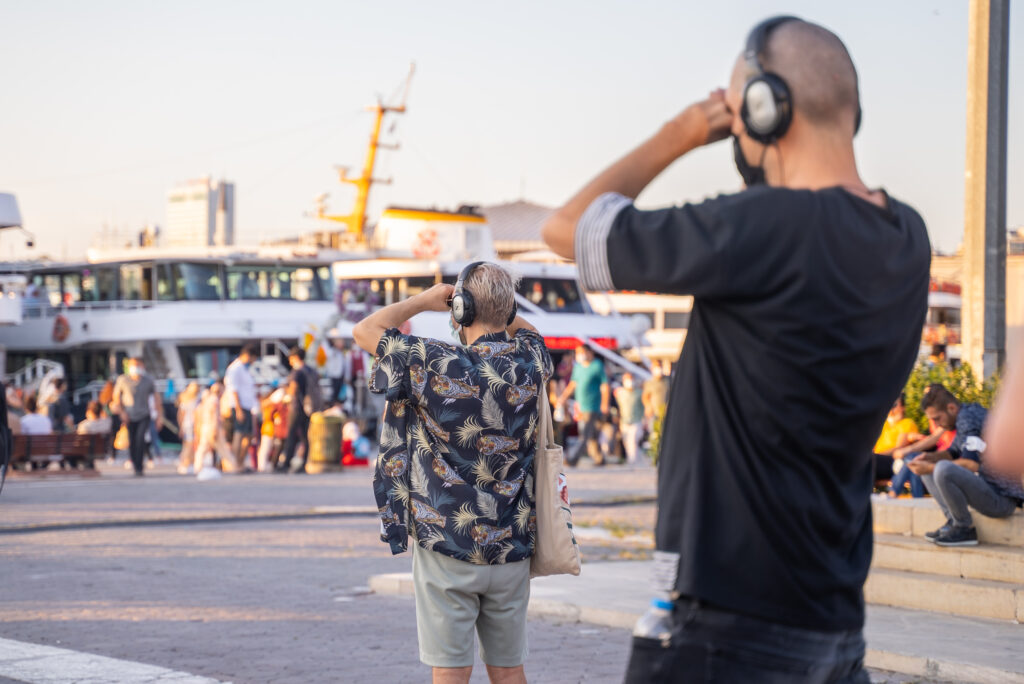
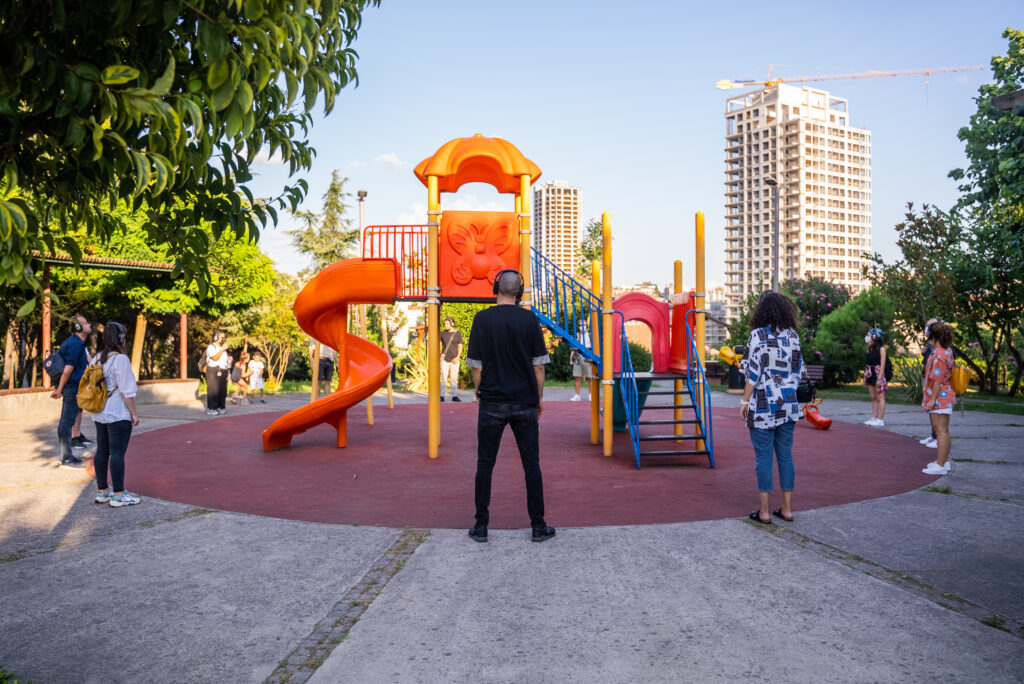
‘Remote İstanbul,’ the Istanbul leg of the ‘Remote X’ project, which has been adapted for 50 cities from London to Abu Dhabi, offers its participants the chance to make a different kind of contact with the city over the course of a two-hour walk. Guided by an artificial voice coming through your headphones, you are invited on a mental, physical and emotional exercise of a kind you are not used to, from Koşuyolu to Bahariye. Don’t forget to wear your sneakers when you go to the show.
Are you up for a walk through the streets of a city you know well, of a kind you have probably never taken before? The walk follows a set route with specific stops and offers an experience designed for you in advance, but how you react, what you witness in the moment and how far you let yourself into the ‘game’ are up to you. As is the kind of emotional/physical communication you will establish with the city… So what awaits each participant is a one-of-a-kind experience.
‘Remote İstanbul,’ the Istanbul leg of the ‘Remote X’ project that the German documentary theater collective Rimini Protokoll has adapted for a total of 50 cities from London to Abu Dhabi, invites its participants to just such an experience. Beginning with a meeting in a neighborhood park in Koşuyolu, the project, accompanied by an ‘artificial’ voice in the headphones handed out to participants, offers a kind of group performance in which you spend two hours in the city walking, stopping, riding the metro, running, climbing ramps, dancing, listening, and looking at things both near and far.
It is a work that sets out to break the memorized city you carry in your body and mind by bringing you into contact with the city’s fixed and/or moving fabric in ways you never do in your daily routine.
A call that promises other kinds of encounters with the city, with streets and buildings you may know very well, and with your fellow city dwellers.
The Istanbul adaptation of ‘Remote X,’ conceived and directed by Stefan Kaegi, was prepared in collaboration with Kundura Sahne, which I had announced earlier and had been planning to attend for some time, and it bears the signature of Jörg Karrenbauer. Throughout the tour, planned yet by its very nature open to surprises, which unfolded across the city under the direction of the voice in my ear, I focused on two things: What is the voice in my ear (the text written for the piece) trying to tell me? And what different kind of communication am I experiencing right now with the city’s ‘limbs’ (especially when, during the metro ride, I realized we were heading toward the neighborhood where I live)?
When projects of this kind, which lead the participant through a space, fall short of weaving the physical experience and the narrative together, the impact of the piece may not get beyond ‘What an interesting thing we just experienced.’ ‘Remote İstanbul,’ which sets out to focus on how artificial intelligence has settled into our lives and on our relationship with the city, certainly gives its participants ‘interesting moments,’ but it also struggles to convey what its real concern is.
At some point I found myself thinking that the artificial intelligence reaching me through my headphones was confused. From then on, although I kept listening to what the voice was saying, I turned my attention to the path it opened up for me in terms of my contact with the city.
I kept on walking, focusing on the different experience the directions provided, because I could not work out exactly what the speaking voice was inviting me to ponder. For instance, if we were walking while thinking about artificial intelligence and our lives, we could have taken our steps concentrating on how we are already being steered by artificial intelligence in the city. The text we heard could also have ‘nudged’ us mainly from that angle.
Instead, what we had in our ears was a text undecided about what it was trying to ‘provoke’ the participant about, and how. With the voice being unclear, my choice was to focus, while following the ‘instructions,’ on sensing how I responded to the city (and to people), and how people responded to me.
Especially during an ‘instruction’ at the metro station, the piece managed to bring me to a powerful feeling. Coincidentally encountering, several times, the very human profiles and movements the voice was talking about made the sense of ‘play’ even more vivid. (Like a mother, father and child walking past me hand in hand, as if deliberately placed on the ‘stage,’ at the very moment the voice was talking about the life cycle and starting a family…)
‘Remote İstanbul’ is a fitting choice for experiencing a piece that invites the audience on a guided walk through a route/space. Building a relationship of a kind we have never tried before with the city we are trapped in by our routines, and, what is more, experiencing the broad possibilities of theater, is valuable. On the other hand, it is also certain that the piece’s artificial intelligence needs to pull its train of thought together a little…
***To read the full article CLICK HERE – Bahar ÇUHADAR / hurriyet.com.tr (Source)
Looking at the past of Beykoz Kundura from the present, Kundura Hafıza took part in the Industrial World Heritage conference held in Essen, Germany, on October 13–15, 2021, keeping up with the international discussions taking place in this field. The conference, organized to identify the opportunities and responsibilities involved in preserving industrial heritage, was hosted by the Zollverein Coal Mine Industrial Complex, a UNESCO World Heritage Site since 2001.
The Ruhr region, which includes the city of Essen, was until recently a center of coal and steel production, and is dense with structures that fell idle in the recent past as production methods and resources changed, and that were subsequently transformed into elements of cultural heritage. The roughly 400-kilometer Route of Industrial Heritage in the Ruhr, made up of buildings repurposed for cultural functions, is an excellent example of transformation on a regional scale. On an excursion organized as part of the conference, participants had the opportunity to see exemplary transformation projects along the Ruhr industrial route, such as the Gasometer Oberhausen and the Duisburg-Nord Landscape Park, on site and to evaluate them together.
On Thursday, October 14, the first day of the conference, the opening speeches were followed by presentations on examples of good practice, and both the physical and the social challenges of transformation processes were addressed. It became clear that many of the decisions requiring sensitive solutions in the transformation process that has brought Beykoz Kundura to its present state, a process that has spanned some 15 years and is still ongoing, involve problems frequently encountered on an international scale as well. On the second day, the conference focused on the social impacts of industrial heritage transformations, with discussions on community engagement and on methods for ensuring participatory conservation.
Immediately after the conference, on October 16, the kick-off meeting of the CONSIDER Project took place. Run by Kadir Has University, the project is titled Sustainable Management of Industrial Heritage as a Resource for Urban Development and aims to develop creative methods for the sustainable preservation of industrial heritage over the next four years. Supported by the European Union’s Horizon 2020 Program, the project counts among its partners universities, municipalities, city councils, heritage sites and civil society organizations from different countries around the world. One of the project’s aims is to create a city-scale route of Istanbul’s industrial heritage buildings, just like the one in the Ruhr region, and, by defining common criteria, to establish ways of documenting and assessing the heritage values of these buildings.
* You can visit our exhibition, organized by the association that looks at the past of Beykoz Kundura, one of Istanbul’s most important industrial heritage buildings, from the present, the Kundura Hafıza Cultural Heritage Preservation Association, titled “Kundura’s Memory: A World Fit into a Factory”, free of charge by filling out the visitor form.

Kundura Hafıza Project, launched in 2015 in collaboration with the History Foundation and growing steadily ever since, centers on oral history work shaped by the memories of nearly 200 former workers of the Beykoz Kundura Factory and their families, memories that have accumulated in each of their minds, while enriching its archive with documents, photographs, objects and many other physical sources. On the UNESCO World Day for Audiovisual Heritage on October 27 and under its chosen theme, “Your Window to the World,” Kundura Hafıza takes its place as one of the key actors in preserving and passing on audiovisual cultural heritage, as “a window opening from the factory’s past memory onto the present.”

Today, the oral history work carried out under the umbrella of the Kundura Hafıza Cultural Heritage Preservation Association forms the foundation of the Kundura Hafıza archive. In looking at Beykoz Kundura’s past, the memories of the factory’s veteran workers and their families, stored in digital media such as video and audio, are used today as resources that nourish collective memory, as audiovisual cultural heritage preserved in digital archives. Thus, as it journeys into the past of the Beykoz Kundura Factory, Kundura Hafıza ‘reminds’ us of what it ‘remembers’ through oral history work, exhibitions, workshops and archival work.
The “Kundura’s Memory: A World Fit into a Factory” exhibition, a starting point for passing on collective memory, is located in the ‘Marangozhane’ (Carpentry Workshop), where wooden shoe lasts were produced in the days of the Beykoz Deri ve Kundura Fabrikası (Beykoz Leather and Shoe Factory). In addition to the videos, audio recordings and archival documentary featured in the exhibition, this space where the lasts were once made also houses objects such as leather, shoe-upper sewing machines, shoes and laboratory equipment, making room for memory to transform, to exist anew within itself and to carry on its continuity. With an inclusive and interactive approach, it captivates visitors with audiovisual narratives delivered via QR codes and tablets, and takes them on a journey through the preserved original buildings of Beykoz Kundura, one of Türkiye’s most important industrial heritage sites.
Founded in the early 1800s and in continuous production until 1999, the factory was transferred in 1933 to Sümerbank Beykoz Deri ve Kundura Fabrikası, after which it became a social living space with a population of up to three thousand, complete with facilities such as a nursery, a cinema, a social club, a health center and a library. The life the factory shaped forms the historical reference for Beykoz Kundura’s present-day tradition of being a ‘social space’ that hosts multidisciplinary events such as cinema, dance, exhibitions and concerts. As the shoe factory turns into a story factory, it follows the traces of the past and adapts them to the present. Born from the repurposing of the Boiler Room, which produced the factory’s energy during the Sümerbank period, Kundura Sinema and Kundura Sahne continue to radiate energy at the heart of Kundura today, aiming to be more than just a cinema and a stage. While bringing their audiences together with elements of audiovisual heritage, they also carry the echoes of the film screenings and concerts held during the factory years to present-day Beykoz and Istanbul.
Kundura Memory Project, which launched in 2015 with cooperation of the History Foundation and has been growing to today, centers on the oral history studies of Beykoz Shoe [Kundura] Factory shaped by the collected memories of nearly 200 former endeavored workers and their families. It enriches its archive with documents, photographs, objects and many more physical resources as well. Kundura Memory is one of the most important actors of the process of protecting and interpreting the audiovisual cultural heritage as “the window opening from the memory of the past to the present” within the theme of “Your Window to the World”, as the chosen scope for 27 October UNESCO the World Day for Audiovisual Heritage (WDAH).
Today, being continued under the umbrella of the non-profit organization; Kundura Memory Association for The Conservation of Industrial Heritage, the oral history studies constitutes the base of the archive of Kundura Memory. Upon looking at Beykoz Kundura’s past, the stored memories of the former endeavored workers and their families in digital media such as video and audio are now used as the preserved resources for audiovisual heritage to nourish the collective memory. Therefore, with the oral history studies, exhibitions, workshops and the archive, Kundura Memory ‘reminds’ of what they ‘remembers’ through Beykoz Kundura Factory’s past.
“Memory of Kundura: The World Within a Factory” exhibition is also located in the ‘Woodshop’, where wooden shoetrees were produced at the time of Beykoz Leather and Shoe Factory, as a starting point in the interpretation of this collective memory. The place contains objects such as leather, sewing machines, shoes and laboratory equipment, as well as the video, audio recordings and archive documentary included in the exhibition by letting the memory to transform and re-exist within itself and allowing it to continue this continuity. With an inclusive and interactive approach, it captures the audience with audio-visual narratives interpreted through QR codes and tablets and takes them on a journey through the preserved authenticated structures of Beykoz Kundura, one of Turkey’s most important industrial cultural heritage sites.
Established in the early 1800s and produced without interruption until 1999, the factory was transferred to the Sümerbank Beykoz Leather and Shoe Factory in 1933, and transformed into a social living place with a population of three thousand including units such as a nursery, cinema, clubhouse, health center and library. The daily life described by the factory creates the historical reference of Beykoz Kundura’s tradition of being a ‘social space’ that hosts multidisciplinary events such as cinema, dance, exhibitions and concerts. As the shoe factory turns into a story factory, it follows the clues of the past and adapts them to the present. Kundura Cinema and Kundura Stage which were born with the re-functioning of the Boiler Room that produced the energy of the factory during the Sümerbank period, aim to be more than a cinema and stage by spreading energy in the heart of Kundura today. On the one hand, it brings the audience together with the elements of the audio-visual heritage, on the other hand, it allows the echoes of movie screenings and concerts made during the factory period to reach today’s Beykoz and Istanbul.