29 February 2024
“These clever auteurs of the theater delight us with their skill at searching for, and finding, an innovative language. From among all the people who have left their footprints on the city, they tell us: “watch where you step, a ball, a dog, a child or an angel could pop out from somewhere at any moment.” They hold up a smiling mirror to this city full of surprises.”
Pınar Erol*
Thirty years ago, in “Kim O”, a police officer stopped passersby in their tracks; having stopped Filiz Sızanlı and Mustafa Kaplan (let’s not count Bilge Arat and Cenk Telimen), wouldn’t you know it, he is now stopping people in their tracks at Beykoz Kundura in “Geçen Gün”. The very same officer stepped out of the piece that Naz Erayda had asked Kerem Kurdoğlu to write back in 1994, and asked passersby questions like “where are you from, what do you do for a living, where did you get all this?” In other words, that passage of “Kim O” became the text of “Geçen Gün”. It turns out Kerem Kurdoğlu had been holding on to it in a corner of his mind and heart for years. A year and a half ago, when Mihran Tomasyan suggested they make something together, work finally began to bring it to life. The fifteen-to-twenty-minute text expanded further and took on its present form. Çıplak Ayaklar Stüdyo, open to every kind of imagination, took on the executive production of the play, and, again at Mihran Tomasyan’s suggestion, Beykoz Kundura joined the project as a producer for the first time. And so the components of the same careful spirit, while creating multiple forms of expression, also managed to remind us of the responsibility of being an audience. How lovely.
The other day, I too watched this performance, which offers slices of a person’s relationship, interaction and exchange with the city they live in, with the other people in that city, and with those people’s other beings (living and non-living). Ever since the day I saw it, I have noticed the smile that settles on my face whenever it comes to mind, at the most unexpected moments. Let me tell you right away what struck me. First of all, all of theater’s expressive possibilities join hands to convey what the city does to people, what people do to one another, and what people do to the city. And they do it in the most aesthetic way possible. They gather with a semiotic air, and each one builds the text through its own discipline. In other words, all those elements of theater that we are used to seeing in support of the text declare their autonomy, so to speak, and this time write the text from beginning to end in their own codes. This should not be taken to mean that the result is a disjointed, eclectic language. On the contrary, we rarely come across works whose parts connect so organically, blend so well, lift one another up and converse with one another so beautifully. What we are watching is a neat translation of the hustle and bustle of “everyday life” into an artistic language. And when one encounters such a collective creation, one truly wants to savor it. Pieces like this usually include the subject or a synopsis of the play, but this time that is impossible to do in the usual way. The plot does not proceed along the classic line of exposition, climax and resolution, nor can its genre be clearly named. I suppose I don’t need to say that this is a deliberate approach. Still, I can say that in this “peculiar” work we watch, through the lens of action and reaction, people who are indifferent, sensitive, timid, rude, thoughtful, helpful, embarrassed, guilt-ridden, judgmental, reproachful, bullying, loving and content, in the midst of the encounters, near misses, escapes and chases through which the city makes us paranoid. We notice the moments that make us smile in our lives of constant struggle and breathe them in deeply. We take a pluralistic look at the ways the city, and therefore the human being, is perceived. Although I feel like calling this a fraternity of disciplines, I decide to refer to it simply as a performance. Looking at the coincidence in the way words and people come together, the thing this performance reminds me of most is the game “Name, City, Animal.”
While waiting for the performers to take the stage, my eye naturally wanders across the set design. Each object, which looks like the components of some Rube Goldberg-style project, forms a whole out of unrelated pieces, just like the content of the performance. These objects, which sit within the whole like an installation, are not expected to form a meaningful sequence side by side. Thank goodness I am familiar with the instruments that Tophane Noise Band makes from the city’s waste, so I can more or less guess what is about to come out of this contraption.

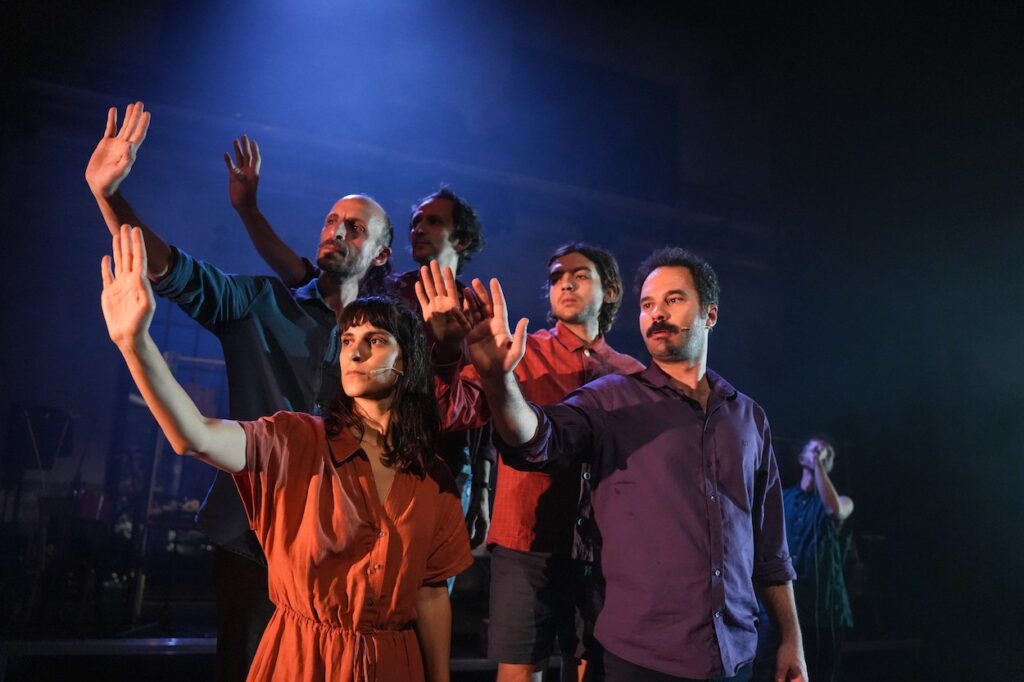
As the performers and musicians step onto the stage, it is as if they are crossing a line into another ground/reality. They are like possibilities in a multiverse. Or like individuals who happen to occupy any given square meter of the city. Then their steps grow stronger. And then their bodies, voices and words join in. As movement blends into words, words into sound, sound into noise, and noise into emotion, the harmony rises. And the audiovisual symphony that paces the routes of the city begins. Voice, words, movement and design join hands to set off an unusual viewing pleasure. Every element and every movement on stage is open to free association. And these free associations multiply the images. Through music, image, bodies, words, thought and emotion, countless human conditions come to life. At first I have trouble following the story within the text. Sentences are formed by the two performers taking turns saying the words allotted to them. This time I want to ask the question that drives theater people crazy: How do you memorize all that? Especially a string of words that do not form a meaningful sentence in succession? Shame on you! I notice an inductive approach. So we are moving from the parts to the whole. Once I stop chasing the successive meanings of the divided sentences, I relax. Only then can I enjoy the melodies in the words. I leave be the words whose stress shifts, which are in a sense broken, so that their music comes before their meaning. My effort to put the pieces of the puzzle together was in vain; they were a deconstruction. And it turns out that what we had been watching was a trailer. The events were only now about to unfold. These repeated narrations each time put in parentheses the routine, whatever the days bring, the possibility of events. I understand now that while we thought we were hearing the same thing, the story was changing depending on its companions. Every day was a new day! I also see from the intertwined conversations that complete each other that there are moments when they, too, stop listening to each other. They pretend to be talking to each other, but each focuses on their own story. They do this sometimes with an echo, sometimes with a canon, sometimes with a chorus, and sometimes by falling silent. I also love the long “rests” that are not afraid of losing the audience. In these moments I savor the stillness they offer. And I find myself focusing as much on what we leave unsaid/cannot say/say only to ourselves as on what we say.
Esme Madra and Ozan Çelik, what can I say to you? You are like two acrobats walking a tightrope. If one of you loses balance, the other will fall. If one of you forgets the lines, the order of the words, the other will be thrown. If one of you drifts for a moment, the other’s math will be off. If one of you misplaces the stress, the other’s rhythm will slip. What a beautiful feeling it is to want to succeed as much for the person opposite you as for yourself. This is a form of partnership in which you are responsible not only for yourself but also for your partner. That is why I think each of you is giving a performance for two. When there is acting as synchronized as yours, a focus that never breaks, that is the pinnacle of partnership. Oh please, don’t fall!

Defne Gül and Berkant ‘Doktor’ Kılıçkap are responsible for this abstract sound design. The noisemakers of Tophane Noise Band, Serkan Aka, Mihran Tomasyan, Selim Cizdan and Ufuk Fakıoğlu, are utterly charming with their songs, their movements, their moments in the spotlight and their moments in the background. They are in charge of the city’s hubbub, its tension, its rush, its joy, its wind and its awakening, as well as the sounds of seagulls, ferries, walkie-talkies, keys, doors, jostling and punches. But the lovely thing is that the desired sounds are conveyed through evocative timbres rather than literal expressions. Now the purpose of that water jug, the hose, the pump, the pan, the dumbbell, the steering wheel and the broom becomes clear. The waste the city spews out becomes instruments for sound effects before our very eyes. A new production is born out of consumption. With those two mischievous songs, the musicians at times deliver a profanity-laced rebuke and at times describe what a civilized person should be. At times they accompany Esme and Ozan to form the crowd of the city, and at times, like urban planners, they pave stones along their path. Moving the set from place to place, they create houses, steps, chairs, roads, slopes, obstacles, underpasses, overpasses and, if you ask me, even bridges. In other words, they do a lot.
The duo’s movements often embody the harshness and uncanniness of the city, and at times are calmed by human sensitivity. Whether they move in the same direction or in opposite ones, the city knows how to bring them into line. They also speak through the sway of their bodies, through their inclines, angles and shifting centers of gravity. Sometimes they take us into the past with steps backward; sometimes they affirm each other; and sometimes, through the symmetry they form, they create their own reality. Let me tell you, Maral Ceranoğlu and Mihran Tomasyan are writing poetry with bodies here.
This performance, made up of the unity of space, time and place, also offers depth through its lighting. Before us is the silhouette of a sooty, foggy, grimy, hazy city. I would almost call it cinematographic. While the light seeping in from outside Beykoz Kundura corresponds to a real slice of life, time and place take on meaning through Utku Kara’s craft. Wherever he wants us to look, our attention is drawn there. The light provides the temporal breaks in the text, which is mostly dominated by the simple past tense, and the transitions from moment to moment. With different variations that multiply that moment, it sheds light on what happens in that part of the city. Right here I lament how much we shortchange the present tense. Events that happen at the same time are remembered differently, and therefore told differently. Isn’t that strange? For some of us a safe space means deserted places, for others it means crowds. And what those who look at the same place, unaware of one another, see does not always mean the same thing. The truth is that every person’s action/inaction steers the story of this city.
Maya Kurdoğlu adds layers to the spirit of the play with the posters she designed. How beautifully she depicts the sea, the pier, the waste, the roads, the mortar of civilization and people’s bewilderment in the face of events. She makes visible what the people living in this city do not see. Aaand the directors of the performance, Naz Erayda and Kerem Kurdoğlu… May they be proud of themselves and of what they have added to this city. Not only do they pull off a direction with difficult math; they do so with an approach that favors none of the staging disciplines over the others. They banish illusion, make room for real slices of life, and create a striking world out of small things. These clever auteurs of the theater delight us with their skill at searching for, and finding, an innovative language. From among all the people who have left their footprints on the city, they tell us: “watch where you step, a ball, a dog, a child or an angel could pop out from somewhere at any moment.” They hold up a smiling mirror to this city full of surprises.
*This article was published in Mimesis Dergi on February 28.