20 March 2023
Tim Burton’s early classics ‘Beetlejuice’ and ‘Edward Scissorhands,’ which stand out for their gothic worlds and melancholic characters, come to audiences as part of Kundura Sinema’s Sunday Cinema Club.
Kaan Denk*

Tim Burton is a special director who, through the singular universe he has created since the very beginning of his career, has managed to bring the stories of his heroes who stand outside the circle to a general audience. Naturally, for every cinephile some of his films will stand out above others, and some will remain more special because of personal experiences. But for most viewers it is hardly possible to remain indifferent to the works of his early career in particular.
The famous Tim Burton world we all know today began to take shape with the short animated films the director had been making since the age of 13. And it is still possible to see the trademark traces of the world of Burton, who most recently, this year, sat in the producer’s and director’s chair for the popular series about Wednesday, the beloved member of the Addams Family. Using the dark elements of gothic culture in all his work, the director promises perhaps a little shiver in his films but, for the most part, a high dose of fun. In fact, it may be worth talking about two modern classics that stand out precisely for these qualities, that come to mind whenever Tim Burton is mentioned, and that sum up the director’s cinema: Beetlejuice (1988) and Edward Scissorhands (1990).
The Colorful Side of Gothic
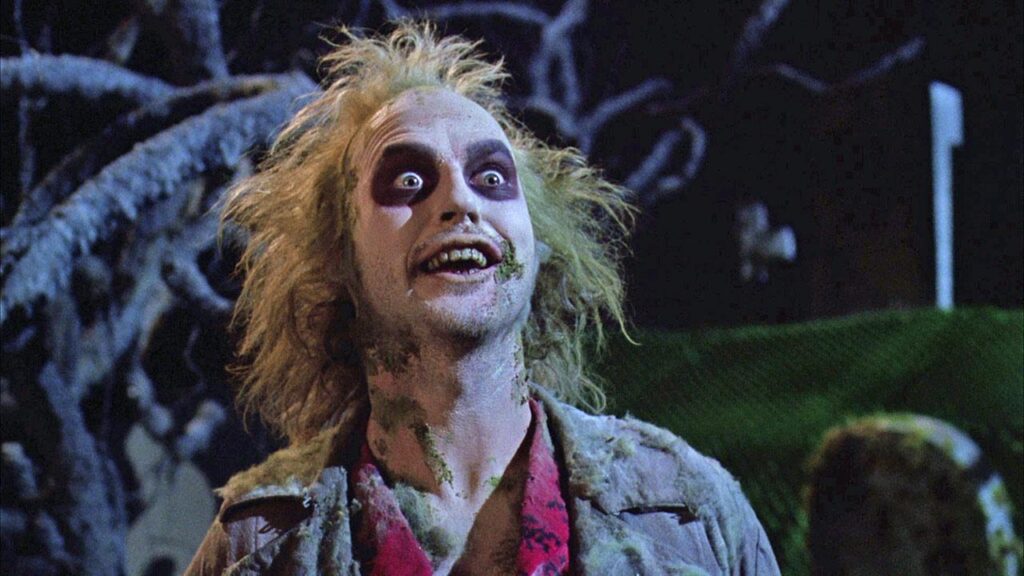
Impressed by the talent the director had shown in his early short films, Warner Bros. had entrusted him with Pee-wee’s Big Adventure, released in 1985. After this first feature, a success both at the box office and with the critics, they set to work on one of the greatest Burton classics. Beetlejuice had all the hallmarks that would come to be identified with the director, and despite a story that might come across as “weird” to a general audience, it was a thoroughly mainstream film. It was in this film that we first encountered not only the eerie and fun side of Tim Burton’s films but also his famous gothic melancholy, which overshadows those qualities. Beneath a bustling romp that feels almost as if it belonged in a children’s film, Beetlejuice also had a rather sad story to tell.

Setting aside the “poster character” played by Michael Keaton, who gives the film its title, what we are actually watching is the sorrowful story of the young Maitland couple, the protagonists of the tale. The film opens with the young couple, deeply in love, having an unfortunate accident while building a new life in their house, which is big for them but which they adore. Getting past this heartbreaking opening with a very delicate touch, Burton then invited his audience into the “afterlife” universe that Beetlejuice also inhabits. The Maitlands’ limbo and their reluctance to leave the house that no longer belongs to them were balanced by the fun arising from Burton’s particular brand of earthly depiction of the afterlife. Yet the real gothic melancholy of Beetlejuice, a film that translated the story’s flow to the screen with astonishing skill, lay hidden elsewhere.
Lydia Deetze, one of the film’s most beloved characters and the role that made Winona Ryder a star, was one of those gothic heroines we would go on to see in every Tim Burton film. The melancholy of Lydia, who cannot connect with anyone she knows, her parents above all, and does not feel she belongs to the world around her, turns in Beetlejuice first into the role of an intermediary and then into that of a savior. Playing one of the key roles in the film through all these functions, the character was also a fine reflection of the director’s career. It would not be wrong to say that creating a world in which a hero who feels like an outcast can feel at home is the signature of both Tim Burton’s personal character and his artistic output.
MONSTER TALES FROM THE SUBURBS TO THE WORLD
Not long after – just two years later (with a relatively big-budget Batman film squeezed in between) – we saw Tim Burton at the helm of a classic he had written himself. Edward Scissorhands set out from a premise strongly reminiscent of the story of ‘Frankenstein’ (and a little of ‘Pinocchio’), one of the director’s favorite literary works. The story, which we witness in the form of a fairy tale, brought the sensibility of gothic culture to the screen in all its aspects. It focused on the utterly lonely life of Edward Scissorhands, who comes into the world with ten razor-sharp fingers resembling scissor blades after the master who created him dies before he can finish his hands. Rooted once again in a story of painful loss, this melancholic outsiderhood now had a physical cause as well.

With a depressive monster tale, Burton responded to the feelings of every character who is seen as a “freak” in society and kept outside the circle, starting with the gothic image in popular culture. With his introversion, gentleness and innocence, this monster had all-too-human qualities; perhaps the only thing he lacked was a pair of hands with which to touch the people he loved. Seen from this angle, the story of Edward Scissorhands shone among the stereotype-reliant Hollywood narratives we came across so often, especially in the late 1980s. At a time when typecasting characters with the label of “freak” in teen movies, action films and all the other dramas with wide distribution had become the norm, he had created a giant freak. Played by Johnny Depp and embodying everything to do with gothic culture, Edward Scissorhands won enormous sympathy from mainstream moviegoers and, just as anonymous fairy tales that end with an important lesson do, brought the story of outcasts inside the circle.
Although we still come across the same themes – and especially the visual elements identified with him – in the recent work of his ongoing career, Tim Burton’s early films have an obvious difference. Among these differences, which could be the subject of an entirely separate essay, what probably catches the eye first, and what is missing from his recent work, must be the spirit reflected in films such as Beetlejuice and Edward Scissorhands. Written and depicted with great sensitivity, these naive stories became far more special works than they might otherwise have been, thanks partly to the era in which they were made and partly to the influence of a young Tim Burton with a fresh cinematic eye. Perhaps that is why it feels only natural to remember these two special films as timeless classics to be watched again and again.
Beetlejuice and Edward Scissorhands will be screened on April 8 and 16 as part of Kundura Sinema’s Sunday Cinema Club.
*This article was originally published in Altyazı.