22 January 2024
For those curious about how Sümerbank’s iconic logo came to be, we have selected this piece for you from the Kundura Hafıza archive…

Nahit Katlan*
Sümerbank’s identifying marks, encompassing all distinctive identifying symbols such as emblems, monograms, abbreviations, trademarks and brands, have changed over time under the influence of commercial development and legal regulations, and above all according to need.
In the Founding Law No. 2262, the name Sümerbank was originally specified as two words: SÜMER BANK… Although grammatically correct, in practical use this was inevitably simplified and merged, and the two words SÜMER BANK became the single word SÜMERBANK. This is something not considered unusual in bank names, and is quite often created deliberately.
To meet the need for a short form, Sümerbank was, in the early days and frequently thereafter, written as SB, using the first letters of the words Sümer and Bank without periods between them, and it still is. No decision or directive formalizing this usage has been found. It appears that the practice is simply a habit born of necessity and an anonymous, collective adoption.
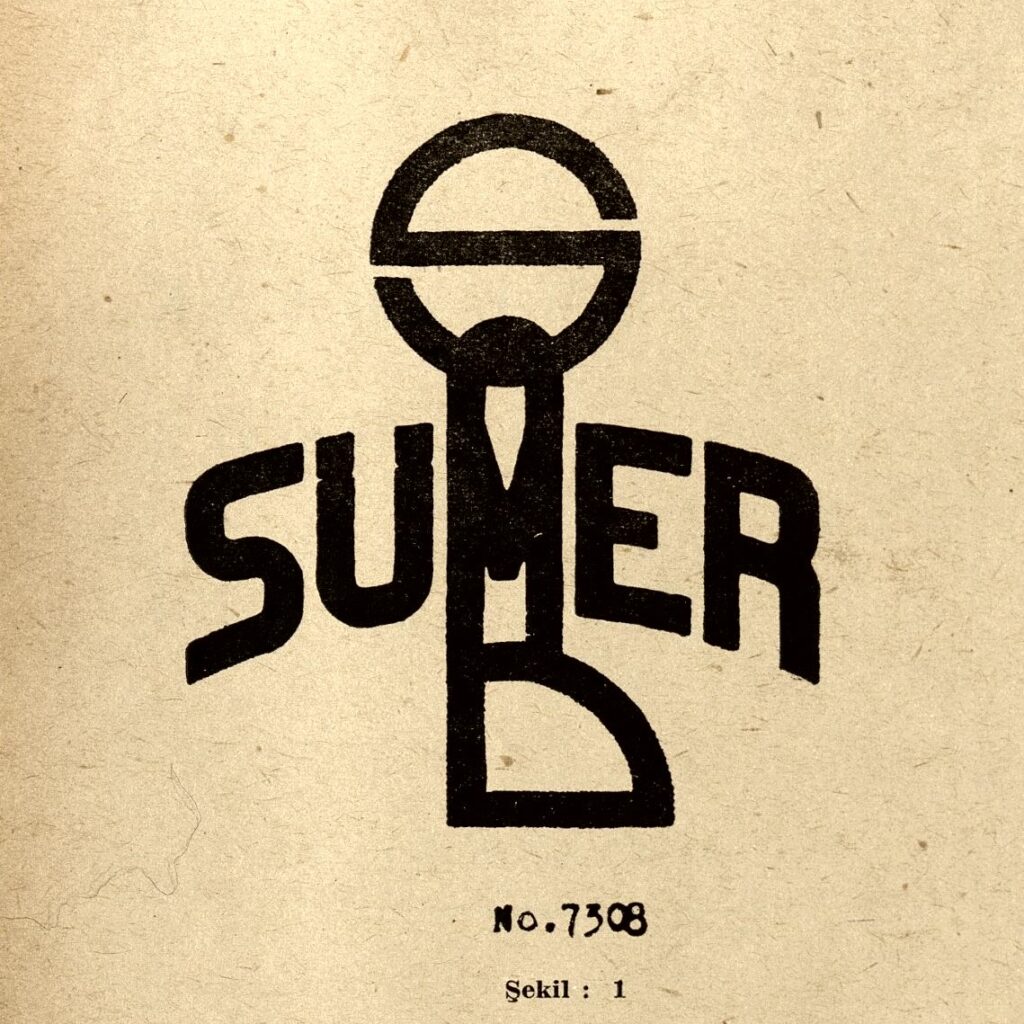
Apart from its conventional use with the letters side by side, the abbreviation SB was in time worked into the shape of a key, a symbol, and this too was readily embraced. According to official records, the appearance of the Key SB can be traced back to around 1943. (1) [1]It appears that this monogram was used even earlier, but why and how it first emerged, and by whom it was drawn, launched and adopted, has not yet been learned even from specialized sources and is not known with any reliable certainty.
In 1943, the key-shaped SB together with the word SÜMER alone was put forward for registration as a trademark, in order to promote Sümerbank products in domestic and foreign markets and to prevent imitation, and these marks (figures 1 and 2) were registered by the Ministry of Economy under the numbers 7308 and 7309 for a period of 15 years[2] from July 9, 1943.
Without initially being standardized to specific dimensions, these marks were circulated to the Sümerbank organization as trademarks to be used on products, with circular No. 79 in October 1943.
Council of Ministers Decree No. 4/8262, published in the Official Gazette on December 18, 1956, took up the matter that Sümerbank had circulated in 1943, expanded and generalized it, and in short made it mandatory, from March 1, 1957, for a mark registered by the manufacturer to be placed on agricultural produce obtained without industrial processing, handicrafts and small craft products. In line with this decree, and given that most Sümerbank institutions and factories had a registered brand or trademark, it was deemed beneficial to redefine the long-used Key SB mark as a standard within specific dimensions and to use it throughout the entire Sümerbank organization. The shape standard prepared to this end (Figure 3) was put into effect as of March 1, 1957, and the use of this standardized Key SB as a uniform mark on products, no doubt also prompted by the approaching expiry of the validity periods of the marks registered under numbers 7308 and 7309, was found appropriate by the General Directorate and approved and resolved by the Board of Directors on 1.3.1957 under No. 302.
[1] Records of the Sümerbank Directorate of Planning and Organization.
[2] Article 16 of the latest and new “Trademarks Law”, adopted on 3.3.1965 under No. 551, published on 12.3.1965 and entering into force on 12.6.1965, reduced the period of validity of trademark rights from the date of registration from 15 years to 10 years.

Following the registration requirement introduced by the Council of Ministers decree, the Key SB mark in its standard form was recorded in the name of Sümerbank for a period of 15 years from 28.02.1957 by the Ministry of Justice under date 16.3.1957 and No. 14893, and registered by the Ministry of Economy and Trade under No. 17635.
With directive No. 5666, issued to the entire organization at the beginning of 1957, it was requested that the standardized Key SB be entered into the inventory records as the ‘Shape Standard’, and it was stated that the sign could also be used as a brand by writing the names of the institutions or factories beneath it. In addition, shortly afterwards, at the end of March 1957, a new circular, No. 127, was issued with the shape standard attached, to ensure uniform usage throughout the organization.
Apart from this generalized emblem and mark, there are also various special trademarks, brands and signs, mostly prepared by the institutions and factories with the approval of the General Directorate, which have been registered and remain in use.
In order to establish a coordinating framework within the organization on this matter, a ‘Sümerbank Trademark Regulation’ was drawn up from mid-1945 onward, with changes made to it from time to time. The records show that correspondence and work on the draft were still going on as late as around 1949. However, the absence of any such regulation among those currently in force indicates that the draft was never given its final form and official status. When the need makes itself felt, the subject will no doubt be taken up again with new work.
Regarding monograms, apart from work within Sümerbank, some proposals have also emerged for identifying Sümerbank in brief. For example, in the book ‘State Organization and Its Duties’, prepared at the end of 1962 by the ‘Presidency of the Board of Directors of the Central Government Organization Research Project’, ‘SÜMB’ was identified and proposed for Sümerbank in the section on monograms; however, Sümerbank did not find this view appropriate and showed its wish, insistence and determination to continue the established monogram ‘SB and/or Key SB’.
Today, with its specific standard dimensions, the key-shaped SB sign has been retained and recognized as Sümerbank’s general official emblem, symbol, brand, trademark and abbreviated monogram; it serves as an identifier and is, for now, sufficient.
Beyond this general situation, certain abbreviations are also seen in Sümerbank communications, particularly in telegraph addresses, for the sake of convenience. Initially ‘SÜMERUM’ and today ‘SÜMERBANK’ are the abbreviated monograms that have been and are used for telegraph addresses. In this regard, institutions and factories have also, mostly independently, chosen and continue to use their own special and varied abbreviations. The view is that the ‘Communications Affairs Regulation’, which was previously prepared but could not be registered, and on which drafting work has begun again, may well become a useful and helpful document for regulating identifying marks, encompassing these matters as well.
Time will tell what kind of development today’s ‘SÜMERBANK’ and ‘Key SB’ monograms will follow.
- Katlan, Nahit. “Sümerbank Tanıtma İşaretleri” (Sümerbank’s Identifying Marks). Sümerbank Aylık Endüstri ve Kültür Dergisi Volume: 5/Issue: 58-59-60 (April-May-June 1966): 25-27