
Unidentified actress [Léontine] in Bateau de Léontine (Léontine’s Boat) (Pathé Comica, France, 1911). Courtesy of EYE Filmmuseum/Desmet Collection (left). Publicity photo of Texas Guinan, 1919. Courtesy of the Guinan Family Archives, Stayton, OR (right).
Cinema’s First Nasty Women is a 4-disc DVD/Blu-ray set that brings you rare silent films about feminist protest, anarchic destruction built on slapstick comedy, and suggestive gender play. Gathered from 10 international film archives, the collection contains 98 European and American silent films produced between 1896 and 1926 that spotlight slapstick comediennes and cross-dressing women of silent cinema. The women featured are truly “nasty” – they organize labor strikes, bake unspeakable pastries (and use them as weapons), shoot out of exploding chimneys, electrocute the police force, and take on a series of identities that gleefully shatter traditional gender norms and sexual propriety. The films span a wide range of genres, including slapstick, genteel farce, trick film, Western drama, and adventure-thriller.
Kino Lorber’s estimated release date is 2022.
Co-Curators: Laura Horak, Maggie Hennefeld, Elif Rongen-Kaynakçı
Producer: Bret Wood (Kino Lorber)
Music Supervisor: Dana Reason (Oregon State University)
Project Coordinator: Kate Higginson (Carleton University)
Contracts Officer: Aslı Eran (Carleton University)
Research Assistants and Translators: Daniel Aufmann (University of Minnesota), Aurore Spiers (University of Chicago), Vanessa Cambier (University of Minnesota)
Participating Archives: Eye Filmmuseum, Library of Congress, Jérome Seydoux-Pathé Foundation, British Film Institute, Blackhawk Films, George Eastman Museum, Library and Archives Canada, National Library of Norway, Swedish Film Institute, San Francisco Silent Film Festival, Museum of Modern Art
Musicians and Composers: To be announced.
Project Partners: Jay Weissberg (Giornate del Cinema Muto – Days of Silent Cinema), Kate Saccone and Jane Gaines (Women Film Pioneers Project), Carleton University (Ottawa).
“Cinema’s First Nasty Women” is supported in part by the Social Sciences and Humanities Research Council.

Mary Jane’s Mishap (G.A. Smith, UK, 1903), starring Laura Bayley. Courtesy of the BFI (British Film Institute).
Spiteful kitchen maids and madcap teens join forces to turn the home into a chaotic battlefield. Housemaids shoot out of chimneys and fiancées wield inedible baked goods as weapons against patriarchy, while headstrong girls flood and burn down their family homes. This disc also unearths the forgotten films of Léontine, the internationally popular French comic character and star of the Pathé Comica series, which released more than 21 films between 1910 and 1912. (That said, Léontine’s identity remains unknown even today!) The disc also features anarchic, rowdy and hilarious performances by Lea Giunchi, Bertha Regustus, Laura Bayley, Florence Lawrence, Berthe Dagmar, Gilbert Saroni, and Lili Zeidner.

La Fureur de Madame Plumette (Madame Plumette’s Fury) (Eclipse, France, 1912), with an unidentified actress. Courtesy of EYE Filmmuseum/Desmet Collection.
The Queens of Destruction are not so different from their anarchic adolescent predecessors. They wreck the house, torment their spouses and launch a feminist rebellion in the streets. This disc presents three French female comic characters: Cunégonde (Little Chrysia), and Rosalie and Pétronille (both played by Sarah Duhamel). The actress who appeared as Cunégonde was recently identified by Elif Rongen-Kaynakçı as Little Chrysia, an itinerant stage performer and skilled film comedian who also starred in Cunégonde’s spin-off series Arabella and Zoé. Duhamel’s films similarly embrace the uproar of social protest and anarchic physical destruction, as can be seen in Rosalie Has Sleeping Sickness, Rosalie and Her Phonograph, and Pétronille Wins the Big Race (Pétronille, Winner of the Big Race). Duhamel’s body is a natural disaster, and in her film world absolutely anything is possible. This disc also includes a section built around “Tyranny at Home,” which showcases to the fullest the mischievous antics of Florence Turner, Alma Taylor, Chrissie White, and Indigenous actress Minnie Devereau.

A Range Romance (Bison, USA, 1911). Courtesy of the Library of Congress.
Gender Rebels explores the highly porous nature of gender in American silent films, from cross-dressing girl spies to the gender-bending slapstick of the Wild West and the frozen North. This disc includes the surviving films of writer/director/actor Gene Gauntier’s girl spy series, along with Edna “Billy” Foster’s finest performance in a Biograph film, in which the young actress was cast almost exclusively in male roles. On the Western frontier, young women disguise themselves as boys and set off on adventures to strike it rich, while other films show the gun-toting, madcap femininity of the West. This disc also includes performances by actor-producer Texas Guinan, Indigenous star Lillian St. Cyr (Winnebago), lesbian comedian Fay Tincher, and Japanese American sensation Tsuru Aoki.

Katherine Grant stars in What’s the World Coming To? (Hal Roach, USA, 1926).
This disc shows the dangers and pleasures that boyish, boisterous young women encounter in urban and modern spaces. While cross-dressing creates countless opportunities for accidental same-sex attraction, women look to men’s clothing as the way to brave the merciless streets of an early 20th-century metropolis. In Phil-for-Short, Evelyn Greeley appears as a Latin professor by day and a lesbian dancer by night, while in the frontier BDSM fantasy Snowbird, stage star Mabel Taliaferro plays a headstrong society girl who disguises herself as a man to rescue her father’s land from a “woman-hating” French trapper. The final set of films plays with the rapid changes in gender and sexuality unfolding in this era, from a topsy-turvy comedy set 100 years in the future, where “men are like women” and “women are like men,” to the confusing rituals, disguises and mistaken identities unleashed by a sorority initiation ceremony in She’s A Prince. It also features the rowdy, joyful performances of Renée Sylvaire, Dorothy Bernard, Louise Glaum, and Alice Ardell.
Upcoming Events
“Nasty Women 3,” Giornate del Cinema Muto (Days of Silent Cinema) (Pordenone, Italy), October 2-9, 2021.
Past Events
“Girls Will Be Boys,” Giornate del Cinema (Pordenone, Italy), October 2015.
“Nasty Women,” Giornate del Cinema Muto (Pordenone, Italy), October 2017.
“Nasty Women 2,” Giornate del Cinema Muto (Pordenone, Italy), October 2019.
“Nasty Women,” Day of Silent Cinema (Days of Silent Cinema) (Indiana University Cinema), October 2019.
“Feminist Laughter,” Festival Internacional de Cine Silente México (Mexico International Silent Film Festival) (Puebla, Mexico), November 2019.
Related Scholarship
For related scholarship and further resources, see the Nasty Women Bibliography!


Cunégonde Femme du Monde (Cunégonde, Woman of the World) (Lux, France, 1912), starring Little Chrysia. Courtesy of EYE Filmmuseum/Desmet Collection.
Cunégonde Jalouse (Jealous Cunégonde) (Lux, France, 1912), starring Little Chrysia. Courtesy of EYE Filmmuseum/Desmet Collection.
“Cinema’s First Nasty Women” comes to Kundura Sinema March 8-28. Stay tuned to watch it at www.beykozkundura.com
This article originally appeared on wfpp.columbia.edu.
Kundura Sahne’s production with one of Europe’s leading art collectives, Rimini Protokoll, sold out amid enormous audience interest. The Istanbul adaptation of “Remote X,” which has been staged in more than 50 cities from London to Taipei and from New York to Buenos Aires, the performance Remote İstanbul created a unique experience for its participants.
Accompanied and guided by an artificial intelligence named İpek, the play takes participants on a surprising tour through the streets of Kadıköy. While encouraging us to observe our individual decisions and behaviors alongside artificial intelligence, it points to the details we miss in the daily rush and invites us to look at our bond with the city and with life through new eyes, creating “different encounters in the city.”
Bahar ÇUHADAR’s Remote İstanbul experience piece is now on our blog!
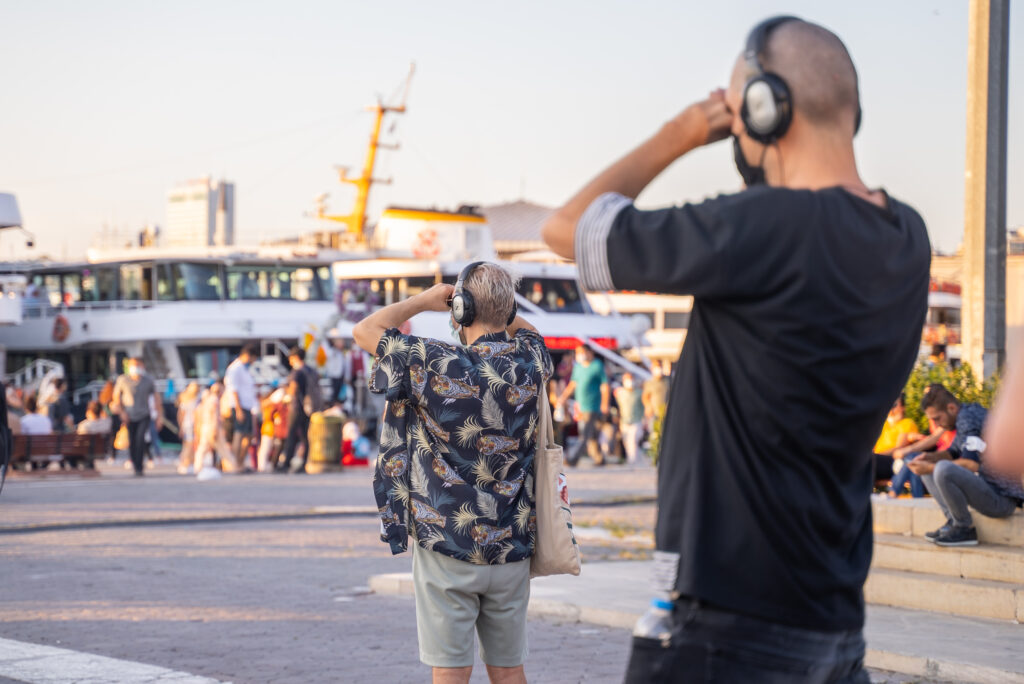
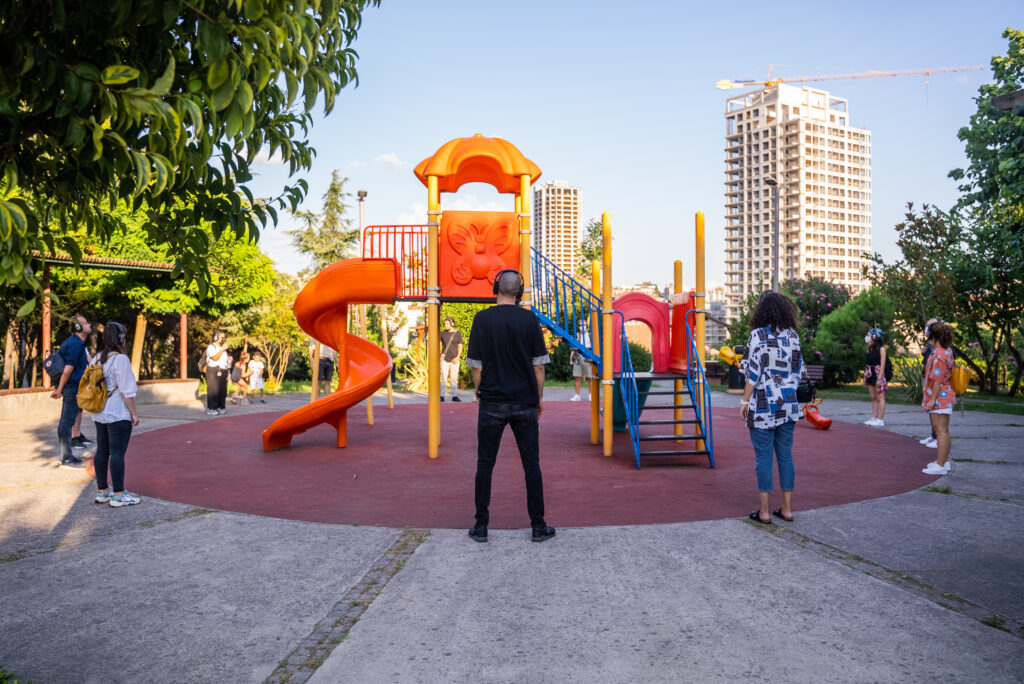
“Remote İstanbul,” the Istanbul leg of the “Remote X” project, which has been adapted for 50 cities from London to Abu Dhabi, offers its participants the chance to make a different kind of contact with the city over a two-hour walk. Guided by an artificial voice coming through your headphones, you are invited, from Koşuyolu to Bahariye, to a kind of mental, physical and emotional exercise you are not used to. Don’t forget to wear your sneakers to the show.
Are you up for a walk through the streets of a city you know well, of a kind you have probably never taken before? This walk follows a set route with specific stops and contains an experience designed for you in advance, but your reactions, the moments you witness and how far you let yourself into the “game” are up to you. So is the kind of emotional/physical communication you strike up with the city… As a result, what awaits each participant is a one-of-a-kind experience.
“Remote İstanbul,” the Istanbul leg of “Remote X,” a project the German documentary theater collective Rimini Protokoll has adapted for a total of 50 cities from London to Abu Dhabi, invites participants to just this kind of experience. Beginning with a meeting in a neighborhood park in Koşuyolu, the project offers a kind of group performance: for two hours, guided by an “artificial” voice in the headphones handed out, you walk through the city, stop, ride the metro, run, climb ramps, dance, listen, and look at things near and far.
It is a work that sets out to break the memorized city in your body and mind by bringing you into contact with the city’s fixed and/or moving fabric in ways you don’t in your daily routine.
A call that promises different kinds of encounters with the city, with streets and buildings you may know very well, and with your fellow city dwellers.
Designed and directed by Stefan Kaegi, “Remote X” was adapted for Istanbul by Jörg Karrenbauer in a production made in collaboration with Kundura Sahne, one I had announced earlier and had been planning to attend for some time. Throughout the tour, planned yet by its very nature open to surprises, as I moved through the city guided by the voice in my ear, I focused on two things: What is the voice in my ear (the text written for the play) trying to tell me? And what kind of different communication am I having right now with the city’s “limbs” (especially once we took the metro and I realized we were heading toward the neighborhood where I live)?
When projects like this, which lead participants through a space, fall short in weaving the physical experience together with the narrative, the effect of the play may not go beyond “What an interesting thing we just experienced.” “Remote İstanbul,” which sets out to focus on how artificial intelligence has settled into our lives and on our relationship with the city, certainly gives its participants “interesting moments,” but it also struggles to convey what its central concern really is.
At a certain point, I found myself thinking that the artificial intelligence reaching me through my headphones was confused. From then on, even though I kept listening to what the voice was saying, I turned my attention to the path it opened up for me in terms of my contact with the city.
I kept walking, focusing on the different experience the instructions made possible, because I couldn’t figure out exactly what the speaking voice was inviting me to reflect on. For example, if we were walking while thinking about artificial intelligence and our lives, we could have taken our steps while concentrating on how we are already being steered by AI in the city. The text we heard could have “needled” us mainly on that point.
Instead, what we had in our ears was a text undecided about what it was trying to “provoke” the participant about, and how. Since the voice wasn’t clear, I chose to focus, while following the “instructions,” on feeling how I responded to the city (and its people), and how people responded to me.
Especially during the “instruction” at the metro station, the play managed to stir a powerful feeling in me. Coincidentally encountering, several times, the very human profiles and movements the voice was describing made the sense of “play” all the more vivid. (Like a mother, father and child passing in front of me hand in hand, as if deliberately placed “on stage,” just as the voice was talking about the life cycle and starting a family…)
“Remote İstanbul” is a well-chosen option if you want to experience a play that invites the audience on a guided walk through a route/space. Forming a kind of relationship we have never tried before with the city we are stuck inside in our routines, and beyond that, experiencing the vast possibilities of theater, is valuable. On the other hand, it is just as certain that the play’s artificial intelligence needs to gather its train of thought a little…
*This article was published on Hürriyet.com.
Author: Bahar ÇUHADAR
Screening in Türkiye for the first time as part of A Summer Night Festival, the silent film classic “People on Sunday” is a unique experiment that brings together documentary and fiction, the anonymous and the personal. Telling the story of how ordinary people celebrate life on an ordinary Sunday in Berlin, the film not only tells us a great deal about life in 1929 but also offers a chance to see the lost Berlin of just before the Great Depression and Hitler’s Germany.

Originally titled “Menschen am Sonntag,” “People on Sunday” was one of the first films to dispense with the star system, with drama and with the demands of commercial cinema.
The 1930 German production was the first project of a group of young people living in Berlin, all of whom would flee the Nazi regime and become important figures in Hollywood. Of the duo in the director’s chair, Robert Siodmak successfully blended techniques he had picked up from German Expressionism into American cinema, especially film noir, and became one of the A-list directors of the era with classics such as “Son of Dracula” (1943), “Phantom Lady” (1944), “The Suspect” (1944) and “The Killers” (1946). The second director, Edgar G. Ulmer, would go on to make many B-movies that are considered cult films today, such as “The Black Cat” (1934), “The Naked Dawn” (1955) and “Isle of Forgotten Sins” (1943).
The original story is based on a piece of reportage by the brother of director Robert Siodmak, Curt Siodmak. Unlike his older brother, Siodmak turned to horror and would go on to create many horror classics whose remakes we still watch today, such as “The Invisible Man Returns” (1940), “The Wolf Man The Wolf Man Writer” (1941), “I Walked with a Zombie” (1943) and “13 Demon Street Writer” (1959).

The screenplay was written by Billie Wilder, who would flee to America and change his name to Billy. Wilder, who would go on to make countless classics such as “Sunset Blvd.” (1950), “Sabrina” (1954), “Some Like It Hot” (1959) and “The Apartment” (1960), would be nominated for an Oscar 21 times for his films and would win the statuette 7 times, including an Honorary Award.
Credited with the film’s exquisite images, Eugen Schüfftan had worked on the special effects of many pioneering films, including “Metropolis” (1927). Also the creator of the optical special effect known today as the Schüfftan process, Schüfftan would first flee to France and then settle in the US, winning an Oscar for black-and-white cinematography in 1962 for his work on “The Hustler.”

Camera assistant Fred Zinnemann would go on to win four Oscars in the Best Director category for “From Here to Eternity” (1953), “The Sundowners” (1960), “A Man for All Seasons” (1966) and “Julia” (1977), and to make countless classics.
Of the film’s producers, Moriz Seeler was murdered in the Holocaust, while Seymour Nebenzal, who managed to escape, would continue working as a producer in America until the early 1960s.

Shooting began in June 1929 and lasted until the end of December. The six young people, who worked other jobs six days a week, came together on Sundays and completed the film on a low budget of around 9,000 Marks.
The film made it past the censors and was first screened in February 1930. While the whole crew feared that no one would like it, the film received acclaim and praise beyond all expectations. It was compared with Walter Ruttmann’s “Berlin: Symphony of a Great City” (1927) and Dziga Vertov’s “Man with a Movie Camera” (1929), and over the years it became a cult film.

While the screenplay was being written, no one was quite sure exactly how the work was divided. As with many films that have become legendary, everyone has a different account of who did what. Billy Wilder said the script consisted of 7 pages, while someone else claimed it was a 30-page script. The actors, for their part, said there was no script at all and that everything they did in the film was either natural or improvised.
“People on Sunday” became one of the ancestors of the “films with non-professional actors” so often seen in today’s cinema. It was the first film experience for all the actors, and they played themselves: a taxi driver, a model, a film extra, a shop assistant and a wine seller. All but one of them never even considered continuing, and they went on with their lives.

Sadly, the original, complete print of the film is lost. A Summer Night Festival screens a version based on a print held in the archive of the Netherlands Film Museum. Missing scenes were added using prints from the Swedish Film Museum, the Cinémathéque Suisse, the Belgian film archive Cinémathéque Royale de Belgique and the Fondazione Cineteca Italiana in Milan, and this version was completed in 2005. While the original print was 2,014 meters long, the current print is 1,839 meters long.
Visually memorized by Berliners, who identify with it, the film has become one of the first that comes to mind for anyone curious about what life was like in Weimar Germany and its Berlin. For the curious, let us note that the actors preparing for the German miniseries “Babylon Berlin”, which streamed on Netflix, were specifically shown “People on Sunday.”

As one critic put it: “This film gives us a magnificent weekend and serves as a reminder, in difficult times, to live in the moment and to take joy in who you are.”

“People on Sunday” meets audiences in Türkiye for the first time on the evening of Friday, August 5, as part of A Summer Night Festival, accompanied by the music and live performance of the Icelandic electronic and experimental pop band Múm.
At A Summer Night Festival on the evening of August 7, we eagerly await a live performance for the 1922 silent film classic “Salome” by BaBa ZuLa, who were our guests for From A to Z.

Murat Ertel
ADALET (Justice) Cimcoz
BABA (Father) Mengü Ertel
CESARET (Courage) Abdülcanbaz
DELİLİK (Madness) Van Gogh
EMANET (Heirloom) The British blues boom of the 1960s
FASO FİSO (Hot Air) Soprano sax
GERİLİM (Tension) Kitchen accidents
HEYECAN (Excitement) Concert
ISPANAK (Spinach) Leek
İSTANBUL Its children
JETON (Token) There was a French band called Telephone; I have their records, too
KELAM (Word) I think I’m pregnant
LAMBA (Lamp) Blow it out, as in the song “Lambaya Püf De”
MERAK (Curiosity) Curiosity Killed the Cat /band
NİYET (Intention) Free spirit
OLMAK (To Be) The words of the minstrels live on
ÖMÜR (Lifetime) Göksel
PERŞEMBE (Thursday) Thor’s Day
RENK (Color) Kızıl Gözlüm
SESSİZLİK (Silence) Space music
ŞİFA (Healing) Music
TABUTTA RÖVAŞATA (Somersault in a Coffin) Film score
UMUT (Hope) İsan is a really good sound technician, I miss him
ÜNLEM (Exclamation) Nokta, the opening track of the album ‘Kökler’
VEDA (Farewell) Melancholy leaf
YEŞİL (Green) Slow Forest and Fast Forest
ZULA (Stash) BaBa

Levent Akman
ADALET (Justice) The foundation of the state
BABA (Father) Always missed
CESARET (Courage) What’s lacking these days
DELİLİK (Madness) It’s good
EMANET (Heirloom) Must not be betrayed
FASO FİSO (Hot Air) A waste of time
GERİLİM (Tension) Not much need for it
HEYECAN (Excitement) It’s good
ISPANAK (Spinach) Popeye
İSTANBUL Beautiful but hard
JETON (Token) The lifesaver of the old days
KELAM (Word) An Arabic word, I think
LAMBA (Lamp) Blow it out
MERAK (Curiosity) Important
NİYET (Intention) The good ones pave the road to hell
OLMAK (To Be) Or not to be
ÖMÜR (Lifetime) It had ayran
PERŞEMBE (Thursday) You can tell it’s coming from Wednesday
RENK (Color) Sadly, we are aware of very few of them
SESSİZLİK (Silence) Hard to find in the city
ŞİFA (Healing) Kam, the shaman
TABUTTA RÖVAŞATA (Somersault in a Coffin) First love
UMUT (Hope) The bread of the poor
ÜNLEM (Exclamation) Rarely used
VEDA (Farewell) Sorrow
YEŞİL (Green) Peace
ZULA (Stash) BaBa
WHO ARE THEY? One of the rare bands in Türkiye that cannot be placed within any single genre, the group was formed in 1996 to make the music for Dervis Zaim’s film Tabutta Rövaşata (Somersault in a Coffin), and it surely had no idea that by 2013 it would become our country’s musical ambassador, traveling from America to Japan, from Canada to Brazil and to many countries across Europe. They draw on traditional folk music and combine what they take from our musical roots with contemporary music. In doing so they never take the easy way out, which is why what they make is original and impossible to imitate. There is funk on one side and electronica on the other, but the source that feeds it all is the music made on the soil of this land, and the result is Turkish psychedelia. Having signed countless film scores and collaborated with world-renowned artists such as Mad Professor, Bugge Wesseltoft and CAN’s Jaki Liebezeit, the band brings an experimental, contemporary line to 1960s psychedelic music and the sounds of Anatolian rock by adding dub and electronic approaches. After crowning their 20th year with the album ‘’XX’’, BaBa ZuLa released the album “Derin Derin” on the GlitterBeat label in 2019. Most recently, BaBa ZuLa, pioneers of Turkish psychedelic music, released their 11th LP, Hayvan Gibi, in their 25th year. Hayvan Gibi, the band’s first live studio recording, was recorded at Artone Studios using the direct-to-disc method. Released on the Night Dreamer Records&Gülbaba Records labels, the album is the 5th in Night Dreamer’s D2D series and also has the distinction of being the first album released on Gülbaba Records. Albums aside, their stage performances are admirable too. Supporting their music and ideas visually with dance and theatrical elements, they become one with the audience and offer something like a shamanic ritual. At this point we can safely say: anyone who has never seen a BaBa ZuLa concert is missing out on a lot!
Tickets for “Salome,” to be screened at A Summer Night Festival with a live performance by BaBa ZuLa on the evening of Sunday, August 7, are available here. On this occasion, let us also recall the band’s video for “Bir Sana Bir de Bana,” made with footage from the 1917 film “Enis Aldjelis” and every bit as beautiful as the song itself.
Peter Sellers, one of the greatest comedians of all time, whom we are getting ready to salute this year at A Summer Night Festival with three unforgettable films, sadly did not have a life as funny and ‘pink’ as his films.

Peter Sellers was born in 1925 in Southsea, a suburb of Portsmouth, the second child of a pianist father and an actress mother. His real name was Richard Henry, but his family always called him Peter, the name they had given to their previous child, whom they had lost in infancy, and he was known by that name throughout his life.
Born to a Protestant father and a Jewish mother, Sellers attended St. Aloysius College, a Catholic school, where he discovered that he was a Jew and someone who had no confusion when it came to faith.
At 15, he started working at a theater as a janitor. At the theater, where he eventually rose to lighting operator, he also began acting and singing. He became the drummer in a band called Joe Daniels and His Hot Shots. During World War II he volunteered for service and went to India and Myanmar as an airman in the Royal Air Force. Returning to England when the war ended in 1945, he went looking for work and began doing stand-up shows in music halls.

After a number of short films, in 1951 he appeared in his first feature, the black-and-white comedy “Penny Points to Paradise”. That same year he started the groundbreaking BBC radio comedy “The Goon Show”, in which he, Spike Milligan, Harry Secombe and Michael Bentine became a legendary team. He kept this legendary program going until 1960; it would deeply influence much later British comedy, from Monty Python to Mr. Bean.
His real breakthrough came with the role of the dogmatic trade unionist Fred Kite in John Boulting’s BAFTA-winning comedy “I’m All Right Jack” (1959). His superb comic talent carried him to leading roles in many films in the 1960s.

In 1962, in Stanley Kubrick’s Nobakov adaptation “Lolita” (1962), he also proved his dramatic skill in the role of Clare Quilty, a mentally unstable man with multiple personalities. This astonishing performance carried him to Kubrick’s next film, “Dr. Strangelove or: How I Learned to Stop Worrying and Love the Bomb”, which brought him his first Oscar nomination. Sellers thus became the first actor in Academy Awards history to be nominated in a single category for playing more than one character in the same film.

In 1963, together with Blake Edwards, the director he fought with most in his career and worked with just as often, he made “The Pink Panther”, launching one of the most entertaining series in film history. The role of the clumsy, well-meaning French Inspector Jacques Clouseau, originally conceived as a supporting character, was so beloved that the series came to be known by this character and his name. The film made waves all over the world, and the second installment followed without delay a year later. “A Shot in the Dark” (1964) brought Clouseau and Sellers to the lead, and the film became the most beloved of the series.
In the 1960s, in a world where everything British was popular, from the Beatles to the James Bond films, all eyes were on Sellers when it came to comedy. In 1964, at the height of his career, the drugs he was taking led to a near-fatal heart attack. When he came to, he said he had seen “Heaven” and met an angel who told him it was not yet his time to die.
When this first attack came, he was working on Billy Wilder’s “Kiss Me, Stupid” (1964). In a move he would later regret, Wilder, rather than halting the project, replaced Sellers with Ray Walston. The actor soon recovered completely and returned to film sets.

Although the 1965 film he starred in, “What’s New Pussycat,” was a huge success, working with Sellers was becoming increasingly difficult. In 1968, he refused to star in “Inspector Clouseau” (1968), which Bud Yorkin was to direct, and was furious that the producers went ahead with Alan Arkin in his place. Disputes with the production company also escalated, so much so that although the Bond film “Casino Royale” (1967), in which he played Evelyn Tremble, was a box-office hit, Sellers was blamed for its costs.
In 1968 he reunited with Blake Edwards, from whom he had parted on bad terms, saying ‘I’ll never work with him again,’ for their first and only film without the ‘Pink Panther’: “The Party”. Shot almost entirely through improvisation, this unique comedy proved to the whole world just how limitless Sellers’s talent was.

By 1970, with his career in serious decline, Sellers began appearing in minor comedies and showing up more often on television. Inspector Clouseau came to his rescue: “The Return of the Pink Panther” (1975), made once again with Blake Edwards, was a big box-office earner in the year “Jaws” was a hit. Coming 11 years later, this sequel marked the return of both the Blake Edwards – Peter Sellers – Henry Mancini partnership and the Pink Panther cartoon character and Pink Panther diamond. Next came the most fantastical of the Pink Panther films, “The Pink Panther Strikes Again” (1976), and “Revenge of the Pink Panther” (1978).
Especially in the mid-1970s, his physical and mental health steadily deteriorated amid ongoing alcohol and drug problems. As his behavior on set became more uncontrolled and difficult, the actor began to clash frequently with directors and fellow actors. Because he stopped taking his heart medication, he never fully recovered from the attack he had suffered in 1964. In March 1977 he narrowly survived another major attack, and the pacemaker fitted to regulate his heartbeat caused him further mental and physical discomfort. Yet he always refused to slow down his work schedule or to undergo the heart surgery that might have extended his life by a few years.

In his private life, too, he was a difficult, domineering and jealous man; he married four times, and in an interview he said of himself: “If I can’t find a way to live with myself, I shouldn’t expect someone else to live with me.” Actress Britt Ekland, his second wife, speaking about their troubled marriage in the BBC Arts documentary “Peter Sellers: A State of Comic Ecstasy”, said Sellers was extremely controlling and mentally unstable: “He clearly suffered from bipolar, or was seriously bipolar. He was a very tortured soul who should have had more help. Instead, he was too helpless to get help, because he was such a valuable asset.”
On “The Muppet Show,” where he was a guest in 1977, when Kermit told Sellers, who couldn’t decide which disguise to wear, “There’s no need to stress, we’re backstage; you can be yourself here,” the actor’s reply was, “I could never be myself, Kermit.”

In 1979 he brought his most cherished dream project to life, starring in the adaptation of a novel by Jerzy Kosinski, a writer he greatly admired: “Being There”. Directed by Hal Ashby, with a production process that took seven years, the film earned Sellers his second Oscar nomination.
In 1980, while preparing to star in “Romance of the Pink Panther”, he was also making plans to revive “The Goon Show”. However, on July 22 he was hospitalized after suffering a major heart attack in his hotel room and remained in a coma for more than 30 hours. One of his doctors said that Sellers never regained consciousness after being admitted and that, although he did not go into cardiac arrest, in his last two hours his heartbeat literally “faded away.” He died in his hospital bed just after midnight on July 24, 1980, at the age of 54.
After Sellers’s death, Blake Edwards’s attempts to revive the Pink Panther resulted in two films in the 1980s. Dedicated to him by Edwards with the words “To Peter Sellers, the one and only Inspector Clouseau…”, “Trail of the Pink Panther” (1982) was completed using unused scenes from the previous Pink Panther film. Edwards’s attempts to make a ‘Pink Panther’ without Sellers continued with disappointing films such as “Curse of the Pink Panther” (1983) and “Son of the Pink Panther” (1993).
In 1996, in a dumpster outside the door of the Park Lane Films company, two lost short films starring Peter Sellers were found: “Dearth of a Salesman” and “Insomnia is Good For You”. Made in 1957, these 30-minute short comedies were screened for the first time in 2013 at the Southend Film Festival.
His controversial life became the subject of documentaries such as “The Unknown Peter Sellers” (2000), “Blake Edwards and Peter Sellers” (2001), “There Used to Be a Me” (2021) and “The Ghost of Peter Sellers” (2018). “The Ghost of Peter Sellers” told the story of what happened during the making of “Ghost in the Noonday Sun”, a pirate film released in 1974 to harsh reviews. Turned into a documentary years later in the hands of the film’s director, Peter Medak, this ‘adventure’ recounted how Sellers first fired the producers and then turned his back on his friend Peter Medak, trying to sabotage the film.

In 2004, Geoffrey Rush played the actor in the TV film “The Life and Death of Peter Sellers”. Winner of Golden Globe and Emmy awards, the film was adapted from Roger Lewis’s book of the same name, built on interviews with members of the Sellers family.
On Premiere magazine’s list of “The 100 Greatest Movie Characters of All Time,” he ranked 49th for his role in “Being There,” 67th for Clouseau and 75th for Dr. Strangelove. He was also 84th on Empire magazine’s 1997 list of “The Top 100 Movie Stars of All Time.”
Although he himself believed he ‘did not exist,’ we salute this legendary actor, who left countless characters in our memories, with three of his films at this year’s A Summer Night Festival. Directed by Blake Edwards with music composed by Henry Mancini, “The Pink Panther” (1963), “A Shot in the Dark” (1964) and “The Party” (1968) will meet audiences in Türkiye for the first time in their restored versions.
Through music projects such as Tamburada, Dandadadan, Kara Orkestra and Konstrukt as well as his solo work, master saxophonist Korhan Futacı has become one of Türkiye’s most original musicians, and he was our guest for From A to Z. The master musician, who blew us away last year at A Summer Night Festival with his special performance for the film “The Peasant Women of Ryazan,” will take the stage in front of the screen once again this year for the Oscar Wilde adaptation “Lady Windermere’s Fan.”
ASMALI: Babylon
BEYAZ (White): Silence
CİN (Gin): Soda
DEMİR (Iron): Fire
ESRİK (Ecstatic): Sky
FANTAZİ (Fantasy): Music
GÜÇ (Power): Talent
HAYAL (Imagination): Happiness
IRMAK: Burak
İSTANBUL: Home
JAPONYA (Japan): Katana
KARA ORKESTRA: Dream
LİMAN (Harbor): Melody
MACERA (Adventure): Improvisation
NAR (Pomegranate): Mystical
OYUN (Play): Music
ÖLÜM (Death): Peace
PERİ (Fairy): Cat
RÜYA (Dream): Parallel
SAPLANTI (Obsession): Life
ŞAN (Fame): Side effect
TUHAF (Strange): Human
UĞURLU (Lucky): Necklace
ÜRKÜNÇ (Eerie): Lie
VAAT (Promise): Responsibility
YERALTI (Underground): Future
ZAMAN (Time): Strange
WHO IS HE? Having performed countless shows in Türkiye and abroad with his projects Tamburada, Dandadadan, Korhan Futacı ve Kara Orkestra and Konstrukt, Korhan Futacı, together with the treasured musician friends he has long been making music with, turns Istanbul’s unique chaos and madness into an impressive stage show adorned with energetic, melodic, harsh and dark tones, giving his listeners an otherworldly experience.
Tickets for “Lady Windermere’s Fan,” to be screened at A Summer Night Festival with a live performance by Korhan Futacı on the evening of Saturday, August 6, are available here. And for “Çok Üzgünüm,” the Volkan Ergen-directed video from the artist’s latest album “Karmaşaya Aşina,” a contender for one of the best albums of 2022, let us take you over here .
Interview with S. Buse Yildirim
Kundura Cinema
Could you tell us a bit more about Kundura Cinema’s mission? How do you position Kundura Cinema in the context of cinema culture in Turkey and beyond?
Kundura Cinema is part of a cultural placemaking project. It is located at the former boiler house of the old shoe factory Beykoz Kundura, which is a place of significant industrial heritage in Istanbul. The cinema is a product of a core intention to sustainably repurpose this post-industrial site. Our mission is to create a new identity for this location, acknowledging the weight of history that comes with this site. For this reason, our story began with the memory project, Kundura Hafiza, through which we were able to uncover untold stories, and gain a better understanding of the social history of this site and of our collective identity. Following the traces of these narratives helped us to consider how we could construct a cultural destination while also developing an insightful approach to the adaptive reuse of the space. Kundura Cinema aims to invite its audience to acknowledge our past and our shared memory. Through our curation, we remind our audiences of this heritage and we encourage them to engage with the stories behind our programme. First and foremost we hope that our audience will become a part of this ongoing journey, with their relationship to themselves and the space forming part of the placemaking process.
Our focus at Kundura Cinema is on designing experiences. We believe that film exhibition should not merely mean bringing films to audiences, but rather that our events should be spatial, immersive experiences that begin from the moment the will of discovery emerges. Our cinema and its surroundings complete each other. Through experimentation, we attempt to bridge past and future and embrace change, while also keeping those bonds with the memory of cinema, and with the inherited legacy of our post-industrial space.
Kundura Cinema’s film programmes span across a wide spectrum of filmmaking practices: from experimental to feminist films; from documentaries to Hollywood classics. How does the choice of films shape the different types of audience of your cinema space?
The location of the cinema and our curatorial policy create natural filters and frames for audience development. As our space is a part of industrial heritage, and partially public, we cannot keep it just for ourselves or for a very niche target audience. As the space belongs to the public, we offer a diversity of genre, and we attempt to reach as wide an audience as possible through our curatorial storytelling. This approach is reflected not only through our curatorial policy, but also through our sales strategy, where we aim to create a sense of balance. For instance, if a programme is ticketed, then we also ensure that we include free screenings within the season.
We aim to allow our audiences to design their own experience, and what is most important here is that we provide enough material to allow them to do this. We find that good quality and original hand-picked programmes also lead to the most interested and dedicated audiences.
Experimenting with exhibition formats can also shape the audience. Although to a degree we determine the boundaries of the cinematic encounter, we also try to leave space for audiences to manage their own experiences. For instance, we organise walk-in cinemas with short films and artists’ films, in which visitors can manage their time and space freely. We find that this format appeals mostly to younger audiences.

To what extent is the programme of Kundura Cinema shaped by the memory of its location, Beykoz Kundura?
When we were conducting oral history interviews as part of the Kundura Memory Project, we were mostly interested in finding out about the social life of the factory. The factory management used to transform the food hall into an indoor cinema after the end of shifts. During the summer time they used to organise an open-air cinema in the garden of the factory, and this inspired us to kick off our open air film festival Midsummers Night Festival. By the way, we still conserve the carbon arc lamp projector left from the factory time – this still welcomes visitors in the foyer of the cinema today.
We were curious about what type of films they were watching back then. It was very interesting to hear that a wide range of films were shown, from Ben Hur to Esther Williams’ films up to Yeşilçam classics. During this process of historical exploration, I discovered the world of classical restoration. Thanks to the support of Elif Rongen Kaynakçı, who is a curator of silent film at the EYE Filmmuseum, Kundura Cinema now finds itself at the very heart of this repertory cinema world. Every year on the 27th of October, we celebrate Unesco’s audio-visual Heritage Day by selecting a film to screen that reminds us of the importance of heritage. The main strand of our curation centres on restored classics and silent film screenings with live music accompaniment. Of course, we also have plenty of programmes with short films and also feature length creative documentaries along with classics.
What does Cinema of Commoning mean to you? What is it about film that can create solidarity, in your opinion?
Powerful, timeless storytelling is a source of solidarity. Cinema of Commoning represents a space for encounters and for exchanging shared values based on our filmic missions. We believe that we can make locality more valuable within global solidarity. We can see how sharing different layers of experience and knowledge can help us to break down vicious cycles in the structure of cultural production. This is the most convenient and healthiest way to keep ourselves vibrant and innovative.
Buse Yildirim (b. 1988) is a curator and filmmaker based in Istanbul. She played an essential role during the construction of the industrial heritage site Beykoz Kundura, and in 2015 she founded the non-profit association Kundura Hafiza. As managing artistic director of Kundura Cinema & Stage, she also curates creative programmes. Her film and video works have screened at various festivals such as RAI Film Festival, Göttingen International Ethnographic Film Festival, Ethnofest Athens, and at many other conferences and galleries.
As the Türkiye screenings of Cinema of Commoning, the project bringing together 8 alternative cinemas and cinema centers from 8 countries, take place at Kundura Sinema, how about getting to know these 8 cinemas up close?
As part of the project, initiated under the leadership of the Berlin-based cultural project space bi’bak and bringing together Kundura Sinema from Türkiye, Sinema Transtopia from Germany, Documentary Club from Thailand, Cinema ARTA from Romania, Forum Lenteng from Indonesia, Cinema Akil from the United Arab Emirates, CCC from Chile and Cine Geração from Angola, the 8 films selected by the cinemas’ curators are meeting audiences simultaneously in Istanbul, Berlin, Dubai, Chile, Cluj, Jakarta, Bangkok and Luanda. Here are those cities and cinemas…
SİNEMA TRANSTOPIA
How can a new kind of cinema be created collectively in a transnational society? Bi’bak’s cinema experiment SİNEMA TRANSTOPIA explores cinema as a space of social discourse, exchange and solidarity. Its curated film series brings together diverse social communities and connects places both nearby and geographically distant; it links past, present and future and, moving away from a Eurocentric gaze, embraces transnational, (post-)migrant and postcolonial perspectives. SİNEMA TRANSTOPIA is a different kind of cinema, one that belongs to both local and international communities at once and understands cinema as an important public space of sociality; it regards film history as highly important for cultural memory work and is oriented toward diversity in film culture and film art. SİNEMA TRANSTOPIA builds a bridge between urban practice and film in order to create a space at the Haus der Statistik on Berlin’s Alexanderplatz that makes access possible, sparks debate, and educates, mobilizes, provokes and encourages.
KUNDURA SİNEMA
Kundura Sinema, a venue in the north of Istanbul that has been transformed into a creative space and film studio, sits at the heart of Beykoz Kundura, a significant industrial heritage site. With our first project, Kundura Hafıza, we carried out an excavation into the past in order to build a new cultural identity. In our programs, by finding and creating new stories with an explorer’s approach and by reconstructing narratives of the past, we also maintain a critical distance. This cultural space of ours is surrounded by film sets and building facades, so when audiences come to the cinema, they pass by film crews, lighting equipment and groups of extras wandering around.
DOCUMENTARY CLUB
Documentary Club was founded in 2014. We are a community working in the field of visual media, bringing great documentaries from all over the world to the Thai market. We strongly believe that through film, people can gain a better understanding of the world around them, and that this will ultimately inspire creative social change. Documentary Club is not only a project that aims to introduce people to documentary films; it is also a club where people can share their diverse interests in art, culture and society. We focus on hosting entertaining and inspiring documentaries as well as talks and events that broaden participants’ perspectives. We also run a cinema called Doc Club & Pub. We opened it in 2021 and hope it will create a space not only for films but also for art and culture.
CINEMA ARTA
Cinema ARTA is an independent cinema in Cluj-Napoca, Romania, that shows non-mainstream films. Opened in 1913, it is one of the oldest cinemas in the region. It is a cultural center focused on audiovisual content, acting as a catalyst for an independent and creative sector and aiming to create cultural experiences that unite and inspire the people who attend its events and become meaningful to them. Its mission is to promote cultural values, tolerance and diversity by showcasing various art forms and encouraging interaction between them and people.
FORUM LENTENG
A non-profit organization based in Jakarta, Forum Lentengwas founded in 2003 by artists, academics, cultural activists and students. The collective focuses on alternative education, using audiovisual media as a tool for learning about and raising awareness of socio-cultural issues. Our programs, created together with local collectives in other cities and on other islands across Indonesia, are about empowering media in order to decentralize the production of narratives and to place these narratives in the hands of the public itself, through many local, interdisciplinary programs such as Akumassa (community-based media education), 69 Performance Club (strengthening the performing arts), the ARKIPEL International Documentary and Experimental Film Festival, and more.
CINEMA AKIL
Cinema Akil is an independent cinema platform that brings quality films from around the world to audiences in the UAE. Showcasing directors and filmmakers across the decades, Cinema Akil aims to spark awareness of and interest in film and the cinematic arts. Starting out as a nomadic cinema in 2014, Cinema Akil has organized more than 60 pop-up cinemas in Dubai, Abu Dhabi and Sharjah, attracting more than 65,000 attendees. In September 2018, Cinema Akil opened its first permanent venue in Al Quoz, Dubai, becoming the first non-mainstream cinema in the GCC. Cinema Akil is a member of the Network of Arab Alternative Screens (NAAS), whose members from the MENA region include Metropolis in Beirut, Zawya in Cairo and Cinematheque du Tangier in Morocco.
CENTRO DE CINE Y CREACIÓN CCC
CCC is a non-profit organization that disseminates culture through cinema and intersecting disciplines and fosters dialogue between local and international arts and neighboring communities. It is based at Raulí 571, in the heart of downtown Santiago. A large, restored old house, it is home to a 30-seat cinema and an open-air space dedicated to screenings, premieres, and festivals and collaborations. The house also has offices and spaces devoted to production and education, workshops and seminars, as well as a gallery and a coffee/bar meeting point. By bringing closer to us worlds that do not otherwise intersect with our country, we encourage the democratization of networks, and we want to have a positive impact on the city of Santiago and its local surroundings.
CINE GERAÇÃO
At Cine Geração, we screen Angolan and African films every Thursday at 18:30 in the backyard of Geração 80, an independent production company in Angola. Sharing Angolan and African stories and celebrating their cultures, as well as bringing the community together through cinema, is the main goal of Cine Geração. Cine Geração is also a way to network with creative professionals in the film industry and other art fields, be they university students, up-and-coming filmmakers or cinephiles. At the end of each screening, we hold an open-mic conversation with the cast, director and/or film crew, on site or via Zoom, or we show a short video with a message from the filmmakers. Cine Geração is a place where people learn from one another’s stories by asking questions about the current state of cinema in Angola and on the African continent. The program is curated around a theme that changes every month.
bi’bak and various international partners are behind Cinema of Commoning, a project that aims to build a network and to gather knowledge about cinemas and cinema initiatives all over the world. Through mixed conversations, it hopes to create a statement that puts forward a future model of an alternative cinema facing the “public” in terms of accessibility, artistic freedom and financial sustainability. The project consists of two steps: starting in March, a collectively curated film program will be screened at partner cinemas in Bangkok, Jakarta, Istanbul, Dubai, Santiago de Chile, Cluj and Luanda. In June, a three-day symposium in Berlin will bring together partner initiatives, film professionals and cinephiles, with the aim of developing further concepts and strategies for sustainable spaces dedicated to film culture. In light of all this, Cinema of Commoning regards cinema as a transnational space for artistic and social practice, a space of public discourse, an agent of cultural memory and urban heritage, and a space where rarely accessible film and video formats are preserved and distributed.
The Türkiye screenings of Cinema of Commoning, the project bringing together 8 alternative cinemas and cinema centers from 8 countries, are coming to Kundura Sinema!
As part of the project, initiated under the leadership of the Berlin-based cultural project space bi’bak and bringing together Kundura Sinema from Türkiye, Sinema Transtopia from Germany, Documentary Club from Thailand, Cinema ARTA from Romania, Forum Lenteng from Indonesia, Cinema Akil from the United Arab Emirates, CCC from Chile and Cine Geração from Angola, the 8 films selected by the cinemas’ curators will be shown to audiences simultaneously in Istanbul, Berlin, Dubai, Chile, Cluj, Jakarta, Bangkok and Luanda.
A limited number of seats will be available, and the films, screened free of charge, can be reserved at beykozkundura.com.

bi’bak and various international partners are behind Cinema of Commoning, a project that aims to build a network and to gather knowledge about cinemas and cinema initiatives all over the world. Through mixed conversations, it hopes to create a statement that puts forward a future model of an alternative cinema facing the “public” in terms of accessibility, artistic freedom and financial sustainability. The project consists of two steps: starting in March, a collectively curated film program will be screened at partner cinemas in Bangkok, Jakarta, Istanbul, Dubai, Santiago de Chile, Cluj and Luanda. In June, a three-day symposium in Berlin will bring together partner initiatives, film professionals and cinephiles, with the aim of developing further concepts and strategies for sustainable spaces dedicated to film culture. In light of all this, Cinema of Commoning regards cinema as a transnational space for artistic and social practice, a space of public discourse, an agent of cultural memory and urban heritage, and a space where rarely accessible film and video formats are preserved and distributed.
Why Did They Choose These Films?
SİNEMA TRANSTOPIA’s pick:
Remake, Remix, Ripoff
Cem Kaya, Germany/Türkiye 2014, 96 minutes.
Berlin today is home to a large German-Turkish community that is an integral part of the city’s cultural life. Many films produced within the Turkish film industry (Yeşilçam), including comedies, action films and melodramas, have been hugely popular within this community. Shown in movie theaters and played at home on VHS players, Yeşilçam shaped not only the migrant film culture in Germany but also a generation of renowned German filmmakers. Despite its important role in the cultural and social life of the migrant community from Türkiye, this phenomenon is generally overlooked, and its presence in cultural discourse is almost nil. Cem Kaya dedicates his documentary to this remarkably prolific film industry, the strong bond it shares with its audiences, and the creative strategies it used to get around copyright issues. Remake, Remix, Ripoff is a film that has always inspired us, and it is a perfect fit for the transnational approach we embrace in our work at SİNEMA TRANSTOPIA.
– Malve Lippmann & Can Sungu, SİNEMA TRANSTOPIA
How can a new kind of cinema be created collectively in a transnational society? Bi’bak’s cinema experiment SİNEMA TRANSTOPIA explores cinema as a space of social discourse, exchange and solidarity. Its curated film series brings together diverse social communities and connects places both nearby and geographically distant; it links past, present and future and, moving away from a Eurocentric gaze, embraces transnational, (post-)migrant and postcolonial perspectives. SİNEMA TRANSTOPIA is a different kind of cinema, one that belongs to both local and international communities at once and understands cinema as an important public space of sociality; it regards film history as highly important for cultural memory work and is oriented toward diversity in film culture and film art. SİNEMA TRANSTOPIA builds a bridge between urban practice and film in order to create a space at the Haus der Statistik on Berlin’s Alexanderplatz that makes access possible, sparks debate, and educates, mobilizes, provokes and encourages.
KUNDURA SİNEMA’s pick:
Majub’s Journey / Majub’s Reise
Eva Knopf, Germany 2013, 50 minutes
Majub’s Journey tells the story of an African man who worked as an extra in the film industry during the Nazi era in the 1930s. Directed by Eva Knopf, this essay-like documentary retells the man’s life through historical documents, archival footage and photographs. While pushing us to rethink German postcolonial discourse, the film creates a different layer of awareness around memory and identity, helping us to reinterpret the present and to think about the past more critically.
– Buse Yıldırım, Kundura Sinema
DOCUMENTARY CLUB’s pick
The Emperor’s Naked Army Marches On
Kazuo Hara, Japan/Indonesia 1987, 122 minutes
Since most cinemas here are multiplexes showing similar blockbuster films, there aren’t many suitable options for Thai cinephiles. As both a distributor and a cinema, we try to create alternatives, especially for documentary films. Our current focus is on classics. Kazuo Hara’s films have always been compelling for the way they address social issues. His most notorious work, The Emperor’s Naked Army Marches On, shows us how controversial and divisive documentaries can be. The film examines the historical amnesia that has continued to poison Japanese society to this day. We always hold discussions after our screenings, and we believe this film will spark conversation among audiences about its subject and about Hara’s documentary method.
– Thanaphon Accawatanyu, Documentary Club
CINEMA ARTA’s pick
Cinema, Mon Amour
Alexandru Belc, Romania/Czech Republic 2015, 70 minutes
Cinema, Mon Amour follows Victor Purice and his team in their daily struggle to keep a cinema alive in Piatra Neamț (Romania). The protagonist dreams of bringing back the glory days of old but struggles to adapt to a harsh new reality. In a theater with no heating, slowly falling apart and receiving no support whatsoever from the state that owns the venue, this struggle is almost quixotic. It is, in fact, also the story of Cinema ARTA, which was renovated and brought back to life in Cluj-Napoca without any public support. Both are stories with happy endings, showing the power of a determined and passionate group of people who follow their dreams and bring about positive change in the communities they belong to.
– Monica Sebestyen, Cinema ARTA
FORUM LENTENG’s pick
Behind the Flickering Light: The Archive
Anak Sabiran, di Balik Cahaya Gemerlapan (Sang Arsip)
Hafiz Rancajale, Indonesia 2013, 154 minutes
Behind the Flickering Light: The Archive is personally precious to me. When I first got in touch with Forum Lenteng in 2012, it was still in production. Looking at a film history that is scattered, vast, important and on the verge of being forgotten, the film holds up a mirror to the state and conditions of contemporary Indonesian cinema. It unfolds through a conversation between Misbach Yusa Biran, founder of Sinematek Indonesia, the first and largest film archive in Southeast Asia, and my colleagues at Forum Lenteng. The film matters to us not only as a dialogue about the preservation of film as a medium, but also for what it tells us about how film can be made accessible to a wider audience, whether as a national treasure or simply as entertainment. In a country where film generally arrives as a product and outside of any discourse, Behind the Flickering Light: The Archive aims to trigger awareness, to make room for thinking about why we love cinema, and to get us thinking about the future.
– Yuki Aditya, Forum Lenteng
CINEMA AKIL’s pick
15.04.2022
A World Not Ours
Mahdi Fleifel, Lebanon/UAE 2013, 93 minutes
In this important community documentary, Palestinian-Lebanese director Mahdi Fleifel uses amateur video footage left by his father alongside new footage of life inside Ain al-Hilweh, the Palestinian refugee camp in Lebanon where he himself grew up. With his exile to Europe comes the guilt of having to document what remains of an existence while having nowhere to call home. With this beautiful blend of sensitivity and guerrilla filmmaking, A World Not Ours is an unprecedented testimony to the Palestinian cause from beyond Palestine’s borders. Cinema Akil hopes this film will be the starting point, or the continuation, of conversations and actions in solidarity with the Palestinian people.
–Butheina Kazim, Khalid Al Sabi & Louise Malherbe, Cinema Akil
CENTRO DE CINE Y CREACIÓN CCC’s pick
One Hundred Children Waiting for a Train
Cien niños esperando un tren
Ignacio Agüero, Chile 1988, 56 minutes
One Hundred Children Waiting for a Train is a portrait of the recent history of Chile, a country under dictatorship and rife with inequality. Guided by Alicia Vega, the film’s young protagonists are given the chance to discover their own films and design them through drawings. Never having been to the cinema before, they discover cinematography, movement, camera angles, film genres, Chaplin, Disney, Lamorisse’s red balloon and the Lumière brothers’ train. In this documentary, Ignacio Agüero reveals what CCC stands for: a space where cinema is a center of dialogue, creativity and community, where we support new filmmakers every day through workshops, screenings and talks, and where we strive to democratize cinema and access to culture.
– Dominga Sotomayor & Ignacio Ocampo, CCC
CINE GERAÇÃO’s pick
Beyond My Steps / Para Lá dos Meus Passos
Kamy Lara, Angola 2019, 72 minutes
Beyond My Steps is a film that highlights many aspects of the arts industry in Angola through a focus on contemporary dance. This documentary brings to light the challenges artists face and the boundless determination they must have in a country where art is still not given the value it deserves. “I want to live in a place where people believe in what I do and where I can once again feel like a free citizen,” says Daniel Curti, one of the dancers. Beyond My Steps also draws attention to the city of Luanda from a wider angle. Looking through different lenses, the audience gets to see the inner life of a city that can convey a narrative through film.
–Mirian Vanda & Fradique, Cine Geração
https://www.youtube.com/watch?v=3zHe9JZhYUg
One of the leading contemporary dance companies on Türkiye’s performance scene, Çıplak Ayaklar Kumpanyası is appearing with two performances in April at Beykoz Kundura’s new stage, Kundura Sahne. Ahead of “Hiçbir Şey Yerinde Değil” (Nothing Is in Its Place), to be staged this weekend, we talked with one of the company’s choreographers and dancers, Mihran Tomasyan, about their performance, which invites us to understand the feelings of loss and migration.
‘Hiçbir Şey Yerinde Değil’ came about, you say, sometimes from an improvisation and sometimes from feelings laid out on the table coming into contact with one another. Could you tell us how the production process took shape?
Dr. Ulrike M. Vieten, an educator at the Senator George J. Mitchell Institute for Global Peace, Security and Justice at Queen’s University Belfast, invited our company to work on the theme of “loss and displacement.” The fact that the subject reflects an ongoing reality, and that the invitation came to us through a university, made focusing on and thinking about this theme very compelling for us. The production process took place in our studio over a period of about two months. During this process, we can say that we approached the concept of migration from many angles and spent hours at the kitchen table in our studio. Demirtaş’s book, newly published at the time; songs and folk songs in different languages; Nesrin Uçarlar’s book “Hiçbir Şey Yerinde Değil,” which inspired our performance; our own family stories; and even the phone conversations between officials and migrant boats stranded on the open sea, which we listened to and were deeply affected by: we can say that many things inspired our improvisations.
Drawing on both human history and your personal experiences, ‘Hiçbir Şey Yerinde Değil’ offers an interpretation of the concept of migration. What does it have to say, especially today, when displacement and forced migration have become an inseparable reality of our lives and a painful knowledge we carry?
Displacement is always ongoing. Wars, climate crises, dictatorships, political oppression, deep-state murders and many other causes constantly force people to move. While we were talking about and working on these themes, we personally witnessed many of our friends moving abroad, and it was impossible for this new wave of migration not to permeate the work. Our piece begins with a search for a way forward and, in the end, continues with that same search. If we as humanity cannot find common ground, this search looks set to go on for centuries to come.
How do you feel about the direction the world is heading in? Are you pessimistic, like many people, or can you say that everything we are going through is a transition and that we will come out into the light?
As the banner greeting those who come in through our studio window says: “Don’t Get Used to Hopelessness.”
Çıplak Ayaklar Kumpanyası at Kundura Sahne throughout April…
https://youtu.be/yiFGDT8l1DY