12 June 2026
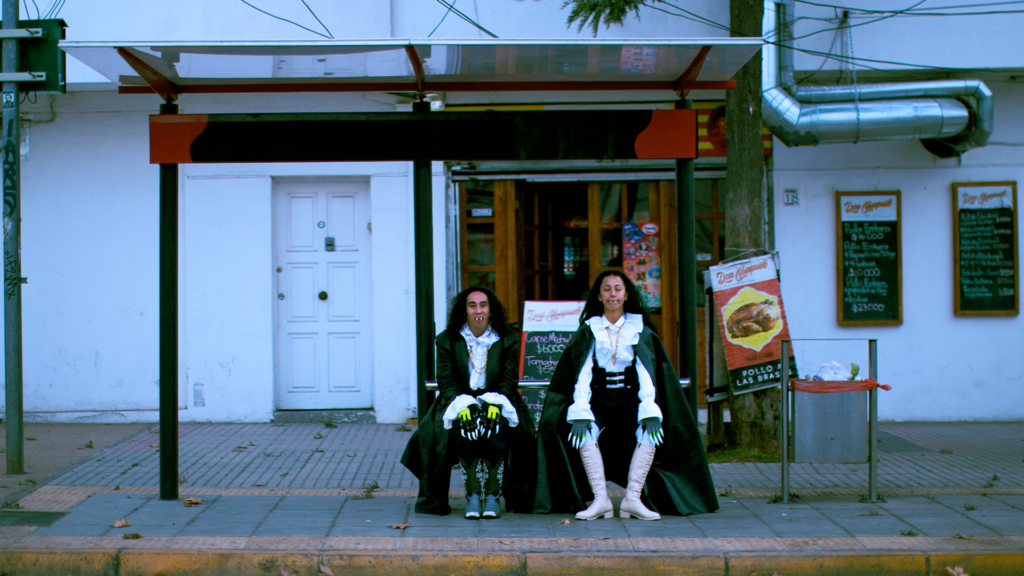
“Vampyr,” staged by Chilean director and writer Manuela Infante, will meet audiences at Kundura Sahne on June 27-28. Ahead of the Istanbul performances, we talked with Infante about “Vampyr.”
Seyhan Akıncı
“Vampyr,” one of the standout works on the international stage by Chilean director and writer Manuela Infante, is getting ready to meet audiences at Kundura Sahne on June 27-28. We talked with Manuela Infante about “Vampyr,” a production co-produced by Beykoz Kundura that is coming to Istanbul with a creative team from Chile and several other countries.
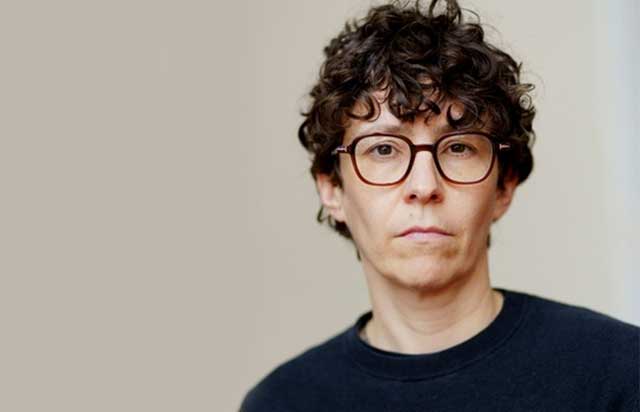
Manuela Infante. Photo: Max Zerrahn
In “Vampyr,” the third part of a line of research that began with your earlier works “Estado Vegetal” and “Cómo Convertirse en Piedra,” how did your approach evolve toward placing ‘non-human’ beings at the center?
For a long time now I have been working on questioning and dismantling the colonial idea of what it means to be ‘human.’ The figure of the vampire allows me to express this from the perspective of the Global South. Colonialism destroyed intertwined cosmologies in which the human and the non-human were not seen as separate from one another. But these ways of thinking are still alive. I see theater as a space of resistance where imposed categories can be called into question. That is why creating a “vampiro sudaka,” that is, a Latin American vampire, becomes an act of disobedience. This is not an aristocratic European Dracula sitting in his library. Our vampire is a wild, hybrid creature; a figure that shatters colonial notions of identity. What has always fascinated me about the vampire myth is its hybrid nature: neither fully alive nor dead; neither animal nor human, and, since it is a decaying being, in a sense also part of the soil. The vampire is a mythological figure that appears in many parts of the world, but what really interests me is the way it resists categories: human/non-human, nature/culture, civilized/savage. If we understand colonialism as the appropriation and exploitation of an Other, we can see that it depends on these very divisions: between the human and the non-human, between nature and culture. That is why the “sudaka” vampire is more than a poetic image. It is an act of resistance, a way of defying an inherited colonial logic. A logic that, even today, deeply shapes how we see, think and act.
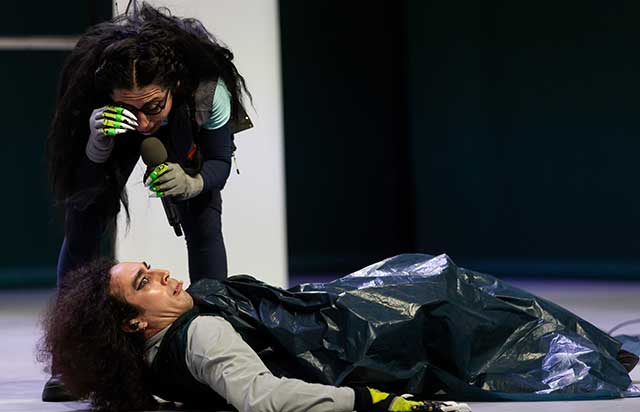
Vampyr. Photo: Nicolas Calderon
You touch on new forms of exploitation. How effective do you think theater’s way of dealing with such current and complex issues can be?
No human body exists independently of other bodies. Life is an intertwined, symbiotic structure. And when you try to “kill” the other conceptually in order to exploit it, you are in fact tearing apart this web of life as well. That is exactly why these categories fail again and again: because they do not reflect reality. I question the conceptual and linguistic distinction between the exploitation of human resources and the exploitation of nature. The vampires in my play resist these categories. What makes them so compelling is that they carry intertwined ways of existing in their bodies. We saw this during the COVID-19 pandemic, and we see it in the microplastics accumulating in living organisms. We are deeply dependent on one another. And to me, the vulnerability that comes from depending on others is something extremely valuable. In Chile we often use the expression “zonas de sacrificio,” that is, “sacrifice zones,” to describe areas that have been devastated by exploitation. I find this expression very striking, because it accepts that some lives and some geographies are expendable in the name of economic development. My work, too, tries to show that these sacrificed zones are in fact places where life, death and exploitation are intensely intertwined. In this sense, the vampire is the perfect creature: made up of many parts, carrying ambiguity and an indefinable state of being in its body. As it is said in the play: “Part dead, part alive, part human, part animal, part soil.” I find the concept of ‘sustainability’ deeply problematic. Because the word itself contains a trap: to sustain. But to sustain what, exactly? Most of the time, it simply comes down to sustaining, that is, keeping going, the very same system that consumes both human and non-human resources. To me it feels more like a technological transformation of the mechanisms of exploitation; and sometimes merely a change in who gets to exploit whom.
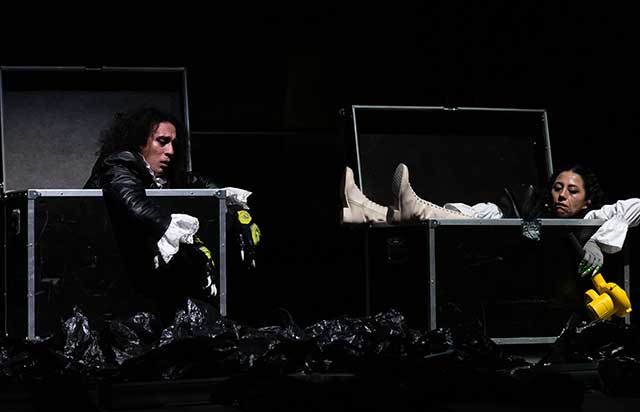
Vampyr. Photo: Nicolas Calderon
The narrative you build through hybrid beings aims to break with human-centered thinking. What strategy did you follow so that the audience could truly experience this rupture?
The rehearsals were like a collective exploration of the uncertain, and they had already begun before the text emerged. Through performative tools and physical work, I wanted to explore how we might overturn the idea of fixed beings, the notion that individuals are coherent, self-contained and clearly defined subjects. How can we question this rigid, monocultural idea that insists a person must be entirely identical to themselves? In theater, it is often assumed that a character must be coherent and have a clear, fixed identity. In this project, however, I am exploring the exact opposite: beings that resist coherence, that are permeable, open and porous. Together with the performers, we explored how this state could take bodily form on stage.
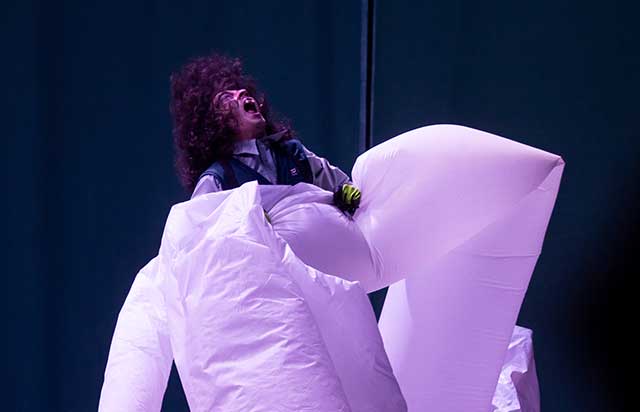
Vampyr. Photo: Nicolas Calderon
What kind of preparation process did you go through in bringing to life hybrid characters that are half human, half animal, half “energy being”? Did this process affect the way you look at nature?
During rehearsals we often talked about exhaustion, not only in the sense of energy but in a deeper, existential sense. What does it mean to feel exhausted? What is energy? How does it circulate? Energy is not just a resource to be extracted; it is something that connects beings to one another and entangles forms of life. And it deserves a way of existing that goes beyond being defined solely in terms of usefulness. There is a line in the play: “The wind is no longer allowed to play, to lift skirts or to blow hats away.” Now it is forced to be productive. I am interested in a form of energy expenditure that produces nothing and serves no purpose, but simply takes pleasure in its own existence. Today’s understanding of sustainability rests on an overly narrow conception of energy. It also relies on a dangerous belief: the idea that humans broke the planet and now have to fix it. This only reproduces the illusion of human supremacy. We live within a logic of compensation; one need only look at emissions trading. What an arrogant idea: to think that we can balance energy and resources, as if the planet’s equilibrium were something we could manage… We are entangled in a vast ecological web, yet we can perceive only a tiny part of it. We must abandon the compensation paradigm and become open to accepting our vulnerability.
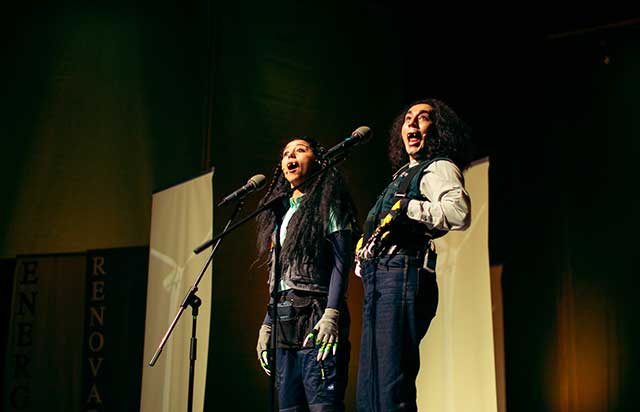
Vampyr. Photo: Franco Barrios
Did you personally connect with the play’s themes of “energy production” and “exhaustion”?
Yes, absolutely. I think exhaustion is one of the most recognizable affects of our time. We are constantly expected to produce more, move more, be more visible, more reachable and more productive. At the same time, we are told that the solution to the climate crisis is, once again, to produce more energy, only this time in a “green” way. This contradiction interested me a great deal. Of course, I see myself within it too. I work in theater, a field that stays afloat on a structure sustained by invisible labor, precarious work, travel, night work and physical intensity. So for me, exhaustion is not an abstract theme. It is something I recognize in the body, in ways of working and in the way artistic systems operate. But the work also asks the question: consumed by whom, and for whom? Because the promise of green energy often conceals the same old colonial structure: some regions, some animals, some workers, some bodies are sacrificed so that others can go on consuming. In this sense, the vampire is not only the creature on stage. The vampire is also a system that feeds on bodies, landscapes and futures while calling itself progress.
*This interview was first published in Milliyet Sanat (https://www.milliyetsanat.com/haberler/diger/vampyr-aristokrat-bir-drakula-degil-/26323).