03 July 2026
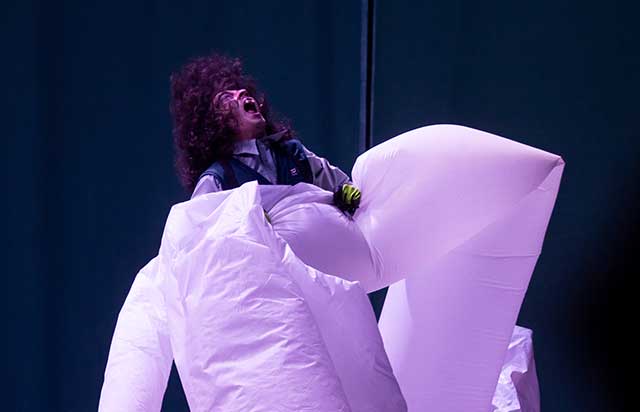
“Vampyr,” a mockumentary about worker vampires who labor through the night beneath wind turbines, uses a jolting theatrical language to expose the energy policies rising amid the climate crisis, and their hidden sides.
MELİSA VARDAL – As Europe battles new heat waves, investment in renewable energy is being presented as the way out of the climate crisis. Wind turbines are among the most visible symbols of this transformation. But is clean energy really being produced for everyone? Does this transformation also protect people and the places where they live, or does it merely expand new areas for investment? “Vampyr,” a Beykoz Kundura co-production, leaves these questions lingering in the audience’s minds. Built by Chilean playwright and director Manuela Infante on the aesthetics of the fake documentary (mockumentary), the play confronts the audience not so much with the familiar vampires of the horror genre as with worker-vampires who work the night shift, who are never allowed to rest and who are left invisible. Performed in Spanish with Turkish surtitles, the production deliberately blurs the line between documentary and fiction.
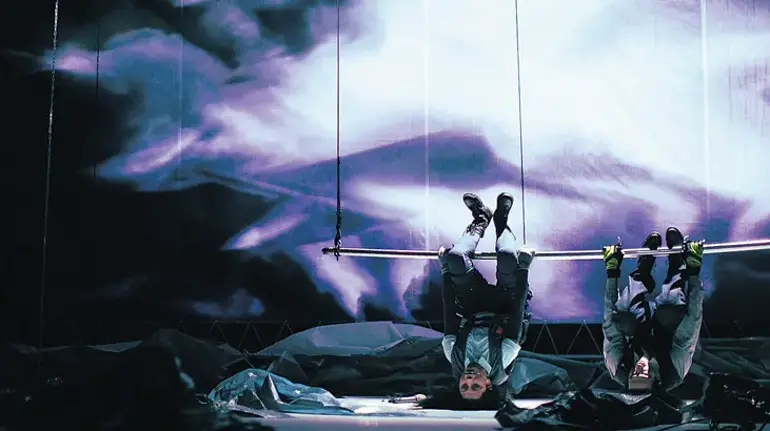
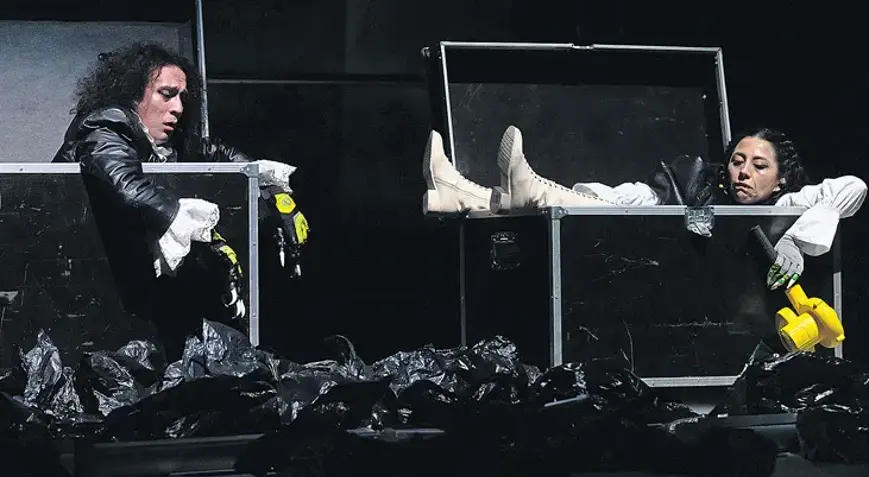
When the stage lights come up, two creatures emerging from black crates reveal who they are without saying a word. With their pointed fangs, animal-like movements and muffled voices, they resemble vampires, but this time they appear not as bloodsuckers but as laborers in work overalls heading out on the night shift, workers whose own blood, in a sense, is being sucked. Their job is to collect the bats killed by the wind turbines. Accompanying them, a voice-over, like a documentary narrator, traces an unseen disaster through scientific reports, field research and testimonies. What at first seems like an isolated incident becomes, as the play goes on, part of a systematic exploitation. In the investigation, the exchange about a worker who did not show up for work (“Was he sick?” “No.” “Was he dead?” “No.” “Was he alive?” “No.”) points to ‘beings’ trapped between living and dying. The report prepared by the scientist also lays bare how this order works. While the company declares that the turbines cannot be held responsible for the deaths of the bats, the sections of the report stating that “the effects cannot be fully known” are quietly glossed over. Science thus becomes not a tool that brings the truth to light, but one that renders the responsibility of corporations invisible. The play, which also draws attention to how information is managed, raises its most striking question toward the end. A woman explains that where the turbines now rise there used to be strawberry fields; in the past they exported their produce, she says, while today they export electricity. While the region’s power keeps being cut, the energy produced there goes to other countries. In this way, the play does not reject renewable energy; rather, it questions the economic relationships within which it is produced. As the world produces more and more energy today, is this energy truly being shared as a public right, or only for profit? “Vampyr” does not offer a definitive answer to this question; instead, it leaves an unsettling void for the audience. In an age when the climate crisis is steadily deepening, the play perhaps reminds us once again of the most important issue: it is not only a question of how we produce energy, but of whom that energy is produced for, whose life it lights up and whose life it darkens.
Energy for whom?
According to the International Energy Agency, global energy investment exceeded 3 trillion dollars for the first time in 2025. Around 2 trillion dollars of this went to renewable energy, power grids, storage systems and other clean energy technologies. In 2024, 91 percent of newly commissioned renewable energy projects generated electricity at a lower cost than new fossil fuel power plants. Yet this growth in investment does not translate into equal access to energy. The data show that progress on energy access has slowed, and in today’s world some 655 million people still have no access to electricity.
*This article was first published in Milliyet Sanat.
Author: Melisa Vardal