22 February 2021
‘Uncanny Valley’ raises the possibility of ‘actroids’ taking the place of actresses and actors on stage. In this pioneering play by the German company Rimini Protokoll, we watch a humanoid robot.
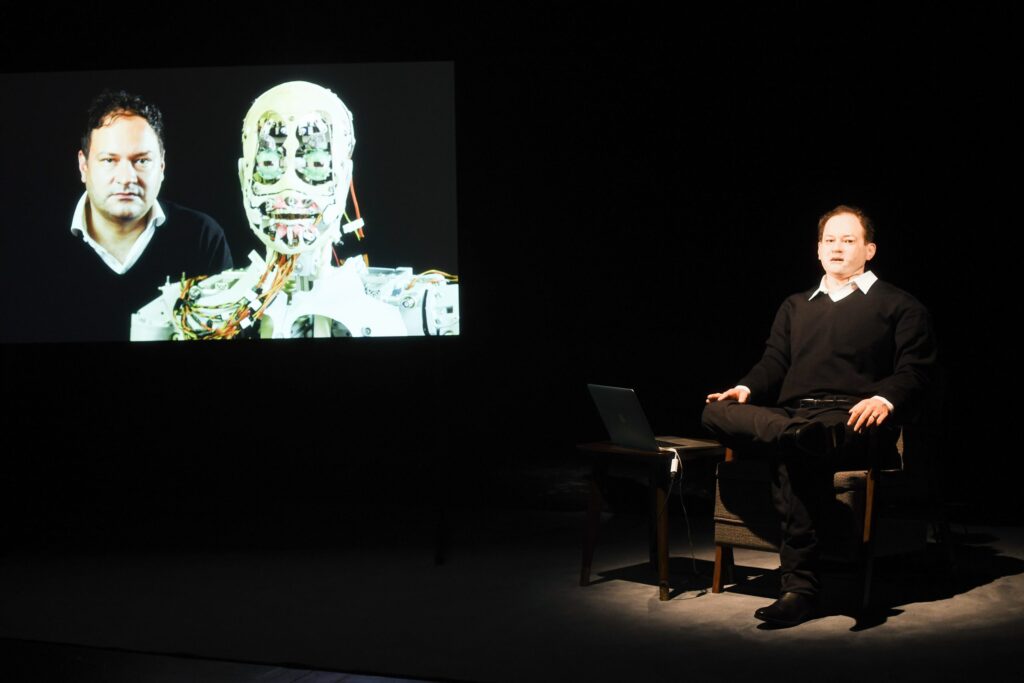
A middle-aged male performer sits on an empty stage. A performer, but not a human; a humanoid robot, an android. Or—to borrow the apt term from an article I came across about the play—an ‘actroid’. He sits before us in an attempt to unravel the blurred boundaries between humans and humanoid robots made with artificial intelligence. With a laptop in front of him, necessarily bound to the armchair he sits in, he is about to give us a presentation, accompanied by images he will project onto the digital screen from time to time and by what is going through his ‘mind’…
‘Uncanny Valley’ is a work by the German company Rimini Protokoll, with text, concept and direction by Stefan Kaegi, one of the company’s founders. Currently being screened with Turkish subtitles as part of Kundura Sahne’s online program, the play takes its name from the Japanese roboticist Masahiro Mori. The term, which Mori used in the 1970s, refers to the uncanny zone of existential uncertainty people experience when they encounter humanoid machines.
So what did Kaegi do? By cloning the physical features of the German writer Thomas Melle and programming his personality traits and behavior, he created what Melle, in the play’s own words, calls ‘an outdated puppet’ of him. Yes, an android that looks exactly like Thomas Melle is on stage. Meeting the audience, he talks about himself from childhood onward, about his literary journey and his psychological struggles. He is someone who could stand in for all those tedious ‘author duties’ (interviews, signings, shoots, etc.) even if Melle were to disappear. Just look: he has already proven himself on stage!
Even the sound of clearing his throat is the same
‘Uncanny Valley’ is a work that, through this ‘theater machine’, invites the audience to reflect on the existence of a human being and of their copy, and on the strange, truly uncanny relationship between the two. Through the footage used during the play, the ‘real’ Melle also becomes part of it. His robot, which in the name of ‘realism’ does not even skip the sound of clearing its throat, reminds us that the fundamental measure of being human lies in emotions and in life’s coincidences, while at the same time asking: “Why do I behave like you? So that you will see yourselves in me? I can empathize with you, but can you?”
The ‘humanoid robot’ question, which has been the subject of cinema and literature time and again, presents itself directly as a subject in theater with this 2018 production. For me, the strangest moment is when, in the recording I watched, the audience enthusiastically applauds the robot on stage with shouts of “Bravo!”
Bahar Çuhadar