22 December 2020
Performing Urgency
A publication series commissioned by the European theater network House on Fire. Co-published by the Live Art Development Agency. Published by the Berlin publishing house Alexander Verlag Berlin.
This publication series focuses on the relationship between theater and politics. It asks how theater can engage with current social issues without compromising either its art or its politics, and what the processes and methodologies for doing so might be. It aims to foster a broader discussion about the conditions, aesthetics, concepts and subjects of contemporary performing arts.
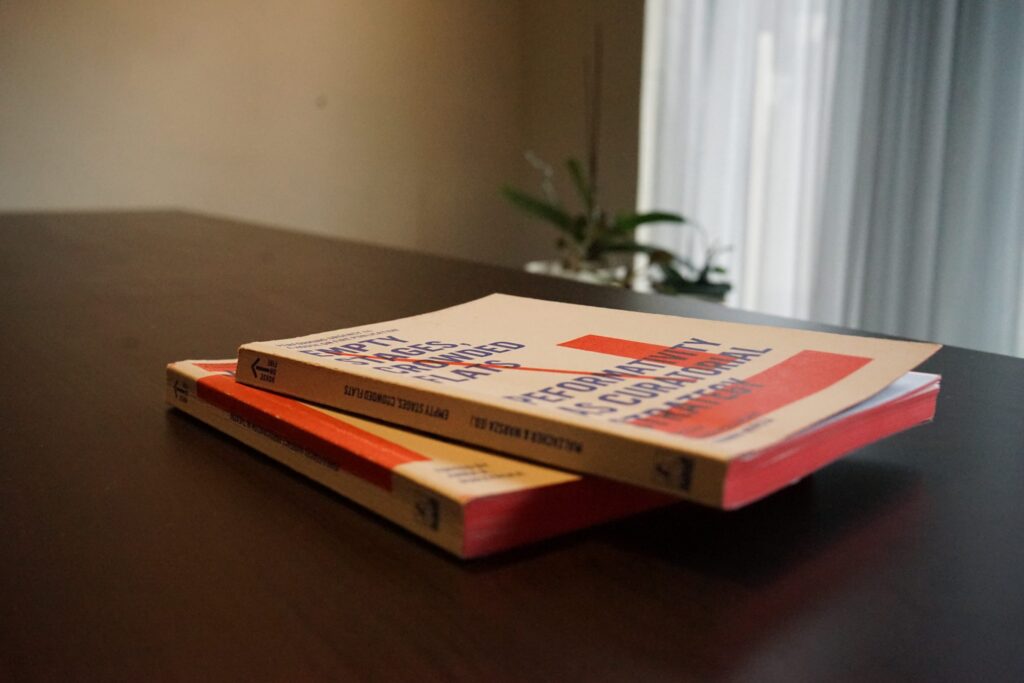
This article appears in “Essays & Conversations,” the first section of Empty Stages, Crowded Flats: Performativity as Curatorial Strategy, edited by Florian Malzacher and Joanna Warsza as part of the Performing Urgency series, under the title “Feeling Alive: The Performative Potential of Curating.” It is published on the Beykoz Kundura Culture Blog with the kind permission of Florian Malzacher. The Turkish translation is by Nil Ege Özden.
Florian Malzacher is a writer, dramaturg and independent curator of the performing arts. He also serves as curatorial advisor to the Ruhrtriennale for 2018-20.
The Performative Potential of Curating
With the arrival of the concept of curating in the performing arts, it became clear that programming performances, theater works, dance pieces or music could involve more than simply selecting or producing shows and then placing them in a particular time slot and venue. What is needed is an arrangement in which works are set in broader contexts, where they interact with one another and with the world that informs them. Not only within the performance itself: we also gain the possibility of transforming a festival, a program, an event or a venue into a broader space of communication and exchange.
Although concepts of curating have been worked out in far greater detail in the visual arts than in the performing arts, the relationship between the two has always been more reciprocal than is generally acknowledged. It is no coincidence that the work of Harald Szeemann, the prototype of the contemporary curator, has been compared to that of a theater director, or that art theorist Beatrice von Bismarck has stressed how close the task of an exhibition maker is to it.
Taking Szeemann’s idea of staging an exhibition seriously, however, leads us even further. It raises the question not only of how curating has, often without realizing it, generally borrowed the tools of theater, performance and choreography, but also of how it could gain much more from these practices by consciously understanding and integrating their strategies and techniques.
The Performance of the Performative
The impressive and at times inflated career of the concept of the performative began with the “speech acts” introduced in J.L. Austin’s lectures “How to Do Things with Words” (1955). As a forerunner of the idea of performativity, he described verbal utterances that draw on the transformative capacity of an act that constitutes or changes reality. The essentially linguistic discourse that followed Austin was the basis for Judith Butler’s radical interpretation, in the early 1990s, of gender as something performed and constructed through speech or physical action: reality as a social construct that exists by being constantly repeated and cited. For Butler, performativity, as defined in Bodies That Matter (1993), is “the reiterative power of discourse to produce the phenomena that it regulates and constrains.”
Although definitions of performativity are numerous, contradictory and vague, most of them are tied to a constructivist belief that there are no fixed notions of objectivity, reality or truth, and that everything is constructed individually, shaped by context and interaction.
Alongside the linguistic arguments, influential impulses for theater and performance studies also emerged from ethnographic and anthropological discourses. The term “cultural performance” was introduced in 1959 by the ethnologist Milton Singer in his book Traditional India: Structure and Change. Singer believed that people rediscover their own traditions and identities through dance, theater and rituals (anything containing an element of dramaturgy). The anthropologist Victor Turner went on to develop the concept of cultural performance, which was taken up by theater makers and theorists such as Richard Schechner, who worked with him and applied his findings to theater, carrying them even further. However different the concepts of the performative may be, all of them, in one way or another, emphasize its capacity to create reality, as Shannon Jackson points out in this book.
Yet there is another dimension to the use of the word performative – equally vague and rather what we might call colloquial. In Jackson’s words, it essentially describes “theater-like but not theater” artworks, “providing an umbrella for clustering works in time, in space, with bodies, in relational encounters.” This is an in-between use of the performative vocabulary that often foregrounds the sometimes productive, sometimes uneasy relationship between the performing arts and the visual arts.
With Szeemann in the back of our minds, it is precisely this notion of “theater-like but not theater” – though often rejected for being all too real – that opens up a whole range of possibilities when applied to the processes and products of curating. How might concepts such as the handling of time, narration, process, the use of space, the co-presence of the audience or role-playing inform and shape curatorial work?
In my view, the curatorial potential of the performative lies not in separating these two strands but in thinking them together as different aspects of the same approach: adapting “theater-like” strategies and techniques makes it possible to curate situations that “create reality.” Such situations do not merely describe reality; they also generate an awareness of their own reality. By placing less focus on the product or the outcome and more on its own becoming, performative curating takes up the central definition of theater and performance: liveness, the co-presence of all participants, and the forming of a temporary community.
For curatorial praxis, separating the more linguistic, anthropological or philosophical concepts of the performative from its literal, theater-like use is an unnecessary limitation. Unlike Dorothea von Hantelmann, who in “The Experimental Turn” (2014) dismisses the latter definition as a mere misunderstanding, I insist that they are connected to the tools of the live arts. This is not only because Austin, Singer, Turner and Butler explicitly refer to theater in their writings, but also because their discourses have in turn been taken up by theater and performance makers and have changed artistic practice. One might say that, by performing the performative, a new reality of performative performances has been created.
Even though conventional approaches try to neglect it, theater has always been a social and self-transforming art form. Theater is a paradoxical machine that allows us to observe ourselves while we are part of the performance. It does not create an artificial phenomenon outside of pure critique, yet it cannot be fully seductive even when it attempts nothing but immersive identification. Theater marks a space in which things are real and at the same time not real, creating situations and practices that are both symbolic and real at once. Curatorial thinking that consciously uses this knowledge underlines its own relational aspects, highlights both social and political implications and creates spaces for negotiation.
This proximity to theater can also be seen in concepts of the curatorial. In art theorist Irit Rogoff’s conversation with Beatrice von Bismarck in Cultures of the Curatorial (2012), for example, questions are raised about how the curatorial is embodied, how things are not made more difficult in the process, and how a public platform could be created that allows people to take part in these processes. For Bismarck, curating is a dynamic field of liveness, transformation and transience.
The fear that a work might appear too complete, like a finished product, is an integral part of all live arts. Here the ever-present possibilities of failure, chance, error and loss of control are seen not as unavoidable flaws but rather as the very essence of the medium. Instead of ignoring these obstacles, embracing them can become a key curatorial strategy for creating a tension that highlights the liveness present even in the most conventional repertory theater, dance company or music ensemble. Extending, shortening, interrupting or altering time can create awareness and give rise to spatial complexities. Inventing specific dramaturgies or playing with the limits of narration, or confronting works that at first glance do not seem to fit together in order to create both tension and openness through their friction, is another option. This list could be extended much further, and the possibilities are considerable. The many concrete examples in this book, developed by curators, artists, dramaturgs and activists, show how widely curating is understood as a performative tool focused on the here and now. At its best, it creates a temporary – specific yet permeable – reality that connects to many other realities, allowing artworks to be experienced not as autonomous entities but in their own right, with their own lives, and in relation to others.


Empty Stages, Crowded Flats
Theater is still bound to specific spaces reserved for its practice: the stage and the auditorium. Yet even in the most conventional settings, being aware of the specificity of the space can produce artistic or curatorial added value. How does the audience enter the space? When does the show actually begin? At the theater entrance? In the foyer, or in the auditorium? What difference does it make when I have to enter from a different place than usual? Is this part of the performance or merely pragmatic? What are the rules of the theatrical contract in this case?
Even conventional theater spaces are not neutral. On the one hand, they provide the necessary technical equipment, protect the work from unwanted encounters with its surroundings, allow for concentration and preserve artistic clarity. On the other hand, the spaces themselves largely define the possible outcome. They are limited not only in terms of architecture and possible spatial arrangements; since they essentially took shape in the early eighteenth century, they also represent a particular idea of the institution. At their core, they reproduce not only certain conventions about what theater is and ought to be, but also a particular image of society. They frame and domesticate both artistic and political visions. It is therefore not surprising that many curatorial projects in the field of theater either try to leave these predetermined spaces behind or to challenge them (as described in this volume, and as we can see in the B-Visible projects of choreographers Deufert & Plischke and dramaturg Jeroen Peeters).
Especially since the mid-1990s, the growing and at times exaggerated interest in site-specific work has brought a particular focus on place, moving out of theaters and occupying supposedly non-artistic spaces, seeking an authentic touch or contradicting what appears to be authentic. More often than not, this meant a move to the outskirts of the city, to empty industrial zones, half-ruined factories and vast storage spaces, which was associated with documentary theater’s need for a commitment to what supposedly lies behind the scenes. At the same time, this also overlaps with the logic of gentrification, at least symbolically, in that it occupies spaces reserved for others.
Using theater’s designated spaces against their nature, as Deufert & Plischke do, or abandoning them altogether challenges not only the institution but also the artistic work itself, revealing both the limits and the possibilities of the genre. Working conditions may become messy; unexpected situations may even arise that require audiences to be organized differently, and these may also limit technical possibilities. Site-specific work cannot simply transfer the logic of a theater venue to another spatial situation. It must be more than a mere reaction to the situation, more than a pragmatic response that deals with the disadvantages or adapts the original plans only as much as necessary. Such work gains momentum when it adapts the logic of its conditions, pushes against them or deliberately contradicts them. It needs to be sensitive to context, making the space part of its own form and content. Not by surrendering to it, however: obeying the space easily breeds boredom and can result in a mere semantic shortcut when narration, atmosphere, movement, space and everything else come too close to one another, so that all artistic tension disappears.
One of the best-known site-specific curatorial projects in the performing arts, German curator Matthias Lilienthal’s X Apartments (2002-), actually has an even more famous predecessor. For the iconic exhibition “Chambres d’Amis” (Guest Rooms), curator Jan Hoet persuaded more than 50 residents of the city of Ghent to let artists work in their homes and residences. His concept of displacement, which he later also used for documenta IX, aimed at the shift in perception that occurs whenever something is experienced in an unfamiliar context. It took art out of the exclusive gallery spaces to which it is usually bound. As he put it in the New York Times article “Avant-Garde Art Show Adorns Belgian Homes” (1986): “I am bothered by the idea that art is here and reality is there.” In Chambres d’Amis, one was meant to have the impression of being “not only in front of the work but inside it.” Each artist, among them Joseph Kosuth, Sol LeWitt and Mario Merz, used one or two rooms to create a work that reflected its surroundings. Since these were homes in use, encounters and discussions with the owners were an integral part of the concept.
Although Chambres d’Amis exhibited only works of visual art, it effectively created its own performativity by sparking the visitors’ imagination. The walks between the houses allowed for very different individual narratives and dramaturgies, and all of this was open to interpretation because it took place inside private homes.
Years later, Matthias Lilienthal took this dimension even further with X-Apartments, commissioning theater directors, choreographers and artists to invent small performances in different apartments. The project offers a set time frame in which different groups of spectators watch short performances, and these groups move on one after another to keep watching. In this way the experience becomes collective. Not only the different locations but also the bodies moving through them from one place to the next become part of the experience, which is far more than the sum of the performances. X-Apartments plays with the spirit of an arbitrarily mixed discovery that connects the audience members with one another.
While the number of apartments, the extraordinary within the ordinary and the shift of perception toward everyday settings play a key role in X-Apartments, Polish curator Joanna Warsza chose a symbolically powerful site for her own project, Finissage of Stadium X (2006-2008), as Ewa Majewska describes in this book. The Tenth-Anniversary Stadium in Warsaw was built in 1955 from the rubble of the war-ravaged Polish capital. It stood for the idea of communism and of a new Poland, but by the mid-1980s it had been abandoned and had turned into a modern ruin. Vietnamese and Russian traders, who took it over as the pioneers of newly arrived capitalism, brought new life to it. The heterogeneity of the site, the debates surrounding the new national stadium being built for the 2012 European Football Championship, and the absence of a critical discussion about Poland’s postwar architectural heritage inspired the three-year Finissage project, which included acoustic walks, performances, a radio station and tours led by activists and artists.
The Theatre, created by architect Tor Lindstrand and choreographer and theorist Mårten Spångberg, gave the notion of site-specificity an almost ironic twist. International Festival, the long-term interdisciplinary project they launched in 2004, positioned itself somewhere between theater, choreography, architecture and curating. In a playful and at times subversive way, they isolated and examined different aspects of what makes up a festival. The Welcome Package (Tanz im August, 2004), for example, was simply a bag, like the ones festivals give to their invited artists, but here it was designed to draw a heterogeneous kind of attention to the conventions of festivals. The idea of curating not only artists but also performance makers and other festivals became even more radical when International Festival handed out the IF logo to theater venues all over Europe for them to use and distribute.
For the 2007 Steirischer Herbst Festival, International Festival developed by far its most ambitious project, building a complete venue as a performance and a curatorial statement. The Theatre was the reenactment of a theater through its construction. Various artists, architects and theorists accompanied this process by holding workshops, forming a kind of social performance with an open outcome. Including a flexible 12×12-meter stage, the theater turned everything in the theater that is not theater into theater. Just as important as this conceptual performance, which turned a different perspective on the idea of space into a performance and thus into a time-based artwork, was another element: its indifference toward the main elements that would normally play an important role. The architectural aesthetics of the venue were highly pragmatic, and its programming was largely left to the festival curators.
Escaping theater’s highly determined and symbolically charged spaces can mean going all the way to even more determined and symbolically charged spaces: the white cubes of museums and galleries. There are many reasons for the growing interest in all things “live” in recent years. Some of them are less noble, such as trying to enter higher-prestige markets. But for many artists and curators, the real motivation remains close to Hoet’s idea of “displacement.” By changing the institutional, aesthetic and architectural frame, the patterns of perception and reflection change as well.
Curator Hans Ulrich Obrist has for many years been one of the key figures in integrating the performative into visual art exhibitions. Since the 1990s he has collaborated with choreographers such as Meg Stuart and Xavier Le Roy, and in 2007, together with Philippe Parreno, he made several time-based shows such as Il Tempo del Postino. Contemporary artist Tino Sehgal, known for bringing the performing arts into museums and galleries, has always produced his work on the border between choreography and visual art, and he shares his thinking on performance through Xavier Le Roy, with whom he collaborated on the work Project (2013). In 2012, on his website, Le Roy described his first live performance, Retrospective, as “an exhibition conceived as a choreography of actions to be performed by artists for the duration of the exhibition.” Le Roy allows the artists to use material from his solo choreographies, letting them re-create their own memories and the stories connected to them. By producing friction between the experiences of time brought together, he highlights the moment in time. The time span of the revisited show, the time each visitor spends, the artists’ working hours and the duration of the entire exhibition, together with their constant changes, create a dramaturgy of their own.
Expo Zero (2009-), part of Boris Charmatz’s Musee de la Danse, is an exhibition, a dance, an exhibition of dialogue. Experts from various fields – choreographers, writers, artists, directors, theorists, visual artists and architects – first spent four days together in a kind of brainstorming workshop, and then opened the space to the public, communicating with one another in verbal and non-verbal ways by presenting movements, thoughts, words and more. Since thinking the museum is at the same time creating it, what belongs to the Musee de la Danse? A dance museum can only be transient; the “Zero” in the working title is a reference to the absence of objects here.