15 March 2022
Elif Rongen-Kaynakçı’s curated program of Istanbul films, now screening at Demirane, consists of short found-footage clips shot by European camera operators at the turn of the century, in the manner of a travelogue film. Accompanying the screenings is this essay by film writer and academic Aslı Özgen, originally published in the Toplumsal Tarih journal, which recounts the captivating history of how Istanbul and the Bosphorus came to be captured on film.
Aslı Özgen
This essay underlines the powerful role of the “fluid frame” in shaping the cinematic image of Istanbul in particular, reflecting on the translation of urban space into a cinematic element. At the same time, it sets out to trace the pre-cinematic aesthetic precursors of fluid frames. Let us also note here that one of the essential avenues for researching the aesthetic precursors of fluid frames, though beyond the scope of this essay, is to reach into the little-known and hard-to-discover corners of film history.

Istanbul is known to have been filmed for the first time in 1896 by Alexandre Promio, the camera operator whom the Lumière brothers, inventors of the cinématographe, sent to the Middle East. [1] Perfected in 1895 by Auguste and Louis Lumière, two brothers who worked as photographers and manufactured photographic supplies in France, the cinématographe could record onto a 17-meter strip of film, develop the exposed film, and, with the help of a light source, project the developed film onto a wall for a large audience. Light and versatile, and therefore easy to carry, the cinématographe was operated by a hand crank, which made it possible to film in the streets, in crowded places, at public events and in faraway lands.
The Lumière brothers asked the photographic supply agencies they already had in various cities around the world to assign camera operators, and encouraged them to film everyday life in every corner of the globe. Promio, too, had come to Istanbul in the footsteps of the travelers who preceded him. The bond between cinema and travel was a strong one from the very beginning.
To put it more precisely, it is impossible to think of cinema independently of the technological inventions that transformed the perception of space and time in the 19th century: trains, steamships, bicycles, elevators, moving walkways, accelerating trams and, later, automobiles and even airplanes gave rise to new ways of seeing. As an art capable of transforming the perception of space and time, cinema became a medium in which these new ways of seeing were put into practice, tested, and pushed to their limits to produce aesthetic experimentation. While it was praised for its closeness to reality because it showed what the human eye could not see, its power to shape perception was also being discovered. (It emerged, for instance, that a train that was actually slowing down as it pulled into a station could, owing to the lens effect, suddenly grow disproportionately larger as it approached the camera, creating the sense that it was gathering speed, and that this had the power to throw audiences into a panic.) Alongside motives such as letting viewers experience a place or archiving an event, the Lumière brothers also drew on the new perspectives, that is, the new points of view, brought by modernity as sources of inspiration in shaping the aesthetics of cinema: in the films of the Lumière catalog, one first notices an aesthetic aim of containing maximum movement within a fixed frame; later on, one sees the possibilities of the moving perspective being explored by placing the camera on trains, on ships and in elevators.
[1] Burçak Evren, “Les Premiers Pas: 1895-1923”, Le Cinema Turc, Mehmet Basutçu, ed. (Paris: Centre Georges Pompidou Editions, 1996), p. 61.
The earliest known images of Istanbul in film history fit into this context. In other words, the first filming of Istanbul is a moment in which, with the aim of letting viewers experience a place, the aesthetic limits of cinema, then a new art, were pushed, and the urban space itself gave rise to a cinematic element. But that is not all: the first filming of Istanbul also makes possible a journey back to the roots of the modern culture of spectacle that permeates the art of the Lumières.
Promio, a camera operator who reflected on and experimented with the possibilities of this new invention, filmed Istanbul from the water, from the Golden Horn. With the images of the city he recorded from a boat moving along the Golden Horn, Promio made one of the first “tracking shots” in history. [1] According to some sources, shortly before this he had made a similar tracking shot from a gondola gliding along the Grand Canal in Venice. The fluidity of these deep, broad waterways running through the heart of both cities, [2] appears to have inspired Promio to move his camera just as these waters move.


In the case of Istanbul, this way of recording the city from a moving perspective flowing over the water would later echo in many films. For example, in the films of the French documentary filmmaker Maurice Pialat, who visited Istanbul in the 1960s; of Alain Robbe-Grillet, who shot his first feature film in Istanbul with Lütfi Akad as his assistant; of Atıf Yılmaz; and of many others, the city’s shores are contemplated from a boat drifting along the Bosphorus or the Golden Horn. All these long tracking shots share a common feature: they possess a “fluidity” that comes from being filmed on the water. In these shots, the gentle or at times turbulent movement of the water also determines the aesthetics of the images entering and leaving the frame. Another element is that the image in the frame flows past just like the waters flowing beneath the camera. The new regime of time and the new perception of space brought by the moving perspective carve out a strong place for themselves in cinema. What is distinctive here, however, is that water is the most decisive element. In light of all this, it seems possible to define this aesthetic element, born of translating the movement of the waters that divide the city in two into cinematic movement, as the “fluid frame.” This essay reflects on the translation of urban space into a cinematic element, highlighting the powerful role of the fluid frame in shaping the cinematic image of Istanbul in particular. At the same time, it sets out to trace the pre-cinematic aesthetic precursors of fluid frames.
[1] A tracking shot (kaydırma plan) is a shot in which the camera moves during filming. A pan, by contrast, is a movement in which the camera rotates from one side to the other around a vertical axis. Source: Ralph S. Singleton, Amerikan Film Terimleri Sözlüğü (Istanbul: Es Yayınları, 2004).
[2] The concept of the “Fluid Frame” (Akışkan Kadraj) was first written up as a short entry for Altyazı’nın Gayrı Resmi ve Resimli Türkiye Sinema Sözlüğü (Altyazı’s Unofficial and Illustrated Dictionary of Turkish Cinema). See Altyazı’nın Gayrı Resmi ve Resimli Türkiye Sinema Sözlüğü: 150. Özel Sayı (June–September 2015): 21-22.

Viewing in motion: temaşa
An important feature characterizing the new ways of seeing brought by modernity was their relationship with the notion of “movement”: new recording devices had made it possible to represent movement flawlessly, while the central, all-commanding, fixed perspective of the Renaissance had given way to the relative perspectives of the subject in motion. In Techniques of the Observer, his book on vision and modernity, Jonathan Crary notes that the rupture in classical modes of vision in the early 19th century involved far more than a visual change in images and works of art, or a break in conventions of representation. According to Crary, this rupture in ways of seeing cannot be separated from a sweeping reorganization of knowledge, nor from the social practices that altered the productive, cognitive and desiring capacities of the subject in myriad ways. [1]
Cinema’s bond with travel culture is likewise inseparable from this newborn way of seeing/watching/looking, from the subjectivity inclined toward change that it triggered, and from the celebration of movement that underlies them. The Parisian arcades that inspired Walter Benjamin’s Arcades Project are among the spaces where this bond found its clearest expression. In Window Shopping, her book examining the seeds of cinema and postmodernity, Anne Freidberg emphasizes that the arcades, spaces built for the “subject in motion,” always housed a “panorama” or a “diorama.” [2] These entertainment venues, in a sense the precursors of cinema, usually featured large-scale pictures designed to make visitors feel as if they were standing in a famous square of a city, in front of a famous monument, or in the midst of an admirable pastoral landscape.
[1] Jonathan Crary, Techniques of the Observer: On Vision and Modernity in the Nineteenth Century (Cambridge, MA: MIT Press, 1992), p. 3.
[2] Anne Freidberg, Window Shopping: Cinema and Postmodern (Berkeley: University of California Press, 1994), p. 4.
In this way, visitors could travel in a single step to Paris, London, New York, a spot in the Alps or the Lake District. Benjamin notes that the spread of the arcades in Paris coincided with the spread of panoramas. According to Benjamin, panoramas, which played with the perception of space and time and transported visitors in an instant to another time and another place, paved the way both for the art of photography and for silent and sound cinema. By the time of the Lumières, the presence of cities’ busiest streets and squares, their monumental buildings, and their historic or natural beauties in the images shot with the cinématographe was an extension of this culture.
Walter Benjamin argues that panoramas were also the expression of a newly emerging attitude toward life. In panoramas, the city or nature is transformed into a view, a “spectacle,” a “temaşa.” [1]
In an interview with the monthly film magazine Altyazı, historian Cemal Kafadar, looking at Istanbul across the Golden Horn, made the following observation about the city’s culture of temaşa, or spectacle: “One feature of the centers that, over the long term, shaped and defined the modernity that took form in the 16th century is that they created a new culture of spectacle or brought new interpretations to existing performing arts: there is Karagöz, there is the meddah, and elsewhere there are other arts. But since we are talking about architecture, we should also talk about the elements of spectacle in architecture. For Sinan, the Süleymaniye is a temaşagâh, a place to be beheld, but from the Süleymaniye the city, too, is a temaşagâh. Walking here, one takes pleasure in spectacle from many surprising, playful perspectives. It was conceived with the idea of creating this pleasure of spectacle not only for a foreigner looking from Pera or a visitor entering the city from the sea, but for every person walking in the city.” [2]
[1] Walter Benjamin, The Arcades Project (Cambridge, MA: The Belknap Press, 2002), p. 6.
[2] “Kamera Öncesi bir Kamera Gezisi” (interview with Cemal Kafadar), Altyazı, no. 109, September 2011, pp. 52-55.
When Kafadar speaks here of the visual pleasure city dwellers would take from their walks in daily life, the close link he draws between “viewing” and “strolling” is present in the word temaşa itself. Borrowed into Turkish from Arabic, the word “temaşa,” besides meanings such as watching, looking and observing, is also related to the word for “walking” and carries the meaning of “stroll”; it can therefore be said that movement and viewing are inherent in temaşa. In other words, temaşa involves moving (strolling), watching while in motion, or watching what is in motion. Kafadar’s observation reminds us that the roots of modernity’s culture of spectacle, that is, of the ways of seeing of the subject in motion and of the new regimes of knowledge born of relative perspective, reach much further back, to the 16th century: “There is a modern pleasure that we call seeing and being seen, which, although it was named in the 19th century, existed before then without a name,” says Kafadar. Interestingly, the seeds of the “fluid frame” that is the hallmark of Istanbul’s image in cinema, or of the panoramic shots flowing over the water along the Golden Horn or the Bosphorus, also reach back several centuries, and the pre-cinematic fluid frames in which the city becomes a “spectacle” are remarkably numerous. Whether in historical accounts, in travelers’ prose or in paintings, a kind of pre-cinematic cinematographic style stands out.

Kömürciyan’s camera before the camera
In tracing the pre-cinematic precursors of the fluid frame, one must first look at a work that Cemal Kafadar cites, again building on the observation above: Eremya Çelebi Kömürciyan’s History of Istanbul. In an entry written for Altyazı’s Resmi ve Resimli Türkiye Sinema Sözlüğü, Kafadar writes that the traveler Eremya Çelebi Kömürciyan, a contemporary of Evliya Çelebi, takes his readers on a boat trip on the Bosphorus, and that this excursion is constructed in a cinematographic style. In the entry titled “Eremya Çelebi Kömürciyan’s Camera Before the Camera,” Kafadar states:
“In his work titled History of Istanbul, he starts from Yedikule and puts his reader in a boat. ‘Come, let us board a boat,’ he says. He rows out a little and says, ‘now let us look at the city from here.’ Then he writes the entire history of Istanbul by talking with the reader he is taking around in the boat and by shaping their perspectives. He says: ‘To the west, Yedikule, the city’s farthest end, comes into view. Let us not leave the boat. Following the shore and advancing slowly eastward, let us attentively behold our surroundings.’” [1]Kafadar sees here a narrative reminiscent of cinematographic editing. He notes that Kömürciyan writes “the entire history of Istanbul by talking with the reader he is taking around in the boat and by shaping their perspectives”; in other words, he suggests that Kömürciyan takes “a camera tour before the camera”: “He pans, he stops, he zooms in. He pulls out, pans again, or adjusts between close-up and long shot.” According to Kafadar, this is “an indication of how the pleasure of spectacle was internalized in the culture of that period.” [2]
[1] Cemal Kafadar, “Eremya Çelebi Kömürciyan’ın Kamera Öncesi Kamerası”, Altyazı’nın Gayrı Resmi ve Resimli Türkiye Sinema Sözlüğü: 150. Özel Sayı (June–September 2015): 78-79.
[2] “Kamera Öncesi bir Kamera Gezisi” (interview with Cemal Kafadar), Altyazı 109 (September 2011): pp. 52-55.
Melling’s decentered perspective
It can be said that the engravings of the painter, architect and traveler Antoine Ignace Melling, who some hundred years after Eremya Çelebi depicted the shores of the Golden Horn and the Bosphorus with extraordinary meticulousness, also harbor a similar vision of a cinematographic excursion. Melling, who came to Istanbul with the Russian ambassador’s entourage, was employed as palace architect during the reign of Selim III. In his engravings, collected under the title Voyage pittoresque de Constantinople et des rives du Bosphore (A Picturesque Voyage to Constantinople and the Shores of the Bosphorus), Melling depicts the city with remarkably fine attention to detail. The most distinctive feature of his pictures is the vast breadth of their spaces: in most of these views, the human figures, which seem almost part of the other natural or architectural details, are extremely small and insignificant compared to the breadth of the space. They are not subjects; like a boat, a tree or the curve of the water, they are part of the landscape. Space always envelops and defines everything within it, holding everything in its grip, as it were.
In these large pictures, there is hardly any privileged subject or privileged point of view forming the center of the image; the subject of the pictures is space in all its inclusiveness, that is, Istanbul and the shores of the Bosphorus. Like the hidden subject behind the camera in a film, all there is in these pictures is Melling’s gaze, field of vision and angle of view (or those of the viewer looking from Melling’s perspective). Melling wants his reader/viewer to sense this ghostly presence, too, for he indicates from which point and in which direction he was looking when he drew each picture. Thus the viewer who looks at all the engravings together sets off on a journey along the shores of the Bosphorus with Melling. It is as though they had stopped at certain points and photographed or filmed certain views. In his autobiographical narrative Istanbul: Memories and the City, Orhan Pamuk also says that he sees a cinematographic style in Melling. Pamuk writes:
“Melling’s views of Istanbul seem to have no center (…) In a map at the end of the book, Melling marked, with the precision of a topographer, from which corner of Istanbul and from which angle he had viewed each of these 48 large pictures as he painted them, but the pictures, like Chinese scrolls or like the camera movements in some CinemaScope films, give me the feeling that the image has no center and no end.” [1]
It seems possible to define Melling’s views of the Bosphorus as a pre-cinematic aesthetic precursor of the fluid frame. Just like the uninterrupted long takes of a camera gliding over the Bosphorus, Melling’s Bosphorus views stretch on and on. The “centerlessness” Pamuk emphasizes also brings to mind the absence of a privileged subject or point of view in these pictures. This feature, in turn, coincides with a common trait of fluid frames, or of uninterrupted long takes, in cinema: in these shots there is no fixed center, nor is there an unobstructed field of vision that offers the satisfaction of commanding the entire view. On the contrary, because what is inside the frame keeps changing, the space outside the frame seems to be felt all the more strongly: it is wondered about, imagined, desired, and cannot be possessed. With each new element entering and leaving the frame, “knowledge” is constructed anew.
[1] Orhan Pamuk, İstanbul: Hatıralar ve Şehir (Istanbul: Yapı Kredi Yayınları, 2003), p. 71


Curiosity, imagination, desire: the journey to the East
According to Kenneth Parker, editor of Early Modern Tales of Orient, Westerners began to take an intense interest in Istanbul after the city passed into the hands of the Muslim Ottomans in 1453. [1] An urgent desire and need arose to learn every detail of Ottoman civilization and culture. There was curiosity both about the work of Muslim scholars, in astronomy and mathematics for example, and about Islamic philosophy. At the time, universities such as Cambridge and Oxford also began to undertake studies in these fields. In England in particular, a great many translations were made from Arabic and Persian in the late 16th and early 17th centuries, and cosmographies and atlases describing the geography and cities of the region were prepared. The production of cosmographies and atlases in particular relied on travelers’ notes or on the diaries in which they recorded details of daily life. According to Parker, it was in this period that travel narratives became popular. It can also be said that many of the thematic and formal seeds of the journey to the East took shape during this time. In the 17th and 18th centuries, for travelers who mostly arrived in Istanbul by ship, “entering the city” and “the first encounter with the city” consisted of a long, unhurried voyage along the shores of the Bosphorus. One may surmise that the strong emotional impact of this moment of first encounter or entry lies behind the fact that the Bosphorus and its shores were so often recounted, described and depicted. Travelers arriving in the city wished to recount this prolonged moment of entry in all its detail, almost like a ceremony, and to portray the sense of both space and time through powerful images. This desire comes clearly to the surface in the writings of the French authors Chateubriand and Lamartine.
[1] Kenneth Parker, ed. Early Modern Tales of Orient: A Critical Anthology (London: Routledge, 1999), pp. 1-35.

In Chateaubriand’s account, the first encounter with the city also takes place from a boat. This narrative is constructed so that the view of the shores flows before the eyes of the narrator/reader. The mists over the Bosphorus are also used as a magical transitional motif. They work almost like an element of cinematographic editing that makes the passage from one scene to another imperceptible, that is, seamless: “We skirted the European headland, on which rises the Castle of the Seven Towers, an old Gothic fortress falling into ruin. Constantinople, and above all the Asian shore, was shrouded in mist. The cypresses and minarets I glimpsed through this haze looked like a forest stripped of its leaves.
As we approached Seraglio Point, the north wind rose and within a few minutes dispersed the mist that lay over this picture; I suddenly found myself before the palace of the Commander of the Faithful; it was as if everything had been transformed by a magician’s wand. Before me, between smiling hills, the Bosphorus wound like a lovely river toward the Black Sea; on my right was the land of Asia and the city of Üsküdar; the land of Europe lay on my left; with its coves and promontories and the great ships riding at anchor, it formed a wider bay, while countless small boats came and went across the sea. Enclosed between two slopes, this bay spread out Istanbul and Galata, tier upon tier, before our eyes on the opposite side. The boundless expanse of these three cities, Galata, Istanbul and Üsküdar, with their houses ranged in tiers; the cypresses, minarets and ships’ masts rising on every side and mingling with one another; the green of the trees; the colors of the white and red houses; the sea spreading its blue cover beneath them, and above, the sky opening another blue plain: all of this filled me with wonder.” [1]
[1] 12 François de Chateaubriand, Record of a Journey from Paris to Jerusalem and Back, See http://www.poetryintranslation.com/PITBR/Chateaubriand/ ChateaubriandItineraryII.htm. The Turkish translation used in the original text is from the compilation published in BiaMag to introduce Ahmet Doğan’s book Avrupa ile Karşılaşmalar. See http://bianet.org/biamag/sanat/138799- istanbul-a-geldiler-yazdilar-resmettiler

A similar cinematographic style can be sensed in the account of Alphonse de Lamartine. Here, the mists that served as a transitional motif in Chateaubriand’s account seem to have been replaced by “close-ups” of the sea. By repeatedly emphasizing the sea’s contact with the city walls and its meeting with the oars, Lamartine succeeds in making the presence of the water felt at all times. This also adds a temporal dimension, a rhythm, to the narrative: “We sail with a following wind along the walls of Istanbul, lapped by the sea, toward the mouth of the Bosphorus. After half an hour’s progress among a host of anchored ships, we find ourselves drawing near the walls of the palace (…) After a few strokes of the oars we had reached a point on the sea from which it was possible to see the Golden Horn, the Bosphorus and the Sea of Marmara, as well as the whole harbor and the inner sea of the city of Istanbul; but once there, forgetting the Marmara, the Asian shore and the Bosphorus, we became absorbed in contemplating, with gazes sweeping all around, the entrance basin of the Golden Horn and the seven cities of Istanbul suspended upon its seven hills (…) No painter’s brush could depict this place as a whole; it would be forced to dwell on its details; and each stroke of the oars carries the eye and the soul to another view, another impression.” [1]
[1] Alphonse de Lamartine, Voyage en Orient (Brussels: Meline, 1838), pp. 238-251. The Turkish translation used in the original text is from the compilation published in BiaMag to introduce Ahmet Doğan’s book Avrupa ile Karşılaşmalar. See http://bianet.org/biamag/sanat/138799- istanbul-a-geldiler-yazdilar-resmettiler

Travelers with cameras
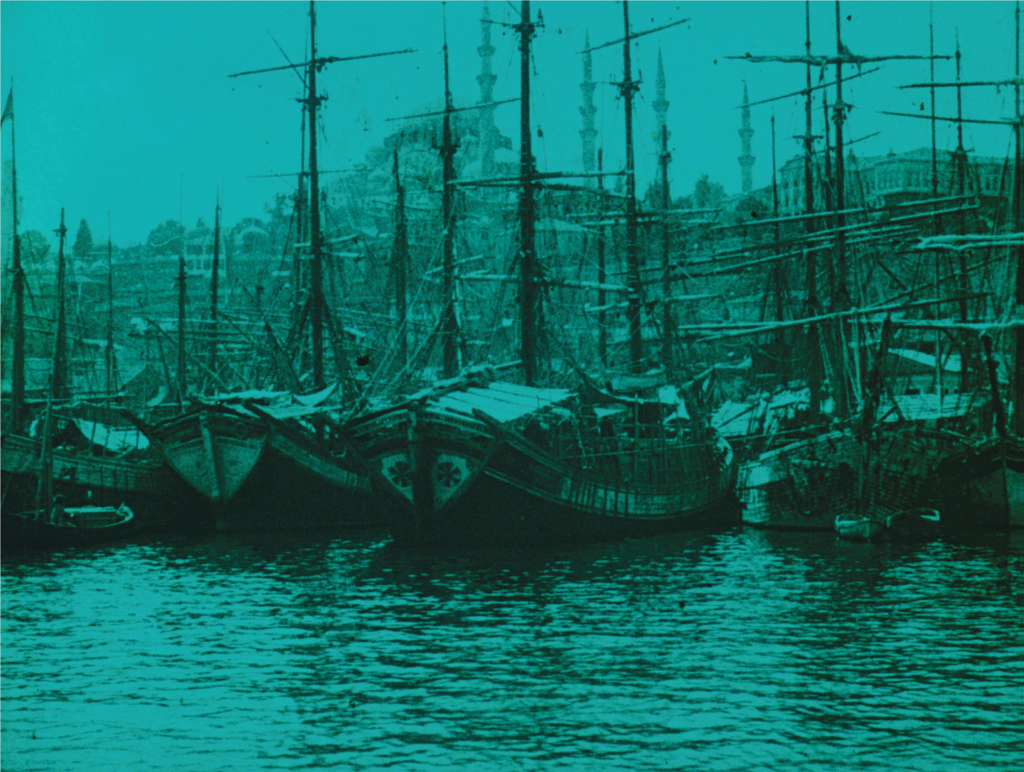
The ten-minute film, believed to have been shot by the French in 1920 and titled Constantinopel, natuuropname van de grootste stad van Zuid-Europa in the copy with Dutch intertitles held at the Netherlands Film Museum, perfectly reflects the gaze of Western travelers, particularly that of the mid-19th century. After an intertitle telling the audience that this great commercial and port city set on the shores of the Bosphorus and the Golden Horn is “very picturesque,” the film opens with a pan of the Golden Horn and the Bosphorus, lasting about two minutes, from a ship anchored at the port of Karaköy. We are now far from Melling’s static, open views; we have weighed anchor, as it were, from the era of romantic depictions that gave the impression of being alone with nature. The harbor is covered with enormous ships, each resembling a gigantic machine. After this pan, the camera leaves the ship and visits the city’s monumental buildings; it wanders through its bazaar, its market and its streets; it mingles with the people, watches them at length, meets their eyes, and is chased away by some for being an “infidel.” Then it returns to its ship, and the second half of the film shows the ship slowly gliding away from the city along the Bosphorus toward the Black Sea. From the slowly advancing ship we see baroque facades along the shore, magnificent buildings, lush green woodlands, distant neighborhoods and historic walls. As the ship makes its way along the Bosphorus, these buildings pass one by one through the frame, flowing past before our eyes. In the last two minutes of the film, the ship’s bow also enters the frame. The French flag almost never leaves the frame, underscoring that the gaze is a foreigner’s gaze and the perspective a foreigner’s perspective. One of the most beautiful fluid frames is found in a seven-minute film dated to 1910-1913, belonging to the Pathé Frères company, which opened the first permanent movie theater in Istanbul in 1908. For in this film, unlike the smooth flow achieved in Constantinopel, natuuropname van de grootste stad van Zuid-Europa thanks to the high vantage point and steady progress of the large ship, the movement of the water is reflected more strongly in the image, because the footage was shot from a small boat that feels the motion of the sea more keenly. The last five minutes or so of this film, some of whose hand-colored frames resemble postcards, consist of a fluid frame moving along the Bosphorus. Tinted blue to convey the feel of the sea air, this sequence shows the famous buildings on the shore one by one. The full movement of the wavy current beneath the boat is reflected directly in the image: the picture sways up and down, left and right. The screen is as fluid as a picture reflected on the water. Meanwhile, the fact that the shore is at eye level makes this swaying all the more palpable. Here we are far from the static views seen in paintings, engravings and pictures, and from the smooth movement with which we gently approach magnificent buildings slowly entering the frame. The magnificent buildings slip in and out of the frame, swaying before our eyes like a reflection, and we draw nearer to and farther from the boats moving along with us. In Turkije, another French-made film believed to have been shot around 1915, we again come across a similar fluid frame tinted blue: first we see the Golden Horn from a fixed point of view. Several boats are moving at different speeds in different directions. This gives the audience a magnificent impression of the principle of movement. The view changes constantly as boats large and small, near and far, drift in and out of the frame. Then, as if we had jumped into one of these boats, we advance along the Golden Horn in a shot moving past the Galata Bridge. Without doubt, this is a shot directly inspired by, or quoted from, Promio’s footage of 1896.
Memory, history and the present
These images, woven with a sense of admiration and curiosity at the beginning of the century, return with a kind of melancholy for a lost past when they are quoted anew in the second half of the century. If modernity denotes a system in which new knowledge acquired through the relative perspective of the subject in motion, newly discovered spaces and newly experienced emotions emerged, then after World War II a style appears in cinema, as in many other arts, that expresses the limits of the subject’s capacity to know, to see and to make sense. According to Gilles Deleuze, situations in which it has become impossible to recognize, remember, know or understand spaces are reflected in cinema as well. Likewise, time is no longer homogeneous; there are temporalities that each person experiences, remembers and constructs differently. [1] With all these changes, a new layer of meaning is added to the fluid frame as well. To put it in the language of film theory, by the 1960s the “fluid frame” acquires the qualities of the time-image in addition to those of the movement-image. That is, ceasing to be a movement-image containing a pure “present,” it approaches the time-image, in which past, present and future are inseparable from one another; in which dream, fantasy, reverie and memory (or a false memory) cannot be distinguished from reality; and in which mental spaces become intertwined with physical spaces and grow ever more complex. “L’Immortelle,” the first feature film Alain Robbe-Grillet shot in Istanbul in 1963, is one of the works that best reflects this transition of the fluid frame into a time-image. Indeed, “Last Year at Marienbad” (L’Année dernière à Marienbad, 1961), the collaboration between novelist and director Robbe-Grillet and Alain Resnais, is one of the main works from which Deleuze distilled his concept of the time-image. “L’Immortelle,” which Robbe-Grillet had been working on long before “Last Year at Marienbad,” is a narrative that moves back and forth between urban space and the image of the city, between personal memory and official history, complicating the perception of both space and time. For example, the Orientalist gaze and Orientalist narratives that largely shaped the image of Istanbul turn into a trap. In the first half of the film, postcard-like pictures of Istanbul, historic waterside mansions seen from the Bosphorus, spacious areas shot with a wide angle, beaches, mosque courtyards and hilltop towers gradually give way to labyrinthine, narrow, winding, crooked streets, passageways and pitch-dark interiors. In an interview, the director states that the protagonist is a Frenchman, and that he deliberately had the protagonist’s associations with this city, which he is only beginning to get to know, shaped by the legends and stereotypes about the Orient that he had previously seen, read or heard of. In this respect, it seems possible to read the film’s Bosphorus sequence, too, in connection with the aesthetic precursors we have discussed so far. In the fluid frame of “L’Immortelle,” the shores of the Bosphorus are again seen from a moving ferry; this time, however, the long take is accompanied by a voiceover: “Fragile buildings at the water’s edge, stucco facades, the beautiful Orient of postcards…” The image flowing across the screen is carried over into discourse. This additional dimension, as we have just explained, plays the most important part in the fluid frame’s becoming a time-image: past, present and future are superimposed; we cannot tell whether what we see is real, a dream, or a memory (or a false memory). At one point the voiceover says, “There, the mosque of your dreams!” Then it adds: “You know, all of this is a product of your imagination.” The mental and emotional experience of the physical space has permeated that space; in other words, space has become an expression of the character’s state of mind. The waters flowing through the Bosphorus, the images flowing across the screen, the memories flowing from the soundtrack and the story being told become one, echoing one another. Here the Bosphorus becomes a symbol of the intertwining of all these temporal layers, of the mutability of all perception, of a reality that can be neither seized nor captured.
[1] See Gilles Deleuze, Cinema II: Time-Image (London: Continuum, 2004).

Translating space into cinema
In light of all this, it becomes apparent that the fluid Bosphorus sequences echo and transform one another both after the invention of cinema and before it, in writers’ descriptions and painters’ pictures. Looking back from today, it must be noted that the narratives and pictures in which we observe a cinematographic style in fact inspired cinema and its language. In this respect, considering them together rather than separating them chronologically and artistically reveals eye-opening connections, commonalities and transitions, both in terms of the transformation of the culture of spectacle and in terms of the transformation of the new subjectivities and new regimes of knowledge brought by modern ways of seeing. Based on the examples we have examined so far, it seems possible to argue that the “fluid frame,” which we have defined as an aesthetic element, takes shape around three themes. First, under the influence of the pleasure of spectacle that Kafadar also points to, the fluid frame has long been used to recount Istanbul’s architecture and history, that is, to move back and forth between past and present and to weave past and present together. Second, it has been constructed to emphasize the power of space in shaping the subject and the changing knowledge of the subject in motion as its perspective shifts, while keeping alive a constant curiosity about the unknown. Finally, at the point where cinema’s power to complicate the perception of time and space and to bring mental processes to the screen comes to the fore, the fluid frame becomes an aesthetic element used to convey, explore, preserve, rewrite and even liberate the present that cannot be captured and the lost time concealed within the present. The flowing, or roving, aesthetic of fluid frames is tested, developed, diversified and brought to maturity in the spatiality and temporality of Istanbul. Lastly, let us note that one of the essential avenues for researching the aesthetic precursors of “fluid frames,” though beyond the scope of this essay, is to reach into the little-known and hard-to-discover corners of film history: for example, how the Bosphorus or the Golden Horn found a place in the Panorama, the Diorama or the moving versions of the Magic Lantern is among the questions that lie beyond the present scope of this essay yet fall within its framework, would enrich its content, and are waiting to be explored. Another question that could broaden the scope of this essay is how the fluid frame has been used, has developed and has changed in other cities with similar geographical features… With all this in mind, it seems possible to define the fluid frame as an aesthetic element through which space is translated into the language of cinema.
Footnotes
Thanks to Elif Rongen-Kaynakçı for her contributions from the archive of the Netherlands Film Museum to this essay and for the exchange of ideas.
This essay was first published in the November 2015 issue of Toplumsal Tarih magazine.