13 October 2020
Jacques Rivette’s first feature, Paris Belongs to Us, was written in 1957 and shot between July and November 1958. Had it been released in a timely fashion, it would have been one of the very first films of the French New Wave, appearing right after Claude Chabrol’s Le beau Serge (1958) and at the same time as Chabrol’s Les cousins and François Truffaut’s The 400 Blows (both 1959), and it might well have helped determine the direction of the movement. Instead, financial problems delayed postproduction work by some six months, and then it took two years to find a distributor. When the film finally premiered on December 13, 1961, the landscape of French cinema looked very different from the time of its making, having been reconfigured by Truffaut’s The 400 Blows and his subsequent Shoot the Piano Player, as well as by Jean-Luc Godard’s Breathless (both 1960). Seen in the light of this new approach, with its jump cuts and vérité-style intrusions, the elaborately choreographed Paris Belongs to Us suddenly looked old-fashioned. Although it did not go entirely unnoticed, its reception was somewhat muted.
Nevertheless, the film contains many of the radical elements that would distinguish Rivette’s later career, and we can see their influence especially in the expansive and intransigent trio of films that marks his peak: L’amour fou (1969), Out 1 (1971), and Céline and Julie Go Boating (1974). These radical elements include a female point of view, a fascination with the rehearsal process of theater, a feeling for the geographic intricacies of Paris, and a sense of shadowy, unnameable conspiracy; and although in Paris Belongs to Us they may not appear especially groundbreaking, they are woven into a framework that combines two venerable structures: the detective story and a young person’s coming-of-age. It would take another decade for Rivette to fully match his style and his content, and to develop, in the cultural climate of the 1970s, the collaborative methods through which this early proponent of the auteur theory would undermine the very idea of the auteur from within. In Bernadette Lafont’s words: “He was a kind of Mao, and his films were a Cultural Revolution.”
Born in Rouen in 1928 into a family of pharmacists, Rivette arrived in Paris in 1949 with a twenty-minute silent film, Aux quatre coins, already under his belt. He became a regular at the Cinémathèque française on avenue de Messine, where he soon met Godard, Truffaut, Chabrol, and Éric Rohmer. Along with them, he began writing for Cahiers du cinéma in 1951 and quickly became one of the magazine’s most incisive and learned critics. Rivette was a cineaste’s cineaste. As one author noted in 1976, of all the original Cahiers critics, he was the only one who could still be seen regularly at Cinémathèque screenings. Despite his deep immersion in the world of film, he was also responsible for broadening the magazine’s scope: he served as its editor in chief from 1963 to 1965 and ran interviews with such noncinematic figures as Roland Barthes, Pierre Boulez, and Claude Lévi-Strauss. He possessed a deep literary culture and tended to use literature in nonliterary ways, drawing on Balzac, Henry James, Lewis Carroll, and others in much the same way that Godard used American crime novels: only the scaffolding of the literary works remained visible. (It is important to note here his longtime collaboration with the exceedingly literate Suzanne Schiffman. Schiffman served as dialogue coach on Paris Belongs to Us, codirector and cowriter on Out 1, cowriter on five other Rivette films, and assistant director on three more. She collaborated in similar ways with Truffaut and remains one of the unsung heroes behind the New Wave.) Rivette was the first of the Cahiers critics to make a film but the last to achieve a personal style. After Aux quatre coins, he shot two more “apprentice” shorts in the early 1950s and then, in 1956, the rather formal twenty-eight-minute Le coup du berger. Le coup du berger was a study of coupling and uncoupling among four people, inspired by chess moves, a divorce trial then in the news, and perhaps a lingering memory of Choderlos de Laclos’s eighteenth-century novel Les liaisons dangereuses.

Paris Belongs to Us is altogether looser, more subjective, and more complex. The camera follows Anne Goupil (Betty Schneider), in her twenties and newly arrived in the capital, who finds herself among a large and troubled cast of characters made up of artists, intellectuals, and political exiles. It all begins when her somewhat older and very knowing brother, Pierre (François Maistre), tells her about a party. When she arrives, all the guests are preoccupied with the suicide of Juan, a promising young Spanish composer and a friend to them all. Reproaches are directed at a couple of other Spanish political exiles for their despair and bitterness over the suicide, and these reproaches are led by Philip Kaufman (Daniel Crohem), a Pulitzer Prize–winning American journalist who has himself been exiled to France as a victim of McCarthy’s blacklists. There is murky business between Philip Kaufman and another American exile, Terry Yordan (Françoise Prévost), who arrives late at the party in the company of the theater director Gérard Lenz (Giani Esposito). Terry had been Juan’s lover, and Philip holds her morally responsible for his suicide. As Anne leaves the party, she asks Pierre why Juan killed himself. “Because he was a jerk,” Pierre replies.
Like Anne, the viewer is left reeling by the crowd at the party and the sheer number of characters. The following day, Anne meets Jean-Marc (Jean-Claude Brialy), an old classmate from the provinces who has come to Paris to pursue a career in the theater. Jean-Marc takes Anne to a barnlike space where Gérard is trying to stage the enigmatic Pericles, perhaps Shakespeare’s least performed play (modern scholars believe he wrote only half of it). A sprawling drama spanning five cities and twenty years is hardly suited to a staging with little financial backing. What’s more, the rehearsals are beset by problems: the actors are constantly leaving to work on or audition for other plays, so Gérard can never manage to gather the whole cast at the same time. When Anne walks into the hall, an actress has just quit the production, and Gérard thrusts the script into Anne’s hands so that she can fill in. He takes Anne into the company on the spot, and the complications multiply. The search for a lost guitar recording turns into a search for the truth behind Juan’s suicide and leads into the labyrinthine depths of a shadowy conspiracy. Revealed through hints and suggestions, this conspiracy may be merely a product of some of the characters’ febrile imaginations, yet on the other hand it seems to be taking on a real, physical presence. Although, at 140 minutes, Paris Belongs to Us comes nowhere near the epic length of Rivette’s later films, it already reflects his wish to plunge the viewer into an immersive, 360-degree experience that is as novelistic as it is cinematic.
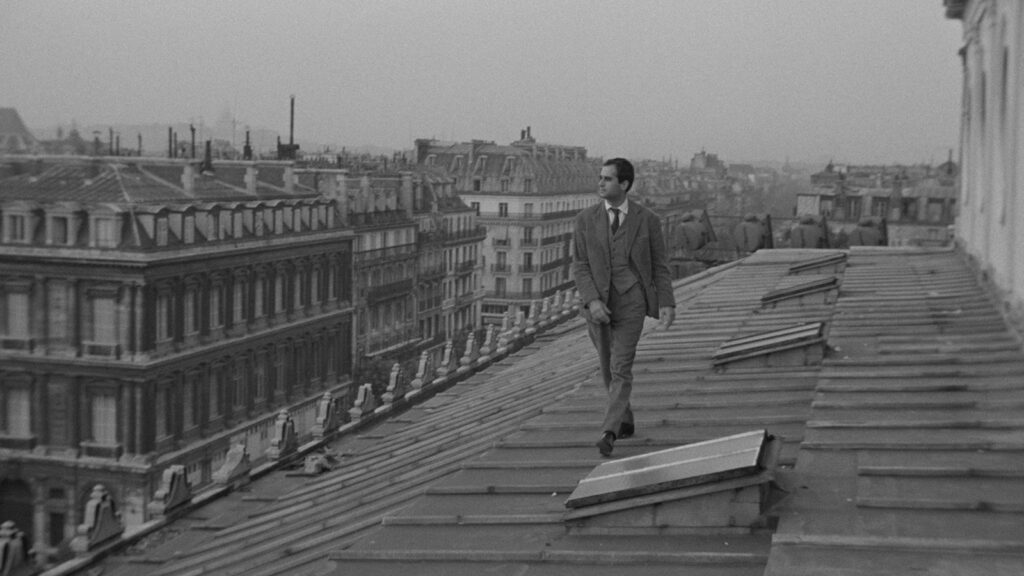
After the opening credits, a line from the poet Charles Péguy appears on screen: “Paris belongs to no one.” In a statement accompanying the film’s release, Rivette said: “A film is, in general, a story built upon an idea. So instead of unveiling the primary intentions at the end of the story, I tried to tell the story of an idea with the aid of the detective story form, because the solution of the conspiracy can do nothing but abolish those intentions: ‘Nothing took place but the place.’ ” The film is full of views of Paris on a tremendous scale, from Auteuil to Ménilmontant to the Latin Quarter: luxury flats, chambres de bonne, grim boarding houses, assorted theaters, café terraces, streets of every size. Even if you don’t know the city, you will come away with a sense of its sharp and soft contrasts, gathered as if in encyclopedic notes – a pileup of city images that seems to illustrate the film’s title while hinting at the city’s ungovernable immensity. In a similar way, the suggestions or intimations of conspiracy (the ineffable links between every person, place, and thing) rest on the film’s irrefutable, resolute materiality. The film is highly specific in its period (1957), in the furnishings of its rooms, its poses and stances, the magazines and newspapers scattered here and there, and the posters on the walls.
In the fraught scenes leading up to the ending, you will notice several times a detail that is by no means randomly placed: a poster for that year’s commemoration of the Paris Commune at Père-Lachaise Cemetery; and you will find one striking climactic exchange of dialogue accompanied, in particular, by an issue of Cahiers du cinéma peering down from a shelf in the background. In a café you will hear an American assessing Nixon’s presidential chances; although this may seem entirely accidental, it fits right in with the casting of Daniel Crohem as a leftist American journalist, since he bears an eerie resemblance to the young Sterling Hayden, who had briefly been a member of the Communist Party but named names before the House Un-American Activities Committee. Note, too, that the character names Philip Kaufman and Terry Yordan together allude to Philip Yordan, a Hollywood screenwriter (Johnny Guitar, The Big Combo) who allowed the blacklisted Ben Maddow to use his name on several scripts. Of course, you can put all of this together and add the Spanish political exiles plotting to return home and organize strikes to undermine the Franco regime, but you still won’t crack the conspiracy’s code. All you will get is the confused and somber mood of the late 1950s, when threats were abundant and paths of resistance few. Evoking the political mood of the period through cultural discourse – overheard talk, literary quotations, details of decor, paranoid mutterings – was exactly the same strategy Rivette would use when he made Out 1, which deals with people’s feelings of betrayal and letdown in the wake of May ’68.
Paris Belongs to Us might have been an unbearably obsessive film were it not for Betty Schneider’s performance as the forthright, determined, and clear-eyed Anne, who, in the classical tradition, asks questions on the audience’s behalf. Anne is naive enough to need things explained to her, but not so naive that she accepts them without objection. (Schneider is so good that one can’t help wondering why she didn’t have a longer career – she appeared in a total of nine films between 1957 and 1962, including Jacques Tati’s Mon oncle and Claude Sautet’s Classe tous risques.)
The film is remarkably sophisticated in its use of space, from cramped apartments to cavernous rehearsal rooms to half-empty boulevards seen through the rear windows of taxis, yet its use of cinematic visual language gives the impression of belonging to a tradition that was already in decline. Rivette would make only one other film that was fully scripted and storyboarded in advance: La religieuse (1966). Afterward, he used open-ended scripts, improvised sequences, and characters developed together with the actors, and at various times he applied methods of guerrilla filmmaking, such as the competing 16 mm and 35 mm crews he used in L’amour fou. Paris Belongs to Us can be seen as a thesis film that brilliantly sums up everything Rivette had learned from Rossellini, Mizoguchi, Hitchcock, Lang, and other masters, and as an understated announcement of the new directions he intended to pursue in the future. However unlucky the circumstances of its release may have been, Paris Belongs to Us ultimately earned Rivette his wings.
Luc Sante
Turkish translation: Murat Müftüoğlu
This article is taken from The Criterion Collection website.