17 October 2022
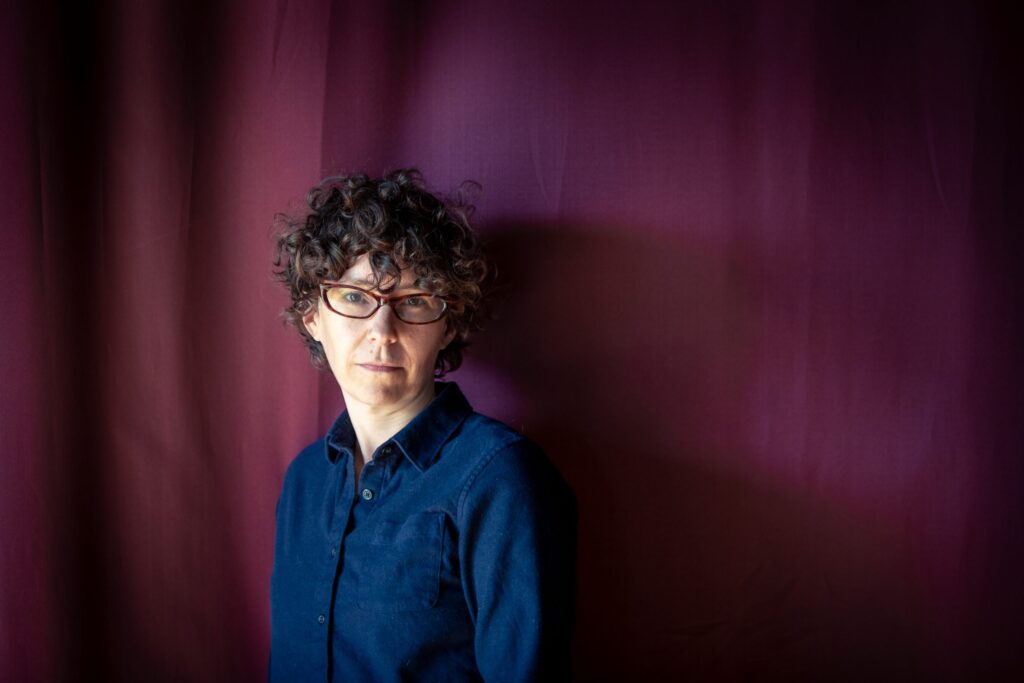
Chilean playwright, director, screenwriter and musician Manuela Infante was born in Santiago in 1980.
She graduated from the Theater School of the University of Chile in 2004. The artist, who earned her master’s degree in Cultural Analysis at the University of Amsterdam, is known for giving complex theoretical subjects a natural form of expression.

Between 2002 and 2016, together with the company Teatro de Chile, she wrote and directed works with the continuous support of the National Fund for Cultural Development and the Arts (FONDARTS).
Four of her plays have been published and translated into English and Italian. Her work has toured the USA, Argentina, Brazil, Peru, Mexico, Germany, Spain, Ireland, Italy, the Netherlands, Switzerland, Singapore, Korea and Japan.

In 2015 she became the first female director of Chile’s National Dramaturgy Festival.
In 2019 she became the first Chilean artist to perform at the Venice Theater Biennale, to which she was invited with two of her plays.

She sees theater not only as “a place where stories are told” but also as a laboratory for embodied philosophy-making.
In her recent work, the artist imagines how a non-anthropocentric theater might be made, developing various stage strategies that question the notion of the human from postcolonial and gender perspectives.
Her play “Estado Vegetal” (Vegetative State), which she wrote and directed in 2019 inspired by the revolutionary ideas of philosopher Michael Marder and neurobiologist Stefano Mancuso, was created by an all-female team. Imagining a scenario in which plants decide to take back their own lives, the play explored the notions of plant intelligence and communication while examining the impossibility of dialogue between humans and plants, proposing a non-anthropocentric theater.
Her latest play, which has toured festivals around the world and will be staged in Türkiye in November as a guest of Kundura Sahne, “How to Turn to Stone?”, takes as its starting point the question of what it would be like if a stone had a play of its own. Bringing to the stage, through a surprising performance and sound and lighting design, how the world might look through the eyes of a stone, and what happens when we try to imitate the stone, which is also “never born, will never grow and will never die,” the play offers audiences a viewing experience that will awaken their minds and hearts.
You can watch the lecture on non-humanist theater that Infante gave in 2019 as part of the Teatro a Mil Festival, with Turkish subtitles.