08 February 2022
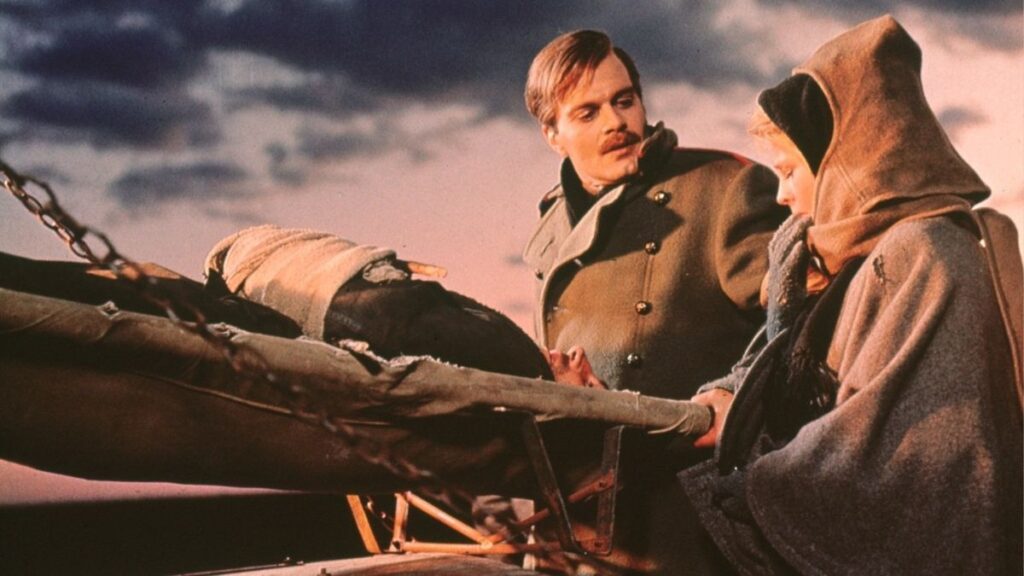
The first and only novel by the great poet of Russian literature Boris Pasternak, Doctor Zhivago, is a masterpiece that influenced world literature with its magnificent 608-page story as much as it profoundly shaped the political atmosphere of its time with a publication history worthy of a spy film. Directed in 1965 by David Lean, the novel’s 3.5-hour epic adaptation, with its haul of Oscar, Golden Globe and Grammy awards, is also a true classic that has not aged a day. For those curious to learn more about the book and the film of Doctor Zhivago, we have put together this roundup.
The banned novel
Pasternak completed Doctor Zhivago, which he had begun in 1945, in nine years. In 1956 he submitted it for publication to the Soviet Writers’ Union’s official literary magazine, Novy Mir, but it was rejected on the grounds that it ‘was not written in line with the official view of the USSR.’ Pasternak, whose poems had been banned since 1936, could not find a publisher brave enough to print it in his own country, so the manuscript of the book was smuggled abroad by an Italian journalist and first published in Italy in 1957. Translated into many languages within a very short time, the book caused a sensation in the West, especially in the United States, and held the top spot on The New York Times bestseller list for 26 weeks.

Boris Pasternak

In the Soviet Union, on the other hand, the novel was banned immediately, without even being read. The Soviet Writers’ Union held a closed hearing and announced on October 28, 1958, that Pasternak had been expelled from the union. What is more, they demanded that the author be stripped of his citizenship and exiled. The Moscow Literary Institute, too, called on all of its students to write a petition condemning Pasternak and his novel and to campaign for his expulsion from the country.
Olga, the muse
The inspiration for the character of Lara is believed to have been Pasternak’s lover, Olga Ivinskaya, whom he met and fell in love with in 1946 and lived with until his death in 1960. A poet and writer who worked as an editor at Novy Mir magazine, Olga Ivinskaya, was Pasternak’s greatest supporter and, sadly, the first threat wielded against him in the political crackdown. In 1950 Olga was accused of ‘complicity in espionage’ and sent to a labor camp; she was released in 1953 after Stalin’s death. The government did not leave her alone even after Pasternak’s death: on the grounds that they had arranged contacts with Western publishers for the book, she was arrested together with her daughter Irina and sent to a camp. Irina was released in 1962, and Olga only in 1964.


Forced to decline the Nobel
Nominated for the Nobel Prize in Literature for his poetry every year between 1946 and 1950, Pasternak won the prize in 1958 for Doctor Zhivago. He answered the telegram sent by the Nobel committee on October 23, 1958, with the words “Infinitely grateful, touched, proud, astonished.” However, the government, which saw the book as anti-Soviet and interpreted the prize as a hostile gesture, had launched a campaign branding Pasternak a traitor and an agent, leaving the author, and Olga along with him, exposed to endless threats of imprisonment, exile and death. Articles condemning Pasternak appeared in Soviet newspapers; alongside many pieces describing the book as “artistically wretched, a malicious work full of hatred of socialism,” he was attacked in an editorial in Pravda, the official organ of the Central Committee of the Communist Party, with the words “a malicious Philistine,” “slanderer” and “an alien stain on our Socialist country.” And so, on October 29, Pasternak was forced to send a second telegram saying that he was declining the prize, adding, “Please do not take my voluntary refusal as an insult.” Yet the pressure did not let up, and on November 1 Pasternak was forced to apologize for the prize in a public statement. The prize awarded to the author was accepted only years later, in 1989, by his son Evgeny Pasternak, who traveled to Stockholm.
The book was freed in ’87, the film in ’94
Although the poet’s rights as a writer were restored a year after his death, the book remained banned in Russia until 1987, and the film could reach audiences there only in 1994.

Bol wrote, Lean directed
The film was directed by the master British filmmaker known for unforgettable literary adaptations such as Great Expectations (1946), Oliver Twist (1948), as well as for the Oscar-winning The Bridge on the River Kwai (1957) and Lawrence of Arabia (1962): David Lean. The novel was adapted for the screen by the British screenwriter who also wrote Lawrence of Arabia, A Man for All Seasons (1966), The Mission (1986): Robert Bol. Bolt was named screenwriter of the year at the Oscars, the Golden Globes and the BAFTAs.
Among the biggest box-office hits of all time
Released in theaters on December 22, 1965, the film sold an estimated 124.1 million tickets in the United States and Canada and became the second highest-grossing film of that year. To this day it still holds the distinction of being the ninth highest-grossing film of all time.
Kubrick’s dream, too
Lean was not the only one who wanted to bring the novel to the screen; in fact, it was one of Stanley Kubrick’s dream projects, as was revealed years later. In notes in his personal notebook from the 1950s, Kubrick wrote, “That precise moment of absolute success for a director is when he is allowed to film this great literary classic of more than 600 pages,” and he also wrote a letter to Pasternak. In the letter, dated January 8, 1959, he said: “Our last film, ‘Paths of Glory,’ received the award for best film of the year in Brazil, Finland and Belgium. And now we would like to buy the film rights to Doctor Zhivago. We have contacted the law firm in New York that represents the book’s Italian publishers. Negotiations are at a standstill, as they are not yet ready to conclude an agreement.” Had the film come to life, the role of Zhivago would have been played by Kirk Douglas, with whom Kubrick had also worked on Paths of Glory.

A dream cast comes together
The film made a huge impression with the iconic performances of Omar Sharif and Julie Christie, as well as with its dream cast bringing together Geraldine Chaplin, Rod Steiger, Ralph Richardson, Tom Courtenay, Alec Guinness, Klaus Kinski.
For the role of Zhivago, which lifted his career several rungs at once, Omar Sharif was not the first name considered. Lawrence of Arabia star Peter O’Toole was Lean’s first choice, but when he turned the role down, it was offered in turn to Max von Sydow, Paul Newman, Rod Taylor and Michael Caine, and in the end it went to a fellow Lawrence of Arabia cast member, Omar Sharif.
The same was true of Julie Christie. The first name that came to Lean’s mind for the role of Lara was Audrey Hepburn. The role was then offered to Jeanne Moreau, Yvette Mimieux, Sarah Miles and Jane Fonda. Finally, John Ford, who had worked with her on Young Cassidy (1965), suggested Julie Christie, and the right Lara was found.


The young Yuri Zhivago standing at his mother’s grave at the beginning of the film was played by Omar Sharif’s real-life son, Tarek Sharif himself.
Shot in 5 different countries
For the film, which took more than 10 months to shoot, a set was built from scratch outside Madrid, Spain. Although Spain was Lean’s first choice because of his experience there on Lawrence of Arabia, the country had its warmest winter in 50 years, and when conditions proved inadequate for telling a story set under snow, some scenes were completed in countries such as Spain, Canada, Portugal and Finland.
At the time the film was shot, Spain was ruled by Franco’s fascist regime. During one of the scenes shot before dawn, local residents who heard the crowd singing a revolutionary anthem in unison thought that Franco had been overthrown; unrest broke out, and the set was put under a security blockade for a whole day.

5 Oscars, 5 Golden Globes
The film, which competed for the Palme d’Or at Cannes, was nominated for Oscars in a total of 10 categories, including Best Picture and Best Director, and took home the statuettes for Adapted Screenplay, Cinematography, Art Direction, Costume Design and Music. At the Golden Globe Awards, the film also swept Best Picture, Best Director, Best Actor, Best Screenplay and Best Original Score.
The moment Maurice Jarre received the Oscar for Best Music, presented by James Coburn and Virna Lisi
Grammy-winning music
The film’s music, which won the Oscar, the Golden Globe and the Grammy, is the work of the renowned French composer Maurice Jarre, whom we lost in 2009 at the age of 84. Nominated for the Oscar nine times for works including A Passage to India (1984), Gorillas in the Mist: The Story of Dian Fossey (1988), Ghost (1990), the composer had won the award, besides Dr. Zhivago, for another David Lean film, Lawrence of Arabia (1962). The film’s soundtrack, now considered a classic, was nominated for Grammy Awards in 1967 in the Album of the Year, Song of the Year and Best Instrumental Performance categories, and took home the Grammy for Best Original Score Written for a Motion Picture or Television Show.
The moment Freddie Young received the Oscar for Best Cinematography, presented by Kim Novak and Richard Johnson
A change behind the camera
As for the film’s cinematography, which also won an Oscar, the name initially attached was Nicolas Roeg, and he even worked with Lean on some scenes… But after a disagreement between them, he left and was replaced by the British cinematographer Freddie Young. Young, who had won the same award three years earlier for Lawrence of Arabia, would win his third Oscar in 1971 for another David Lean film, Ryan’s Daughter (1970).

Among the greatest of all time
Ranked 39th on the American Film Institute’s list of the 100 Greatest Films, compiled for the centennial of cinema, Doctor Zhivago was named the 27th greatest film of all time by the British Film Institute.
Doctor Zhivago can be read in Turkish in Hülya Arslan’s translation, published by Yapı Kredi Yayınları, and you can watch the film on Sunday, February 13, at Kundura Sinema.