26 February 2021
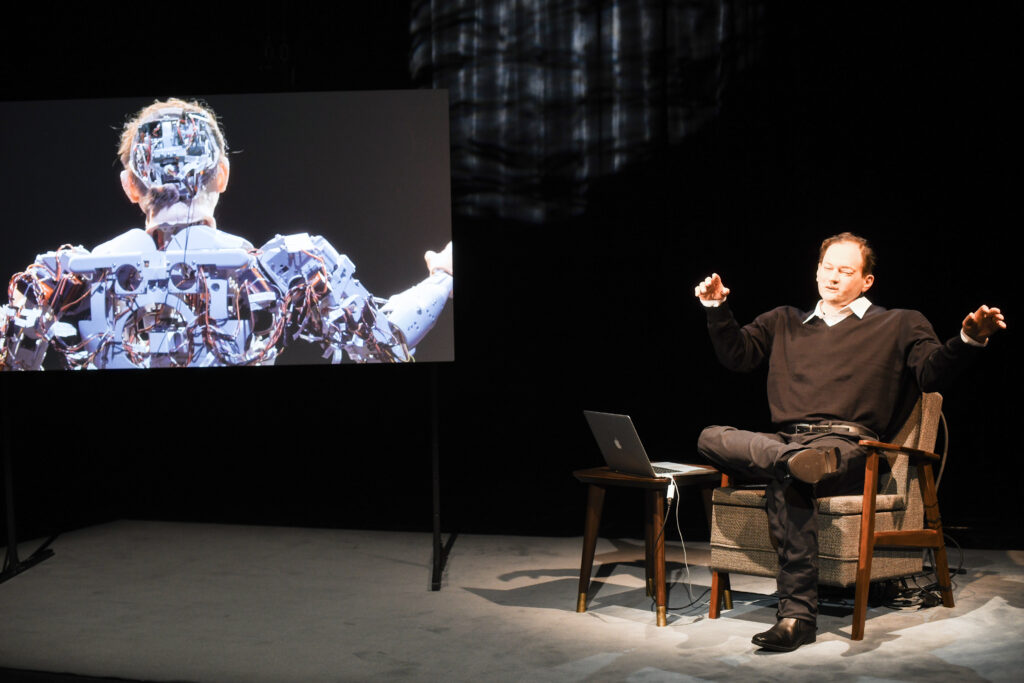
The guest of Kundura Sahne’s online program is Stefan Kaegi, one of the founders of Rimini Protokoll, among the most important art collectives in European theater. The guests of his project, which he titled “Uncanny Valley,” are the German writer Thomas Melle—or rather, a copied, manufactured android of Melle—and the British mathematician and computer scientist Alan Turing…
“All normal life, consciously or otherwise, resents domination. If the domination is by an inferior, or by a supposed inferior, the resentment becomes stronger. Physically, and, to an extent, mentally, a robot—any robot—is superior to human beings… If a robot can be created capable of being a civil executive, I think he’d make the best one possible. By the Laws of Robotics, he’d be incapable of harming humans, incapable of tyranny, of corruption, of stupidity, of prejudice.” This is how Isaac Asimov, the American writer and biochemist who served as a professor of biochemistry at Boston University, sums up the situation in his book “I, Robot” (first published in 1950, adapted for the big screen in 2004, and published in Turkish by İthaki Yayınları).
From the Anthropocene to transhumanism… I am one of those who think we are stuck in this skin and body, in mortality with 206 bones. For instance, René Descartes, who said that ‘the soul is immortal,’ speaks in his book “Discourse on the Method” (published in Turkish by Bilge Kültür Sanat) of a robot monkey that looks exactly like a monkey. Just as, in its time, there was Mary Shelley’s “Frankenstein; or, The Modern Prometheus” (published in Turkish by Can Yayınları), written when she was 18—the so-called modern Prometheus, a manifestation of the robot image in humanity’s imagination… For now, the digital revolution is part of our lives in versions such as surgical robots, secretary robots, factory robots and cleaning robots. Perhaps in a very short time, teacher robots, soldier robots, sex robots or lawyer robots will be among those taking their place in everyday life. Who knows!
As you know, when we visit many websites, what is asked of us in the name of security verification is proof that “I am not a robot.” I am talking about Captcha (Completely Automated Public Turing test to tell Computers and Humans Apart), invented in 2003. In the end, we have to prove that we are not robots in order to continue with what we are doing. And if the system is not satisfied, it even loads new questions onto the page. What I mean is that while we kept grappling with those questions, at the same time, in some corner of the world, new levels were springing up in a trek across topics.
For instance, while Elon Musk was signing a deal with NASA for some project worth who knows how many trillions of dollars, let us—far from even attempting to think about issues such as ecological destruction, the extinction of species, pandemics, the climate crisis, androids and cyborgs—just keep talking to Apple’s Siri and then arguing and bickering with that voice! Really, how many people are there who don’t bicker with that voice? With a nod to those who say that, in the shadow of all this, we are living in a simulation, allow me to come to the point, to the subject of today…
Recently a news item titled “There’s an android at Kundura Sahne!” landed in my inbox. I eagerly read the newsletter and clicked the link to the performance they recommended I watch. Afterwards, with that same enthusiasm and appetite, I wanted to share it with you. Our topic: “Uncanny Valley,” the android (humanoid robot) performance that takes the use of artificial intelligence in theater to a new threshold, shown as part of the online program of Kundura Sahne, Beykoz Kundura’s dance and performance stage. The creators of the performance: Rimini Protokoll…
Produced by Rimini Protokoll, which was founded in the early 2000s under the leadership of Stefan Kaegi, Helgard Haug and Daniel Wetzel, and created with concept, text and direction by Stefan Kaegi, the play takes as its starting point the concept of the ‘Uncanny Valley,’ first used in the 1970s by the Japanese roboticist Masahiro Mori to describe the uncanny zone of existential uncertainty people experience when they encounter androids. Incidentally, in developing this idea, Mori drew on psychiatrist Ernst Jentsch’s “On the Psychology of the Uncanny,” published in 1906, and neurologist Sigmund Freud’s essay “The Uncanny,” elaborated in 1919.
In “Uncanny Valley,” in which we watch alone on stage an android copied and manufactured with reference to Thomas Melle, an extraordinary author of German literature, the writer’s literary journey and his manic-depressive experiences are recounted. Another subject on stage is also the most fundamental reference of “Uncanny Valley”:
Alan Turing, who worked for the British military, was honored with awards for his inventions that broke the Germans’ communication codes during World War II, is regarded as the founder of computer language, and whose death is shrouded in mystery. Questioning the perception and structural integrity of reality, and enthusiastically received by the theater world when it was first staged in 2018, the play offers a viewing experience as unsettling as it is intriguing, in the ‘uncanny zone’ where the questions ‘what is a human?’ and ‘what is a machine?’ become entangled.
In short: If you’d like to treat yourself to 60 minutes of something lovely these days and slip away, even a little, from the parallel universe you find yourself in, you can visit www.beykozkundura.com. You have until February 28 to take a free peek at this performance. But before you discover this ‘uncanny valley,’ come take a look at our interview with Stefan Kaegi, the creator of the performance, who through a wide range of collaborations creates documentary theater plays, audio projects, special formats and works that exist in urban settings; who, following research and conceptual processes, prefers to work with ‘experts’ who have a story to tell but are not professional actors; and who has met Istanbul’s art lovers before!
“You will feel this phantom pain”
Donna Haraway, the American academic and author of “A Cyborg Manifesto,” who says, “By the late twentieth century, our time, a mythic time, we are all chimeras, theorized and fabricated hybrids of machine and organism; in short, we are cyborgs,” continues as follows in the chapter “From Cyborgs to Companion Species” of her book “Başka Yer” (Elsewhere): “This is as much a story of biopower and biosociality as of technoscience. / Cyborgs… can be figures for living within contradictions.” Cyborg, uncanny valley, android, actroid or transhuman—what do all these names/definitions correspond to and mean in your perception?
It is interesting that you quote Haraway. As you know, she is also very curious about animal intelligence—and right now I am working with a very intelligent octopus as the protagonist of my show. And when we look at it, it seems so alien to us that people like Vilém Flusser (philosopher, writer and journalist) say they come from outside this world. Cyborgs, on the other hand, are a concept we are very familiar with. We are so closely connected to—even dependent on—technology that it hurts when we lose our technological devices. If you lock your cell phone away somewhere for a whole day, you will feel this phantom pain.
Turning to “Uncanny Valley,” could you tell us about its theme and creative process? What was your source of inspiration? How did Stefan Kaegi, Thomas Melle and Alan Turing come together?
I had been fascinated by some humanoid robots I saw in museums, but I felt the power of encountering them when I encountered them in theater, where the encounter can be much more powerful because the robot appears before you as a performer. At some point I came across Thomas’s book “The World at My Back.” In the book, Melle shares a chronicle of his psychological illness. I thought, I guessed, that he would be interested in swapping places with a robot in order to avoid the inconsistencies caused by his bipolar disorder.
Thomas was inspired by the robot idea almost immediately… And, much to my delight, he offered to add the part about Alan Turing. The inside of the robot was created by Chris-Creatures, a small animatronics workshop in Berlin. They made the entire exoskeleton. While the silicone skin and hands were being produced at the mask workshop of the Kammerspiele München in Germany, they also installed 32 servo motors. Actually, making the robot walk would have been a completely different story. Luckily, for the purposes of a lecture performance in a theater venue, we did not need that feature.
“Forgetting less and living longer”
“Uncanny valley” is a concept that has been used frequently in recent years. Of course, arts and culture have their share of it too; we come across it in cinema, exhibitions, literature and music. Watching every day how this concept, used by roboticist Masahiro Mori in the 1970s, has seeped into the present is in some ways both fun and mysterious. At the point we have reached today, it is obvious that technology is changing and transforming our world. How do you see this change and transformation? For instance, what will it be like to make art in an “uncanny valley”?
With each passing day, robots serve us more and more. Someone may even have written an algorithm that answers interviews like this, in which case it would be hard for you to prove that I am not the one answering your questions. That said, I was curious whether people could empathize with an object. It is a classic theater question applied to the simulation of an actor. We are probably all trying to make ourselves more efficient, less fragile. We want to forget less and live longer. And we all rely on technology and medication to go further down this road. Where is the limit right now?
What are your thoughts on the questions in the play’s description: When the copy replaces the original, what does that mean for the original? Do the copy and the original compete with each other, or do they help each other?
I prefer not to answer the questions raised by the play; I hope the play inspires each audience member to answer these questions. That said, I can say that the process of creating this human copy helps all of us look at human beings more closely and precisely. I think something similar happens to painters when they try to paint the human body. They begin to look at the original very closely and precisely. For me, this play is about empathy, because when we project ourselves onto the robot, we cannot help but empathize with this machine. And one of the many human “programs” that make me doubt where the boundary between a robot and a human lies is precisely this empathy mechanism within us. How free is our free will, really?

“A good moment to question growth”
Machines have begun to replace humans in many fields. There are questions such as, “Could artificial intelligences and machines replace humans in theater as well? If so, how might they guide the audience?” Do you think we would need to give theater made by artificial intelligence a name other than theater?
From a certain angle, theater is the first thing that comes to my mind when I think of artificial intelligence. Because what is artificial intelligence? It is the effort to predict what people will feel and what they will need. And to prepare direct responses to these. In theater, if you have a sad scene, you put on a certain kind of music. You predict what feelings will be stirred in people. So there is a strong connection between the two… There is only one option for how a scene will end. You feel sad and that music plays. People go through this mood, reach catharsis, and in the end they applaud. In interactive forms, you try to open up different branches. As in computer game design after GTA (the video game series).
There were cases where “open world” games let you go in any direction you wanted. The game offers you every kind of option for how you might behave. So I think there are very broad possibilities in this realm. But I’m not saying we should replace this kind of classical artificial intelligence—that is, classical theater direction—everywhere with programmed, computerized artificial intelligence. It might be interesting to try it once or twice and reflect on what we have been missing. But then let’s go back to the venues and make completely live work.
In fact, in my latest play there was an animal, which I mentioned a moment ago. An octopus. And there were a few people around it. The play included improvisation at times. So it has nothing to do with surrendering to technology. But I think theater has always blended live art with technology. It has been this way since the ‘deus ex machina’ of Roman and ancient Greek times. Indeed, Aristotle wrote about this. Many of the illusions used in Baroque theater were in fact extremely technical things too. And this is normal, because our lives are also seriously affected by technology.
There is the philosopher Jacques Derrida, who says in “Of Grammatology,” “This world is the manuscript of another world, closed to universal reading, whose cipher only existence can decode,” and the novelist and critic Raymond Williams, who says in “Modern Tragedy,” “Man is not ‘by nature’ anything: he is the being who both creates and transcends his limits.” In light of the words of these two masters, how do you think the pandemic we are going through on a global scale will transform the performing arts and the way people live in the future? Or, in the 4.5-billion-year history of the Earth, will the 350,000-year story of the human child simply carry on as before?
Human beings are definitely a worn-out animal species. Somehow they have lost their user manuals, their instincts. Having started to outsource everything they used to do themselves—either to machines or to countries where labor is cheap enough for your money—they no longer know what else to do. I think it is a good moment to look at this nature, since it will continue for a while. The pandemic is definitely a good time to ask ourselves how much longer we want to live and reproduce ourselves. It is a good moment to question growth, in terms of both economic growth and population growth, the lengthening of our average lifespan, and so on.
Are there any new projects and plays on the table? It would be nice to share the news here.
My octopus piece is finished and is waiting for its audience. In fact, its recording will be released online this week as an online version by Théâtre Vidy-Lausanne. During the restrictions, I created an audio tour for abandoned theaters: Black Box, Phantomtheatre for 1 person. (Black Box, Phantom Theater for 1 person).
With my colleagues at Rimini Protokoll, Helgard Haug and Daniel Wetzel, we created a live Zoom performance version of our “call center” play “Call Cutta.” It is a performance that takes place only on Zoom, and we will open this project next week. And we are working on a large immersive exhibition for the CCCB museum (Center of Contemporary Culture of Barcelona) in Barcelona… And as for Türkiye, I hope our audio tour “Remote İstanbul” will start again at Kundura Sahne (this summer).
Betül Memiş / Cnnturk.com