14 January 2021
Situation Rooms © Ruhrtriennale / Jörg Baumann
‘Almost Like a Lehrstück’: Florian Malzacher’s conversation with Daniel Wetzel of Rimini Protokoll appears in the book “Intermedial Performance and Politics in the Public Sphere,” edited by Katia Arfara, Aneta Mancewicz and Ralf Remshardt and published by Palgrave Macmillan in London in 2018.
Florian Malzacher is a writer, dramaturg and independent curator of the performing arts. He also serves as curatorial advisor to the Ruhrtriennale for 2018-20.
CHAPTER 13
‘Almost Like a Lehrstück’: Florian Malzacher in Conversation with Daniel Wetzel/Rimini Protokoll
Florian Malzacher
For many years, the theater collective Rimini Protokoll (Helgard Haug, Stefan Kaegi, Daniel Wetzel) has been known for bringing ‘real people’ onto the stage and for creating its own distinctive, highly influential form of documentary theater. In recent years, another strand of their work has come to the fore, which can be summed up as the creation of complex, semi-virtual spaces as well as the use of existing urban spaces as the material and protagonist of the piece. While they mostly address political subjects, there are also questions as to whether their work could engage more directly with the concrete social problems of our time. Florian Malzacher, who worked as a dramaturg on Rimini Protokoll’s first piece, is a curator of performing arts and a writer who in recent years has focused on the relationship between art and politics. Discussing a number of recent examples of Rimini Protokoll’s work, and also referring to various works by other artists, Daniel Wetzel highlights the similarities and differences between art and politics in Rimini Protokoll’s practice. A central question we explored throughout the conversation was whether theater can go beyond being merely a space of representation and critique and become an agonistic space in which new and different forms of political process can be tried out.
This text is based on a live conversation held in Berlin on February 19, 2015, which was later revised and updated via email1.
LEVELS OF PARTICIPATION
In recent years, as the number of economic, political and social crises around the world has grown, there has been a renewed focus on the relationship of art and artists to politics, along with a desire to define what political theater today might look like and what role artists might play in society. Your performance installation Situation Rooms (2013) focuses on the role of weapons in the world2. Considering Rimini Protokoll’s earlier works, this seems an unusually concrete social subject.
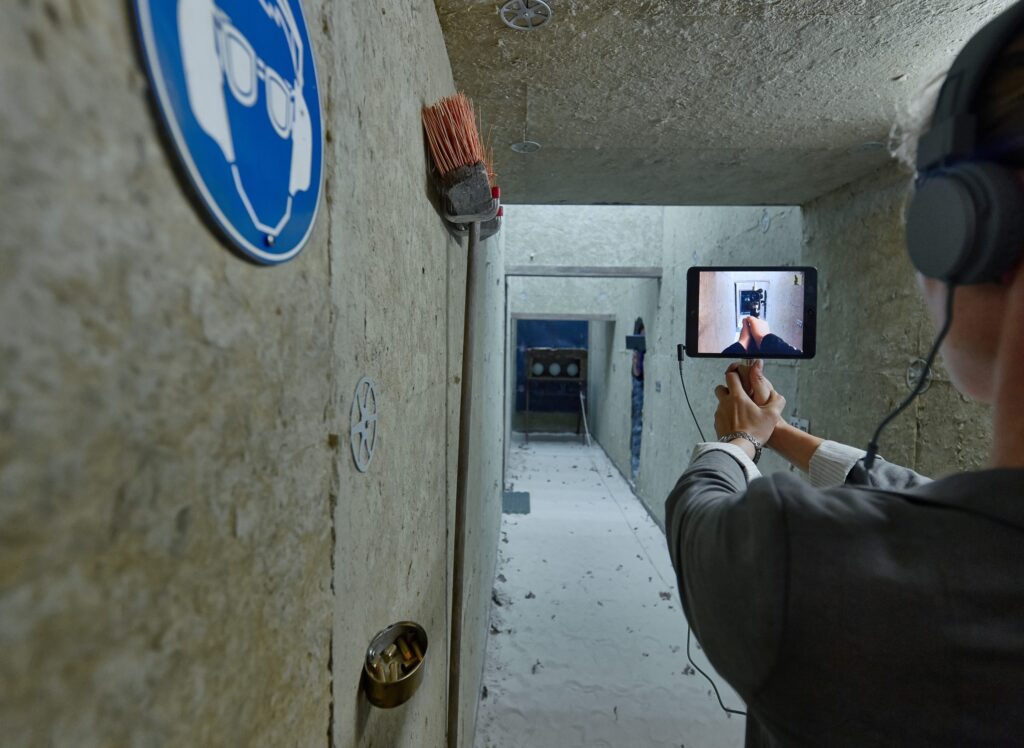
The path to Situation Rooms was initially determined by form rather than content. We wanted to develop a particular model of theater; the subject of the piece came later. Our starting point was projects such as the various audio tours we had done in previous years, followed by a video tour called Outdoors (2011)3 in Aberystwyth (Wales), in which you take a tour of the town guided by films on an iPad. The video you watched had been shot exactly where you were walking; that was the principle. The person filming, talking to you and guiding you was the protagonist of the story, and since thirteen episodes were shot simultaneously in a single take, they also encountered one another. The starting point for Situation Rooms was to bring this principle back into the theater. That is why, for Situation Rooms, we designed a highly realistic set made up of seventeen spaces, in which each door takes you to a different country, sometimes to a different continent, and always to a change of ‘situation.’
Situation Rooms has seventeen spaces representing different places in various corners of the world. In addition, you encounter twenty-four different virtual performers, who in turn represent larger groups (arms dealers, soldiers, victims, doctors, etc.) that at times openly oppose one another. As is often the case in your work, the question arises of whether one should present ethically questionable situations without comment, without stating one’s own position. In your live theater work, I suppose there is a rather pragmatic reason for this, since you cannot have people represented on stage in a way they would not accept themselves. But in Situation Rooms the protagonists appear on film, so you could in fact easily comment on them. Yet you still present their situations side by side, without commentary.
Rather than without commentary, I present them after thinking them through, developing, scripting, rehearsing and editing them very carefully, and arranging the music used. It would be without commentary if I simply invited someone to say whatever was on their mind and then used the result as a whole, unchanged. In fact, that is also a possibility in our theater. In 100 Per Cent City, for example, it is essential that we capture as wide and as spontaneous a range of views as possible in a given city4. In Situation Rooms, on the other hand, the aim is difference and distance. Unlike in conventional theater, nobody says to your face or to the audience, ‘I did this and that’ or ‘I sell tanks.’ Instead, you are drawn into the performer’s perspective; they speak their words directly into your ear, and in a sense you ‘see the subject through their eyes.’ What matters here is creating a focus and characterizing the individual situations as sharply as possible. You have to be aware of the limits of what a visitor drawn into the situation can bear. Because it is such a direct form of narration, presenting very concrete images you can connect with emotionally, it allows you to switch between perspectives on almost the most disparate situations. Of course, we made the greatest effort here to talk to people from the arms industry, but almost all of them immediately rebuffed our efforts. They had no interest whatsoever in a dialogue.
Still, I suppose it was ultimately easier to show what you wanted to do with the participants than it was, say, in Wallenstein (2005). In that performance, a conservative mayoral candidate from the city of Mannheim, who had lost the election and his reputation, was on stage talking about the end of his political career and about the people he felt had betrayed him. You probably had to do a great deal of negotiating and, in the end, cut a lot of material you would have liked to show5.
On the contrary, we actually had to rein the politician in. And in both cases, questions of cutting, reducing and focusing were very important. The difference was that the films in Situation Rooms became documents in their own right. Situation Rooms is not a piece you can direct; it is like the kind of mechanical clock with twenty figures you might see in a medieval town hall, except that instead of watching these figures in a clock tower, you need twenty performers when you press ‘start.’ This is because the whole audience moves in parallel with the performers’ individual camera movements, as on a film shoot. There are two levels of participation here: the first is the collaboration with the experts who are not present, and the second is the collaboration with the other spectators you encounter in their roles in the other episodes (Figure 13.1).
You create a space that could almost be called a kind of hyper-Stanislavskianism, one that contains as little ‘outside’ as possible. Above all, through a hyperrealistic set designed by Dominic Huber, in which even the temperature changes and sudden gusts of wind blow, you draw the spectators as deeply into the situation as possible. The theatrical aim is for the individual to be completely ‘inside’ an analog virtual world in which any Brechtian alienation effect is avoided. I sometimes think that immersion in theater, apart from its political potential, simply means participating.

Situation Rooms © Ruhrtriennale / Jörg Baumann
Figure 13.1 Situation Rooms. Rimini Protokoll. Photo: Pigi Psimenou
Isn’t more distance needed, in the sense of critical distance from the realities you present? Why, on this subject in particular, do you place your trust in authenticity, concrete reality and empathy – right down to ambient temperatures designed to help you immerse yourself in the work?
First, watching yourself try to maintain or regain distance in this situation is an internal process. Second, the fictional side of the production is always present. In a way, you feel the heat of Africa and the wind on a Middle Eastern terrace where wet laundry flaps in the breeze. But in one episode the African room represents an improvised radio station in present-day South Sudan, and in another the room is a classroom in Zaire twenty years ago. This makes up part of that distance, in the sense of the actuality of the moment when the footage was shot. The illusion is constantly broken because you see the other participants and are holding an iPad in your hand. This is less illusionistic than the games with virtual reality headsets that have started to go on commercial sale. For me, what is ‘authentic’ actually lies somewhere in between. Amid all these realistic signs, the reason for what is said is obvious, and these are not easily identifiable reality effects. Reality is the unresolved in-between space among the situations that I inhabit or occupy in turn. You can enjoy the illusion and at the same time be constantly aware that it is all a game.
To return to the question of representation, which is always on the agenda in theater: for me, representation in Situation Rooms works quite well as long as I am familiar with the spaces shown, such as a corporate boardroom in the West. In that case, I can place the representation in a context based on my own experience. When you take me into non-Western contexts, things become more complicated. Can I really understand them? Am I expected to immerse myself in them? Or doesn’t the situation almost turn into a parody?
You are placed inside an image that is meant to be accurate to a certain degree, yet it is not accurate, because it shows its limitations, its shortcomings. And this point where the signs intersect is exactly where theater begins. Of course, all of this feels like being on a film set. It is also where comedy emerges at the edge of the notion of representation. In this concrete example in Syria, you stick a bandage on another participant’s hand, and this sign shows that the person is injured to a degree that means they can wait another day for treatment. What you see in the video is that the patient has a gunshot wound in the leg, but you are actually ‘treating’ a spectator ‘in Syria,’ while in ‘your own’ story you are in Sierra Leone, where it is obvious that all the wounds were inflicted with more primitive weapons such as machetes, kitchen knives and the like. In Situation Rooms, the point is overlaps and divergences as much as the act and tactic of ‘immersion, involvement.’ It is not about parody but about irony. Sarcasm would be the next step. But that expression assumes that everything has already been said. The irony in juxtaposing situations, by contrast, allows the dialogue to continue.
At the height of the so-called refugee crisis, the municipal theater in Bochum packed a group of people into the back of a truck to show what refugees feel when they are crammed into a transport vehicle. I know that this way I might indeed better understand the feeling of being trapped in a confined space, but I don’t think I would better understand the full extent of the fear and, more importantly, the systemic causes that lead to it. Here, the anecdotal explanation would in fact prevail over the systemic one. As a participant, you concentrate on the situation and ignore the context that created it. This creates the danger of the subject being completely trivialized.
Absolutely. But it still depends on the concrete experience and how it is framed. Today there is a clear focus on different strategies of representation, but as with all kinds of theater and experiment, there are also those that miss the mark. For the summer of 2015, I proposed a concept involving a night-time boat crossing between Türkiye and the Greek island of Lesbos. It included tourists, border guards from both sides, survivors and others. It didn’t happen. But formally, it would clearly have been very different from crossing over in an inflatable boat with a sputtering engine.
An inflatable boat with a sputtering engine would at least have been consistent. But even then, the boat shouldn’t just be floating in a theater pool. Nor should I be aware that the director could rescue me if the engine stopped. So the question remains: am I having a real experience, or am I imagining that I am having one? There is also a certain amount of arrogance involved here. In the end, I may even have understood less than before. And the misunderstanding only grows.
In a theater pool, you have a theater experience. Reflecting that is essential. If the point of approach were not made clear in this way, it would be arrogant. And for me, this is a clearly different approach compared with the undecidability between ‘real’ and ‘fake’ in many productions of the early 2000s, as in the case of Sonde Hannover (6). But the point is not to create reality effects. On the contrary, the point is to listen, to think, without giving up your distance from what you hear. It is an act of letting go, a different kind of play theater in which the protagonist, the performer, hands things over to the audience. Different possibilities can emerge from this. In our performance World Climate Change Conference, 670 spectators become members of the delegations of 196 nations7. When you enter, you are given a small booklet that you hang around your neck and that also serves as your country badge. That way, everyone can see that today you are speaking for Turkmenistan. Then everyone takes a seat in the conference hall, and ‘we’ as delegates are briefed on what decisions ‘we’ as the global community took in Rio, what we have done since then, and where we stand now, ahead of the Lima summit and then the Paris summit. After that, in our model, each delegation has to take action by doing research as well as negotiating with the others. At the end of the performance, we show whether we are below the 2-degree or the 3-degree limit [of temperature change], and the result is usually not far from reality. This is because you identify with the countries you are assigned to. Here, representation becomes playful, combined with the desire to understand better. Someone once said that the piece gave them the chance not to have to be Germany, but to be Mexico for three hours instead.