21 December 2020
The Theater of Rimini Protokoll
Translated into English by Daniel Belasco Rogers, Ehren Fordyce, Geoffrey Garrison, Mat Hand, Sophia New and Walter Suttcliffe. Translated into Turkish by Nahit Evre Uçarcı. This article has been translated and published on the Beykoz Kundura Culture Blog with the permission of Florian Malzacher.
Florian Malzacher is a writer, dramaturg and independent curator of the performing arts. He also served as curatorial advisor to the Ruhrtriennale in 2018–20.
Alexander Verlag Berlin

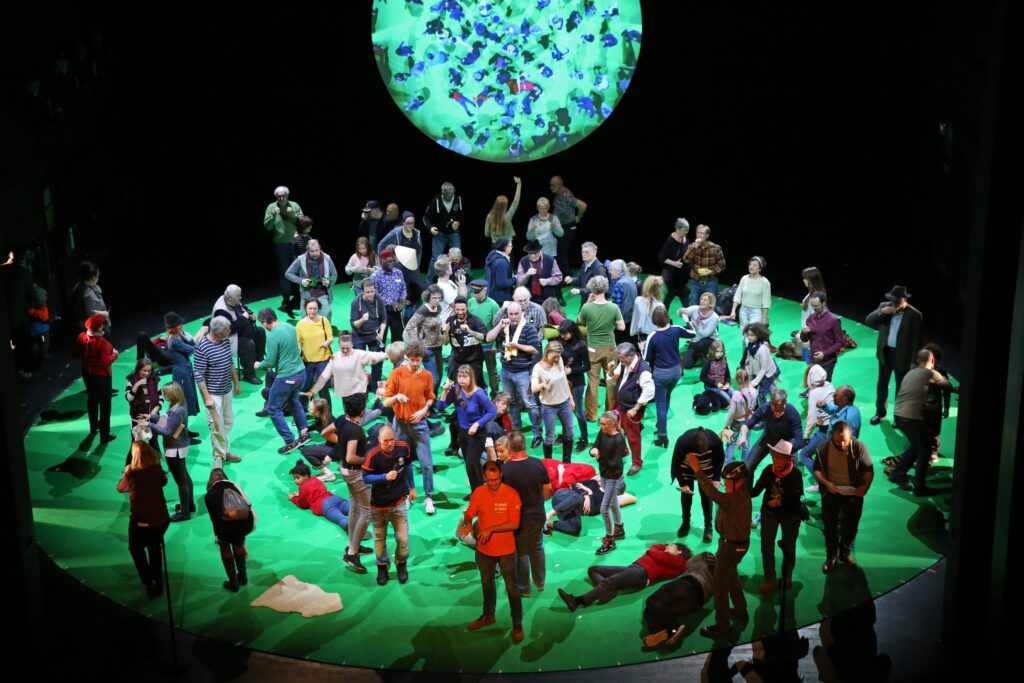
Photo: ©RiminiProtokoll
Dramaturgies of Care and Insecurity
The story of Rimini Protokoll
Florian Malzacher
A man steps onto the stage and shows some slides about chickens. He talks about deep-litter systems, key issues in feeding, pest control and slaughter. The audience is bewildered or amused; three or four of them are annoyed. After the hour-long presentation, it is time for questions about poultry farming and about representation in the theater. Yet is the man on the rehearsal stage of the Institute for Applied Theatre Studies in Giessen really aware that everyone there was expecting something entirely different, namely a real performance rather than a real person? And are the spectators really sure that Mr. Heller is a genuine expert in poultry farming and is not acting? The 1997 piece Peter Heller spricht über Geflügelhaltung (Peter Heller Talks about Poultry Farming) is a candidate for the prototypical origin of Rimini Protokoll’s theater. The idea came about in a student bar in Giessen, around a large table, over beer and schnitzel. Stefan Kaegi, who had just arrived in this small Hessian town from the F+F art school in Zurich, brought along someone who actually kept poultry. In fact, he had come for only six months, just to see whether there was anything to be learned at the institute, which had been founded by Andrzej Wirth in 1982. Because this was the place where René Pollesch, She She Pop, Showcase Beat Le Mot and (some members of) Gob Squad, among others, emerged to challenge or undermine traditional state-subsidized theater, the conservative newspaper Frankfurter Allgemeine Zeitung later described it as “the greatest source of mischief in German theater.” The Institute for Applied Theatre Studies is the only university department in the German-speaking world that combines theater theory and practice and devotes itself above all to contemporary and experimental forms of theater, and in this sense it remains unique to this day. In this context, Peter Heller was a quickly produced experiment, a theatrical game designed to irritate those who, through their studies, constantly had to deal with the irritation of theater. It was theatrical ready-made. For Stefan Kaegi and Bernd Ernst (who had arrived in Giessen the same year as Kaegi), it was the first in a series of inquiries into how powerful the black box is as a mechanism of representation, to what extent anything placed inside this box automatically becomes theater, and how the image of the black box is in turn changed by what is placed inside it. Peter Heller was followed by productions staged by Bernd Ernst and Stefan Kaegi featuring a purebred Great Dane and a neurotic ufologist. In 1999, calling themselves Hygiene Heute (Hygiene Today, as opposed to shabby German theater), they produced their first full-length show, Training 747, for the Cutting Edge Festival of the Staatstheater Darmstadt. The piece is a complex and playful story that draws mysterious parallels between two legendary airplane landings: the forced landing of Joseph Beuys’s bomber in World War II and amateur pilot Mathias Rust’s landing near Red Square in Moscow. At this point, their interest in theatrical ready-mades had already given way to a passion for creating complex theatrical events. Rimini’s origins, however, have other precursors as well. Marcus Droß, Helgard Haug and Daniel Wetzel, schoolmates from Giessen, had been developing performances since 1995 under the name Ungunstraum – Alles zu seiner Zeit (Unfavorable Space – Everything in Its Time). Above all, these performances served to discard theatrical mechanisms or to lay them bare. In doing so, they also repeatedly brought non-professionals onto the stage as “experts” for particular functions. The trio met on the set of a stage project by the composer and director Heiner Goebbels, who was then a visiting professor at the Institute. The students’ project was based on Kafka’s story fragment The Great Wall of China, and so Ungunstraum’s Stage 1 took us on an imaginary journey from Giessen to Beijing. The group went on to call almost the entire series of related performances and installations from that period stages (Etappen). There was no comprehensible narrative in the work, and indeed almost nothing comprehensible at all. Kafka’s text was replaced by real train connections. The performers, too, disappeared into an installation made of glass panels that could be written on and projected onto, along with all kinds of sound and technical equipment. The very essence of the performer was approached very critically (in such a way that the actor would reveal nothing about himself or herself). “Something had pushed us onto the stage, but then, the whole time we were on stage, we hid ourselves.” (Haug) The name Ungunstraum came from a brochure about China that emphasized “the difficulty of transporting people and goods in a country with extremely unfavorable spaces (Ungunsträume).” Droß, Haug and Wetzel wanted their own ‘unfavorable spaces’ to pinpoint exactly where, compared with other art forms, infrastructure seemed to dominate form and content in the theater. They were suspicious of technical perfection. Their task as performers was to operate and present the lighting and sound equipment, which was placed fully visible on stage, rather than to act themselves. The more elaborate and carefully constructed the settings became, the more unreliable their own appearances on stage became. Following the half-ironic maxim “rehearsing is for cowards,” they wanted to be “professional art amateurs.”
The trap of representation (which is essentially present throughout the entire German theater scene) had to be avoided at all costs, and in Giessen, more than anywhere else, it was regarded as the primary cause of theatrical evil. Anything pleasing, anything that could be accused of trying to “give the audience what it wants,” anything “connected with purely visual effects and surfaces associated with conventional dramaturgy was generally subject to the charge of not thinking.” (Wetzel).
Ungunstraum’s works mostly found their dramatic structure through the use of technical applications and their instructions. In their 1996 piece Piraten: “Piraten” (Pirates: “Pirates”), Helgard Haug and Daniel Wetzel nailed a box shut around Marcus Droß while an interpreter translated everything that was not said into Czech. In this case, where yet another performer disappeared from view, the main idea was the realization that Droß was a human sound card being installed in a computer according to genuine installation instructions. “If your box is equipped with audiovisual functions, you can install a human equipped with audiovisual plug-in units in your box. […] Most of these humans should be installed by an authorized person in case of damage. If you install the human yourself, you will not be insured against any damage to your box.”
During the same period, Stefan Kaegi, as an art student in Zurich, worked on his own disappearance. Once he wrapped pork sausages around his head; another time he sat in a cupboard for 5 hours and, blowing through a tube, fired small paper balls with text on them at the audience. He also turned himself into a table for 3 hours, or hung suspended in the air above the audience with a typewriter. Unlike Ungunstraum, what mattered to Kaegi was the production of text; he saw himself above all as a writer. Only gradually did he move from the performativity of his texts to the performance of the reading, and from there he became increasingly interested in performance itself. Another reason for this was that his readings were more successful than his literature.
The radio play became an important medium for him, because it allowed him to keep working on performances in which he transformed text live, for example through a simple guitar delay pedal, and then multiplied it. Kugler Der Fall (The Kugler Case) was first published in print in 1998 and later broadcast on radio. The live performances following the radio plays Dagobert (2001) and Glühkäferkomplott (2002) also belong to this series.