09 February 2021
3.3. Evaluation of the Plays
3.3.1. Breaking News:
The play takes the form of a reality show in which footage from daily news bulletins broadcast around the world is shown live, one after another.
“(…) Just as the object no longer has any relationship with the earlier object, the news produced by the media no longer has any relationship with the “reality” of facts. Both the object and the news are the product of a selection, an edit, a shot (…)”[14]
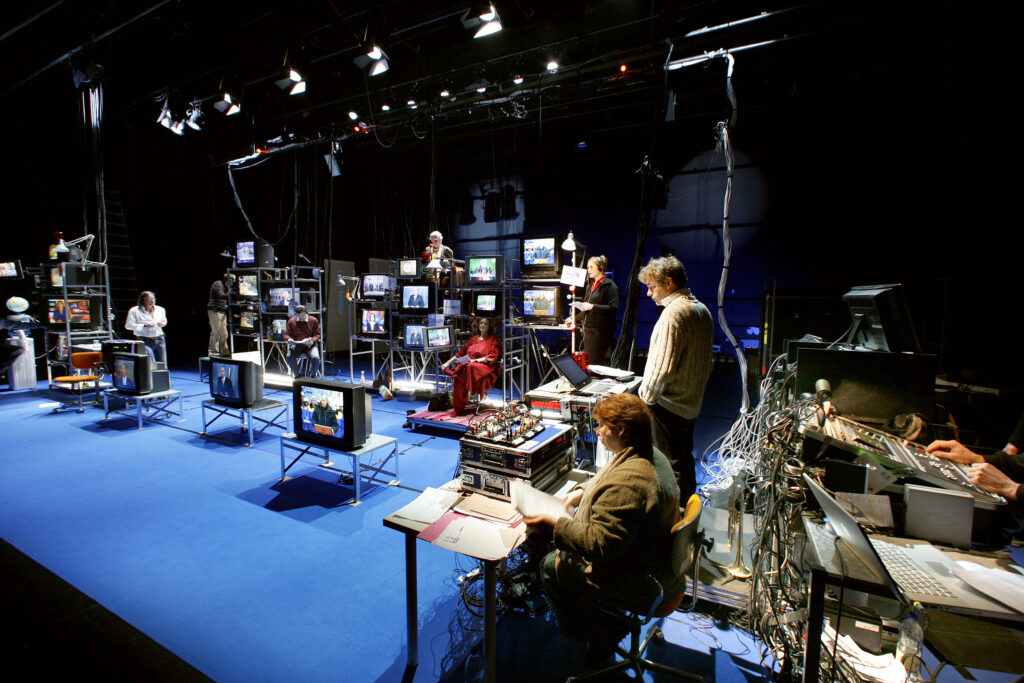
In this play by Haug and Wetzel, staged in 2008, there are 25 TV monitors and numerous satellite dishes on stage, and the stage has been turned into a huge studio.
First, Martina Englert, Marion Mahneke and Sushila Sharma-Haque come on stage. Standing in front of boards displaying pictures of their homes, they introduce themselves and talk about their relationship with TV. After the three men who follow them do the same in turn, the boards are turned around to reveal a large world map, and each person begins to describe, geographically and culturally, the part of it that falls to them. The experts of everyday life chosen by Rimini truly bring the skills and experience of their professions to the stage. Sushila Sharma-Haque is an editor at the international broadcaster Deutsche Welle in Germany; Simon Birgisson is a researcher-journalist in Iceland; Andreas Osterhaus is editor-in-chief at the French news agency AFP; and Hans Hübner is the Africa correspondent for the German television channel ARD. All of these experts take their places at their own monitors on stage and begin watching, together with the audience, the evening news of various countries broadcast live via satellite. On stage, much like reporters, they give special headlines to the news items they choose. They translate the news and comment on it. With the commentary on the different news segments that follow one after another, seeing how the main topics emphasized by broadcasters in different countries vary or stay the same makes each performance a different live experiment and produces a different result.
Magel says that over the course of two hours the images around the world are almost the same, but the emphasis differs.[15] In fact, one can never be sure of this. Depending on the changing topics of the day, broadcasters in different countries may report from different perspectives. In such cases, it is not entirely clear whether Rimini favors leaving the flow to chance, or whether highlighting the sameness of the images is meant to emphasize the technological dominance of the global world. I think it would be more accurate to interpret each performance as an investigation of the content of the news as it is shown live on channels such as ARD, CNN, Al Jazeera, BBC and the Pentagon. The group simply asks questions such as “How much foreign news reaches Iraq compared to Iceland?” or “Which images are shown in South Africa compared to Ukraine?”, “What is the breaking news of the day?”, “What gets lost in the hunt for images?”[16] This work is accepted as a topical inquiry or investigation.
Breaking News is a work that turns into entertainment by conveying real news as interpreted from personal perspectives. It can be said to be a simple play that has no problem of credibility. No attempt whatsoever is made on stage to create an illusion. The only text used in the play is Aeschylus’s “The Persians.” Hans Hübner recounts his memories of Africa by blending them with The Persians; here, too, deeply subjective memories are synthesized with a dramatic text. Apart from this, the performers speak in their own words, without any text. Katia Arfara describes the performance style of the experts on stage as follows:
“(…) In recounting what is happening, the experts of everyday life are like the Messenger in ancient Greek tragedy or a Brechtian narrator. With their objectivity and impartiality, their style of acting echoes Piscator’s idea of the actor guiding the audience like a piece of stage material, “without feeling deeply.””[17]
The technical operation of the multimedia surrounding the play—that is, the control of sound and video—is carried out from the stage. In the use of multimedia, one of the most important elements of the new theatrical language the group has built in relation to reality, the illusionist approaches of realistic theater are strictly avoided. According to Katia Arfara, the performance of the company, which strives to redefine theater by tearing down all preconceptions about what it is, consists of three temporal layers.[18] The first of these is actual, live time. This is the time in which the participants instantly translate the news they encounter on television. The second is recorded, documentary time. This temporal layer is the situation in which interpretations are made using previously recorded television footage. The third is historical time. It is the temporal layer created by incorporating the text of The Persians into the play. Thus, the different temporal layers indicate degrees of authenticity. The play, which contains all these different temporalities, achieves a state of being “here and now” by juxtaposing the anti-theatrical situation of the experts of everyday life on stage with TV images.
We can say that Rimini Protokoll’s intention in placing television and news bulletins at the center of the play is to make its audience ask questions about comparing the images that television, as a mass medium, produces in the global world and about questioning their reality. At the same time, it is also about the audience’s changing relationship with the content of news bulletin footage. The change in attitude toward the consumption of television news can be exemplified by the way live war footage during the Gulf War was watched over dinner. Baudrillard says that what mass communication gives us is not reality but the vertigo of reality.[19]
While seeing the same images in completely different geographical areas produces one result in the play, showing the sameness or difference of the information these images contain also brings contradictions to light. While the play raises a wide variety of questions about the media and the visual form of the global press, it also leads societies that consume the images created by television to confront the relationship they have established with image and reality. The fact that television, the most important medium of information, actually moves away from reality precisely through the images it creates becomes another conclusion for the audience. Robins says the following about the use of images:
“(…) While I am interested in how images are used to know and understand the world, I also want to draw attention to the fact that they can be used to prevent, reject and deny the reality of events in the world. As important as the question of what is shown—indeed, an even more important question—is the question of what is not shown (screened out).”[20]
Rimini Protokoll has raised its questions about the most influential mass medium of the world we live in, and revealed the form of sociological relationship it produces, by means of television itself, the very object at the center of its critique. In other words, the material for the television object, the culture and the mode of reception questioned in the play was once again television. This attitude is in fact much like pop art’s understanding of art. It shares common ground with pop art’s critique of consumption, which it carried out by using as its material everything that is itself consumable. The observation made by Neil Postman, who says that television “forms the paradigm of our public understanding,” about the spread of the language of TV is important:
“While television presents the news to us packaged as vaudeville, it forces other media to do the same, so that the information environment as a whole is shaped to mirror television.”[21]
In using TV and the images of the reality it creates in its play, Rimini Protokoll inevitably mirrored it as well.
In defining the function of television and images in the play, we can say first of all that they are used in place of a text. The text of the play is formed through the interpretation of the news coming from television. Here, without any linear narrative, the play moves on to a different news item with each changing news image and the person interpreting it. This rapid succession of news images and commentary has brought speed and dynamism to the play in an aesthetic sense. But the defining feature of the images is that they transfer the present-day realities of life into the play, without any projections of written documents or previously prepared fictional films. The real images being watched around the world are shown to the audience simultaneously from the theater stage. The reality here takes shape not as the showing of real documents in the conventional manner of Piscator’s plays, but as bringing what is real onto the stage without aestheticizing it at all. The playing space is constructed with images; beyond that, the images have no further use, such as expanding the boundaries of time and space. In Breaking News, too, we find the consequences of the qualitative change that images have undergone within the postmodern paradigm. Because the images serve the play not to create thematic unity or meaning through their content, but simply through their presence as images. In other words, the emphasis is less on what the images tell than on how they are told and edited, and on the diversity or sameness of this (around the world). Society is no longer the society of Piscator’s theater, moved or shocked by the image, but a media society that uses the language of the media as an ordinary, everyday language. Their theater, too, is created in the same language—that is, with television.
The central structure of the images in the play and the aesthetic they create is a new techno-aesthetic formed within the aesthetics of the media and communication technologies. Thus technology has now shaped the artistic imagination at the level of form and content. That is, content has become fused with form, and formal structure has come to be perceived as art.[22] The fact that the images produced by technological material are used as they are, in their everyday functions, without being aestheticized and without even the aim, as the Wooster Group had, of creating a new unity of meaning from them, indicates that art has now been reduced to mere technique and material. Moreover, bringing everyday life to the stage just as it is (the experts not concealing their own personalities, and the everyday news in the television footage) has completely erased the boundary between art and everyday life.
In Breaking News, Rimini Protokoll does not present to the audience, from an ideological perspective, its political stance regarding the questioning of television images in the global world. In the end, it makes no proposition. Having exposed people’s perceptions as they drift away from the reality created by images, it does not set out in search of any answer. With the noncommittal attitude of postmodern art, the play ends just as it began. Wetzel expresses this choice in their plays as follows:
“Theater can be a tool for creating experience, but it is not suited to perceiving the world in a standard way. It may concern your next-door neighbor or the ideology of global markets. But we do not make theater to tell you our own critique or to get you to accept a critique as true. If that were the case, we would write brochures.(…)”[23]
The questions that ought to be asked in the play remain hanging in the air within the format of an entertaining reality show. It can be said that this ambiguity at the end of the play is also clearly visible in their other plays. One of these is Radio Muezzin.
3.3.2. Radio Muezzin:
The play was created under the direction of Stefan Kaegi and first staged in 2008. In the play, in which four muezzins from Cairo appear on stage as performers, the starting point was a real issue. In Cairo, the call to prayer recited by many muezzins in different voices was banned, and it was decided that the call to prayer recited by a single muezzin from one central location would be broadcast across the city on radio frequencies. In order to select this one person, 30 muezzins were entered into a call-to-prayer competition, and those other than the winner lost their jobs. Radio Muezzin brings together on stage three muezzins who lost the competition and the muezzin who won it. The experts of everyday life perform themselves on stage.
The muezzins sit on chairs in an area covered with carpets (just as in mosques). Behind them are four projections. The muezzins talk about themselves, their work, their families and their ideas. While they speak, pictures from their lives or prepared video presentations are shown on the screen behind each muezzin. As the muezzins talk about themselves one by one, documentary images of their real worlds are also shown to the audience. They share deeply intimate information about their lives, such as how much money they earn, what they think about religion and women, or how big their homes are.
The fact that the play brings to the stage an event that actually took place in real life, together with the real people involved in it, is a clear example of Rimini Protokoll’s use of found objects in its artistic approach. The only difference between this play and the reality shows watched on television screens is that it is watched not on television but on stage. Baudrillard says that the ancestor of the reality show is the ready made.[24] The transformation of the play’s found-object elements into artistic material while preserving their own functionality, without removing them from their function in the world of objects, is the essential orientation that defines the making of Radio Muezzin.
“Today, any object, individual or situation is a potential ready-made to the extent that the phrase Duchamp implicitly uttered about the bottle rack, “ It exists, I came across it,” can be said of them. Thus everyone is invited to show themselves as they are and, just as the ready-made plays its role live as it is from the museum’s screen, they too are invited to play out their lives live on screen. (…)”[25]
How the reality of the experts of everyday life making themselves so transparent on stage, all but exposing their lives through pictures and video films, affects the audience is a matter of debate. The reality on stage of the other three muezzins who lost their jobs carries the potential to produce an effect similar to the way people in front of the television lose their capacity to react by growing accustomed to the horrifying images they watch on reality shows. Does the viewer’s capacity for empathy increase while listening to the life stories of the muezzins on stage who have lost their jobs, just as they are, and while watching real documents on the screen? Or does the viewer put a distance between themselves and all this reality and consume it as material for a show? Baudrillard expresses the problem of the relationship that the reality show viewer establishes with reality, which encompasses these questions, as follows:
“The same problem is encountered in reality shows: the television viewer must be drawn not in front of the screen (they have always been in front of the screen—indeed, that is their excuse and their refuge), but into it, to the other side of the news. In a way similar to what Duchamp did with the bottle rack, transferring it as it was into the other realm of art and thus creating an inextricable confusion between art and the real, the same conversion must be carried out on the television viewer.”[26]
It is necessary to repeat the questions concerning the effect that the authentic presence of the muezzins on stage has on the audience. Is it possible for the audience to become voyeurs of the reality on stage and turn deaf to that reality? If the reality of the “others,” whose realities on stage are proven with documents, is indeed being abstracted, the orientalist elements present in the play also have a share in this.
The muezzins show on stage, without completing them, a number of rituals belonging to Eastern faith, such as reciting the call to prayer and performing the ritual prayer. They do not carry them through to the end, in order to avoid using an act of worship or any religious ceremony for the purpose of spectacle. Still, while one should be skeptical about how large an audience a play built around fragments of such religious rituals could find in a Muslim country, in Germany or other European countries it is likely to be found interesting by audiences because of its authentic character. Here, of course, the West’s orientalist view of the East plays a role. However, how and to what extent the reality of what happens on stage affects the audience, how real a relationship the audience establishes with reality, or whether they consume its authentic motifs merely as the aesthetics of a show, is not clearly evident in this play adorned with religious rituals.
In Radio Muezzin, film and projection are the only means of showing the reality of the people and events on stage. Through them, a great many details about the lives of the muezzins telling their stories are shown. Their reality is reinforced. Through these pictures of their living spaces, their children, their neighbors and their own lives, one comes across various examples of the living standards of Cairo’s muezzins and their outlook on life. While all the details of how they clean the mosques where they work and how they became muezzins are conveyed in their own words, their photographs are shown in the background as images that in fact depict their identities. For example, the muezzin who won the competition is interested in bodybuilding, and becoming a muezzin was not actually his dream. Since childhood, others had wanted him to be raised as a muezzin. The photograph he had taken in front of McDonald’s after placing second in a Qur’an recitation competition he entered in Malaysia is interesting. The strange longing he feels, as an Easterner, for the Western way of life is all but laid bare in this photograph. In this and similar ways, projected images that openly reveal the true circumstances of the people are displayed. In addition, a film made from various footage of Cairo is used in the play to reveal the authentic living conditions of a Muslim country. Since film and projection are the only source through which the play—which shows reality with all its documents without creating any illusion whatsoever—is able to create on stage the aesthetics of Muslim worship and of everyday life, we can say that film and projection are the most important elements of this play.
The muezzin who placed first in the competition and won the right to recite the call to prayer from the central system left the show in the later stages of Radio Muezzin. In subsequent performances it was stated on stage that the reason for this was the tense atmosphere between him and the muezzins who had been left unemployed, and his image on the screen was used in the play in his place. The image took the place of reality. The approach of having objects from real life take part in the play without concealing anything of themselves continued unchanged; in place of the found-object muezzin, his double—his video image—was used in the play with the same function.
Regarding the outcome produced by showing a state of reality through photography and film, it should once again be noted, with respect to the principle of use of film and projection in this play, that it remains uncertain whether the impact of what is real actually reaches the audience, and that there is a possibility that reality is consumed by the audience as if it were a fictional show. This situation is just like the reaction shown to the reality meaning of images on television screens. Kevin Robins, saying that screen voyeurism is giving way to an unprecedented cruelty and indifference toward life, quotes John Berger:
“The screen is taking the place of reality. This substitution has a double function. Because reality is born of the encounter between events and consciousness. To reject reality is not only to reject objectivity. It is also to reject a fundamental part of what is subjective.” [27]
It is clear that the power of the screen eliminates genuine responsiveness for its viewers. From this, it is a highly likely outcome that, in Radio Muezzin, the projected images of subjective realities become detached from their real context for the viewer and are consumed as just another fictional show, exactly as the television screen does to its viewers. From the 1980s onward, as what was private opened outward and turned into news, information and images, and as the boundary between inside and outside melted away, a “private life industry” came to the fore in a cultural environment in which public and private spheres became intertwined.[28] Just as the entire cultural field was affected by this, so was theater. In Rimini Protokoll’s works, however, this influence has turned into a distinct orientation. When the realm of subjectivity, like all other realms, was surrounded by the mass media, fields and professions with their own languages, images and visuals emerged, such as private-life journalists, private-life magazines, private-life cinema and private-life novels.[29] In this case, I think it would not be wrong to define Rimini Protokoll, which is described as “new documentary theater,” as a “theater of private life” favored by the private life industry, since its theatrical style, by bringing certain people from real life onto the stage, makes no claim to prove reality beyond documenting their realities.
It is said that Radio Muezzin “explored the complexity of contemporary Egyptian society through the differences between its protagonists.”[30] The atmosphere created in Cairo by the call to prayer recited by the muezzins in many different voices was shown in a film made by editing together numerous images from the city. The central focus of the play is that the centralized form of the call to prayer, recited by a single person, is a move toward the disappearance of authenticity in a changing Cairo. From this perspective, we can assume that the play intends to raise questions about how the need for human beings disappears as technologies advance, and how authentic characteristics are steadily diminishing in a globalizing world. But was an honest relationship really established with this situation through genuine empathy? Or does lending a theatrical quality to a show prepared merely with this intention, simply because it contains the elements of performer and audience in a particular time and place, represent the final stage that contemporary theater has reached? At this stage, the umbilical cord between re-enactment/production and the audience has been severed. That is why, in Rimini Protokoll’s Radio Muezzin and a number of their other plays (Mr. Dağaçar and the Golden Tectonics of Trash), the reality of life and real people are present on stage just as they are, in their real state. They conceal nothing of their reality. Daniel Wetzel defines the company’s notion of theatricality as follows:
In our understanding, theatricality has nothing in particular to do with acting. This is a common misunderstanding. Theatricality is the process that takes place between us while I watch the person in front of me. It is a state of pausing, of being affected and of being open. I call theatricality the process of aesthetic experience. It is a process of creative perception. That is exactly why theatricality is political.”[31]
From this definition, it can be seen that the company perceives real life as political and has no intention of producing art and ideology with an aesthetic beyond this. In fact, showing real lives on stage (when it could just as well be fictional, since reality is not their focus) amounts to nothing more than satisfying the hunger of viewers who have already embraced voyeurism in front of the television.
As part of “İstanpoli,” a “Garajistanbul, Istanbul 2010 European Capital of Culture Project,” the company presented the play “Mr. Dağaçar and the Golden Tectonics of Trash”. The directors of the play, which premiered in Istanbul on October 15, 2010, were Helgard Heug and Daniel Wetzel. I think it would not be wrong to say that “Mr. Dağaçar and the Golden Tectonics of Trash” was created as an exact copy of Radio Muezzin in both form and content. The real people of this play are waste pickers who collect solid waste on the streets. On stage there are various kinds of waste and the carts of the paper collectors. At the back of the stage is a screen onto which the projection is cast. The stage has been set with elements from the natural, real lives of the people we are about to watch. This is the same approach to the stage as the carpets in Radio Muezzin. The realities of these people, four of whom are of Kurdish origin and one Roma, are conveyed, just as in Radio Muezzin, both through their own accounts and through photographs and film footage that reinforce their realities. While describing their lives both as people of the street and as minorities in Türkiye, they share very personal information with the audience, such as their families, their social circles, their working lives and their financial hardships. The photographs and film footage supporting this information are projected onto the screen at the back of the stage, onto the carts, or sometimes onto a cloth that is also used for shadow play. The prepared film and photographic images bear witness to moments of daily work and life. The greatest hardship for the paper collectors is that the growing solid waste recycling companies are cutting into their earnings and gradually taking their work away from them. This situation is exactly the same as the hardship experienced by the muezzins in Radio Muezzin who lose their jobs in the process of globalization. At the end of both plays, Rimini has no concern with taking sides or producing solutions to the hardships of its performers/experts. Nor does it reflect on the fact that this situation now relates to an unstoppable global crisis, and it positions the audience just as it positions itself. Both of these plays, made with people from different geographies, share the same subject and the same scheme (non-actor real-life people, private lives revealed in turn, real-life images, various authentic elements…). Aesthetically, a ready-made scheme can be seen applied to the same kind of people, even if they come from different geographies. The cultural identities these people have in real life are shown in the plays in a completely formulaic way, more or less the same. In order to bring what is real to the stage, Rimini Protokoll turns these people into its own material and makes them consumable objects. In reality, the subjects it addresses from a perspective entirely removed from social critique, and what the people’s hardships are, may not matter very much. As we have seen, it fits them all into the same formal template and makes them the object of the show. The single and most obvious means of doing this is the film and projection used. Whatever the subject or the narrator, film footage and photographs documenting their real lives are always streaming on stage. It is difficult to say that this form of presentation and these realities touch the audience more than those under observation in television reality shows.
Not only television: with new communication technologies, the perception of surveillance has developed, traditional surveillance has become institutionalized, and watching has turned into voyeurism as part of a mechanism of oppression.[32] The siege of visual culture and technologies continues by presenting and showing the viewer what is ever more real. For audiences nourished by this tendency, Rimini Protokoll’s real-life stories are undoubtedly very close to the viewing culture they are accustomed to from television and visual technology. The purpose behind Rimini Protokoll’s use of technology is likewise to serve the audience’s habit of easy reception in front of the news or reality shows by presenting the reality of life to them visually. For the audience, this means taking in reality visually and quickly and making it consumable. Yet this reality is the reality of life; it is the real lives and hardships of the muezzins who are speaking. From this, we can conclude that the company’s relationship with the masses is nothing like Piscator’s relationship with the masses. The reason the company uses the visual technique the masses are accustomed to, and the display of reality they are also accustomed to, is that this is the general mode of mass perception. In other words, the shows are made for the audience. Piscator, on the other hand, offers the masses an aesthetic they are not at all accustomed to as he reaches out to them. At a time when projection and film were not yet widely used, Piscator wanted to affect his audience quickly in order to carry out political agitation. The intention of reaching the masses with this impact was to reveal political reality.
As can be understood from the plays of Rimini Protokoll evaluated here, they keep their distance from conventional forms of staging. Elements such as illusion, psychological realism and linear storytelling have no place in their plays. Action, rather than the main story presented to the audience, comes to the fore. Events/subjects are recounted from the stage without being dramatized. Their performances are anti-theatrical as well as anti-dramatic.[33] Media devices are at the center of the plays as elements that can never be dispensed with. These definitions largely coincide with the characteristics of Lehmann’s postdramatic theater.[34]
To summarize the function of film, projection and media devices in the Rimini Protokoll plays we have examined:
Reality and life are brought into the playing space/onto the stage through real images of real people shown by means of film and projection. As in Breaking News, the television screen brings real-life information live to the stage. In Radio Muezzin, film and projection are used to transfer personal lives from real life to the stage. The reality of life has been documented just as it is, without being aestheticized. These documentary images were prepared with the intention of reinforcing and proving the realities of the real-life experts on stage; however, there is a high probability that the reality of these prepared images is a reality prepared from Rimini Protokoll’s own point of view. Now that reality in images can easily be altered with technical means, the documentary status of all image-producing devices appears questionable. In that case, the images are assumed to be real not in order to prove the reality of the experts on stage, but merely so that they fit the reality show format on which the company bases its performances, and they are used to document the realities and lives of the real-life people on stage.
In all of the works, modes of use have been created for film and projection, and for the images they produce, that exist so that the performance can take place and that generally make it possible to carry out a present-tense performance on stage. Since there is no text, the images have been made the source and center of what the narrators on stage recount. The images necessarily appear on stage so that any subject or situation can be recounted at that very moment, and so that the reality of what is recounted can be proven. Of course, along with this functionality, the presence of film and projection as objects has also been used to create the aesthetics of the authentic situation on stage. For example, the 25 TV monitors in Breaking News turned the stage into a television studio, while in Radio Muezzin the film shown on screen brought the authentic atmosphere of Cairo to the stage.
The group, which generally chooses its subjects from events or situations belonging to the globalizing information society, wants everyday realities and experiences to reach its audience on stage, again within the aesthetics of the everyday and the ordinary. In the techno-cultural age we live in, the expansion of the realm of visual experience leads Rimini Protokoll, too, to carry out a technological rationalization by confronting its audience with visual experiences.
“Rimini Protokoll makes theater in a systematic, experimental way. It does not search for absolute truths; rather, it searches for models of collective reality.”[35]
What is being described here comes close to meaning that, with its plays, the group never fully captures reality, and instead achieves a fragmentary show made of elements related to reality. Their most evident attempt to realize this reality formally is the reality show format they employ. Real people, the real world and real situations seem ideal for a real stage model that excludes illusion. However, the connection established with the viewer here is not at the level of heightened senses and shocked emotions. It holds the possibility that the audience consumes the reality they watch by separating it from the reality of life. The real-life realities of the people the viewers see on stage as real are proven and reinforced through the arm of film and projection. In this way, life is brought onto the stage. For the viewer, this is likely to result in distancing themselves from, and severing their bond with, the reality they are watching. Because by looking at the world through a screen or through mediated media devices, as Gingrich says, we watch what is happening “out there” without missing anything but also without coming into direct contact, and thus we are protected from the effects and consequences of what we see [36]
Whether real documentary images are documents is debatable. Because, as mentioned earlier, what is real is now a matter of the viewing position. The reality of every film and photograph that serves as a document is now regarded with suspicion. In taking a photograph digitally or producing an image with computer technology, intervening in color, brightness, contrast and areas of light and shadow has become something easy to do in terms of time and effort.[37]Today, even National Geographic magazine moves pyramids around in its photographs to make them fit its cover. Since Rimini Protokoll, too, uses real images within the context of its own editing, it should not lay claim to reality. In that case, describing this staging as documentary theater sounds rather too ambitious.
Film and projection have also had different journeys within the postmodern paradigm through changing processes. In comparing the ways film and projection are used in the plays of the Wooster Group, the American avant-garde company of the ’70s, and of Rimini Protokoll, which came under the influence of the techno-culture of the globalizing world after the ’90s, it is important to identify the differences and commonalities that first stand out. This identification will be useful in revealing, through the specific cases of two different theaters, the changing forms of art’s relationship with reality, and it will also reveal the changing thinking behind artistic production.
[14]Jean Baudrillard, Simgesel Değiş Tokuş ve Ölüm, p.99
[15]Eva- Maria Magel, “What The Messenger Brings”,Frankfurter Allgemeine Zeitung, 21.02.2008, (online) http://www.rimini-protokoll.de/website/en/article_3419.html
[16]Rimini Protokoll, website, play description (online) http://www.riminiprotokoll.de/website/en/project_888.html
[17] Katia Arfara, “Aspect of a New Dramaturgy of the Spectator Rimini Protocoll’s ‘Breaking News’”, p.114
[18] Ibid..117
[19] Jean Baudrillard, Tüketim Toplumu, trans. Hazal Deliçaylı- Ferda Keskin, Istanbul, Ayrıntı Yayınları, 2008, p.27
[20] Kevin Robins, İmaj, p.26
[21] Collective volume, Sanatlar ve Toplumsal Etkileşim, p.27
[22] Ibid., p.23
[23] Barbara Van Lindt, “Call It Call Cutta In A Box”, Kunstenfestivaldesarts, 01.05.2008, (online) http://www.rimini-protokoll.de/website/en/article_3656.html
[24] Jean Baudrillard, Kusursuz Cinayet, trans.: Necmettin Sevil, Istanbul Ayrıntı Yayınları, 2006, p.44
[25] Ibid.
[26]Ibid., p.45
[27] Kevin Robins, İmaj, p.124
[28] Collective volume, Sanatlar ve Toplumsal Etkileşim, p.36
[29] Ibid.
[30] Peter Snowdon, “Ambassadors Of The Azan”, Al Masry, 03.03.2010, (online) http://www.rimini-protokoll.de/website/en/article_4562.html
[31] Barbara Van Lindt, “Call It Call Cutta In A Box”, Kunstenfestivaldesarts, 01.05.2008, (online) http://www.rimini-protokoll.de/website/en/article_3656.html
[32] Collective volume, Sanatlar ve Toplumsal Etkileşim, p.41
[33] Katia Arfara, “Aspect of a New Dramaturgy of the Spectator Rimini Protocoll’s ‘Breaking News’” p.115
[34] Hans-Thies Lehmann, Postdramatic Theater, trans. Karen Jürs-Munby, London, Routledge, 2006.
[35] Katia Arfara, “Aspect of a New Dramaturgy of the Spectator Rimini Protocoll’s ‘Breaking News’” p.118
[36] Kevin Robins, İmaj, p.48
[37] Collective volume, Sanatlar ve Toplumsal Etkileşim, p.92
İlksen Gözde Olgun