05 October 2020
The concept of “Early Murnau” is a little bittersweet. The German director’s career was so short that the films in this new collection from Masters of Cinema take us up to just six years before his death. Although the director’s most famous film, Nosferatu, belongs to the 1921–25 period covered by this collection, it is not included in the selection. The collection ends just one year before the making of his hypnotic Faust, and two years before his Hollywood masterpiece Sunrise.
Technically, then, we could call this period “middle Murnau,” or “the Murnau you may have missed if you only know Nosferatu and the surviving Hollywood work.” All the same, each of the distinctive, spectacular films in this gorgeous selection deserves a place on your shelf. The films in the collection have all been released on DVD by Masters of Cinema before, but gathered together on Blu-ray they make for a far better bargain.
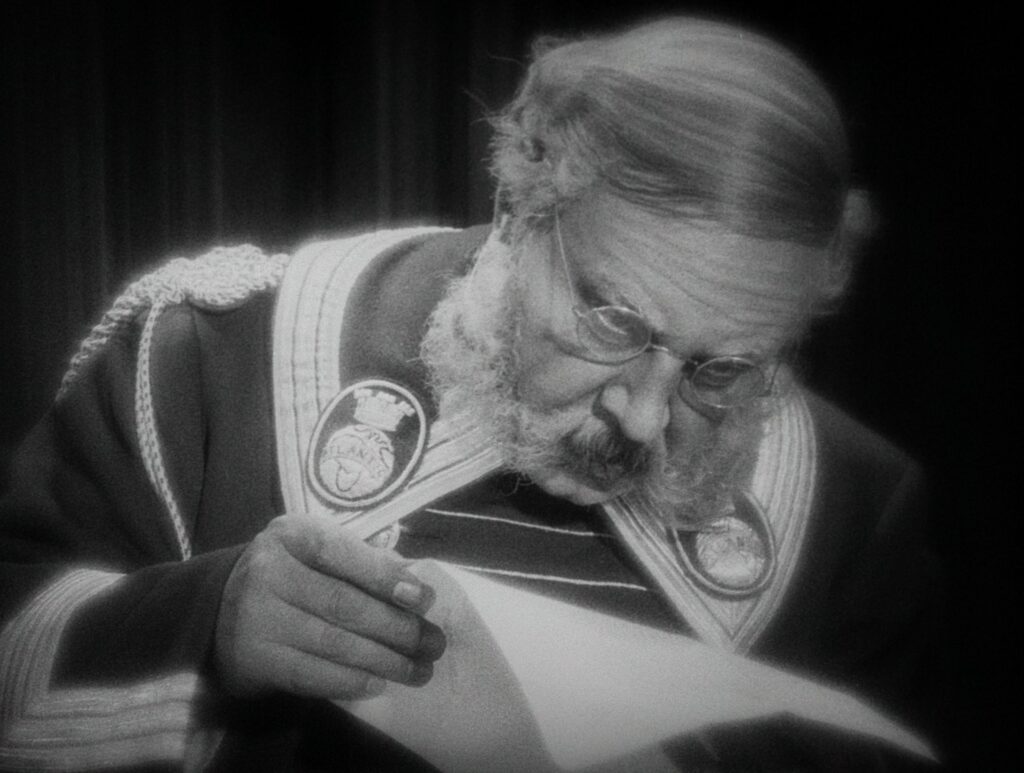
We begin our exploration of Murnau’s lesser-known German productions with Schloss Vogelöd (1921), a country-house mystery rendered mysterious and dreamlike by the director’s touch. At the peak of our journey, Tartuffe (1925), a bracing and inventive adaptation of Molière, introduces a deeply noxious, self-centered hypocrite and then hangs him out to dry. In between, Phantom (1922) shows us the romantic and financial misery of a clerk who longs to be a poet, while Die Finanzen des Großherzogs (1924) lets us witness the tangled affairs of an aristocrat. The undisputed star of the collection is the low-key masterpiece Die letzte Mann (1924). Starring Emil Jannings, the film charts the downfall of a hotel doorman who is demoted to toilet attendant.
As the many extra features and essays included in the collection attest, Murnau’s output is hugely varied; the director swings from genre to genre, refusing to stay in one place for long. Stylistically, though, Murnau is always unmistakably himself. In both Phantom and Die letzte Mann, for example, we see the walls of the city bend down to hem in the heroes. And – as you may already have noticed – most of these films explore themes such as anxieties over money and social status, impossible dreams and the toxic effects of excessive pride.
The faces of these oppressed, haunted characters loom out of the darkness in crisp close-ups, or are surrounded by Murnau’s gloom, fed by spectral apparitions and psychologically motivated special effects. These films represent a highly sophisticated form of Expressionism: instead of the heavy greasepaint and distortion of Caligari, there is a subtler and far more unsettling atmosphere. These are works much closer to poetic realism than to Paris’s famous old theater, the Grand Guignol. The set design in Schloss Vogelöd, for example, is stunning, while the dissolving close-up of Lya de Putti in Phantom is as gorgeous as it is unsettling. In this era, before horror had become a codified genre, Murnau made cleverly constructed, genuinely disturbing films, full of shadows that creep in where they are not wanted, yet never swamp or swallow the frame.
Schloss Vogelöd may feel a little slow and stagey for modern tastes, and Phantom is definitely overlong. But thanks to their arresting visual language and the gut-wrenching twists in their stories, both films more than reward a quiet night in on the sofa. Die Finanzen des Großherzogs reveals that Murnau was incapable of making a film without beauty, but that extended comedy did not come naturally to him. Tartuffe, a true delight to watch, is not only a sharp, human satire told visually but also a valuable lesson in how a stage play should be adapted for the screen. Murnau’s decision to place a film within a film gives a modern bite to this satire, in which Emil Jannings plays the deliciously wicked title character we can’t get enough of. Die letzte Mann, meanwhile, is a masterpiece that every cinephile serious about silent cinema should watch more than once. Now that we have the chance to see it on Blu-ray, every minute of the film, from its dizzying opening sequence through its heartbreaking middle to its sardonic happy ending, promises new treasures with each viewing. Jannings’s magnificent performance and Karl Freund’s dizzyingly roaming, spinning and climbing camera draw the audience into the darkest of emotional spaces.
Highly recommended for anyone who loves Murnau’s better-known work, this collection deserves to be lingered over. The troubled families and terrifying cities in these films may not seem like very pleasant places, but as landmarks of Murnau’s enchanted world they offer an incomparable cinematic feast. Supported by the aforementioned Freund, as well as by screenplays from Carl Mayer and Thea von Harbou, each of these films that Murnau made for Erich Pommer’s film studio UFA is a quality production, deep and elegant. The essays accompanying the collection, the audio commentary David Kalat recorded for Die Finanzen des Großherzogs, and David Cairns’s smart new video essay, which – understandably – focuses on Die letzte Mann, make this Murnau experience all the richer.
“Art – authentic art – is simple,” Murnau once said. “But simplicity itself demands artistry.” Other films by the director may be so familiar to us that we can almost miss the touch of his technique, but the works gathered in this set allow us to understand exactly what makes a Murnau a Murnau.
Pamela Hutchinson
Turkish translation: Gizem Ünsalan
This article is taken from Silent London.