15 June 2021
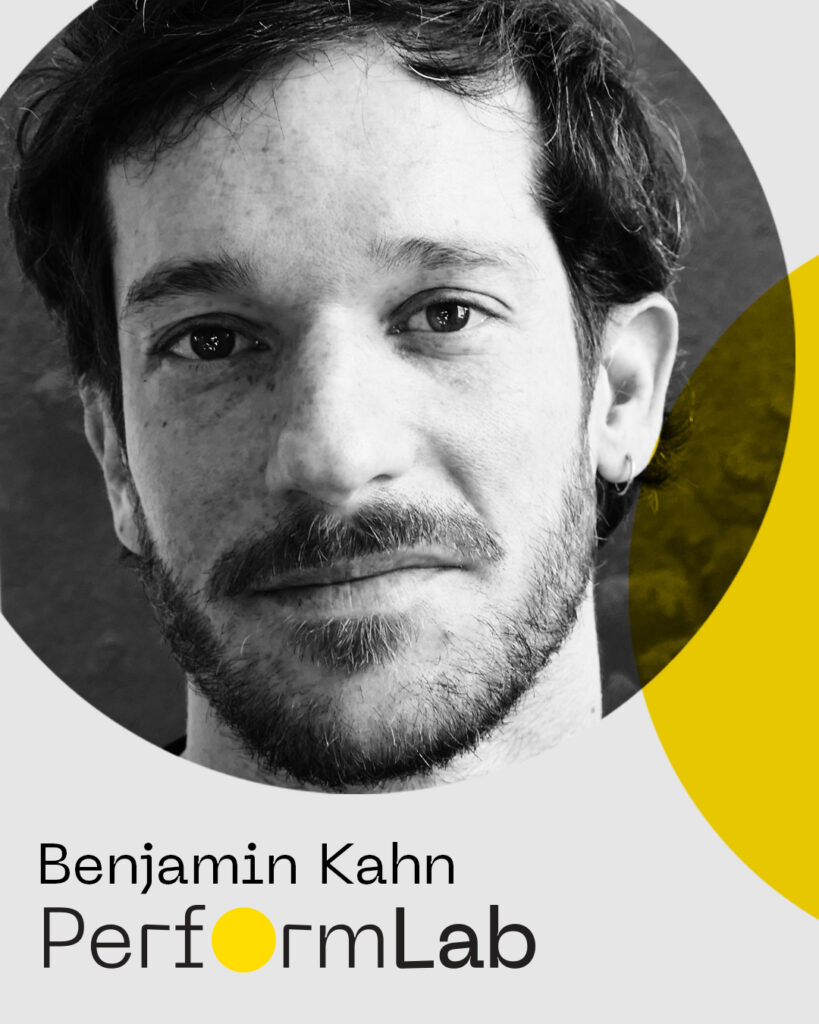
Kundura Sahne‘s interdisciplinary and international concept and practice development program in the field of performance, held for the first time this year, PerformLab, brought together artists from Türkiye and the Netherlands at Beykoz Kundura from May 29 to June 6. Performance artist and choreographer Benjamin Kahn was a guest of Ten-Question Conversations!
Interview: Ayşe Draz & Mehmet Kerem Özel
Art Unlimited – 10-Question Conversations
Benjamin Kahn
Kundura Sahne‘s interdisciplinary and international concept and practice development program in the field of performance, held for the first time this year, PerformLab, brought together artists from Türkiye and the Netherlands at Beykoz Kundura from May 29 to June 6, 2021. Realized by Kundura Sahne in partnership with Productiehuis Theater Rotterdam and with the support of Dutch Performing Arts, the PerformLab program gave artists from Türkiye at different stages of their careers, selected through an open call – Barış Arman, Dilan Onay, Doğan Can Serinkaya, Filiz İzem Yaşın, Halil İbrahim Aygün, Nadir Sönmez, Nursev Irmak and Selen Gürmen – the opportunity to share and develop their work over the course of a week, together with the artists from the Netherlands. PerformLab was also accompanied by artist İlyas Odman as its Art Fermenter, who brought a new perspective to artistic processes through the concept of fermentation. This approach, which proposes using fermentation as a tool for looking at artistic processes from a new perspective, formed the backbone of PerformLab. The artists from the Netherlands were dancer and choreographer Benjamin Kahn, Amsterdam Fringe Award–winning dancer and performance artist Cherish Menzo, actor and performance artist Khadija El Kharraz Alami, and Green Room Award–winning educator, artist, theater maker and director Samara Hersch.
Kahn, who believes that dance and choreography are powerful political tools, is interested in deconstructing the ways we look at individual and collective bodies; in his performances he places all kinds of power relations at the center in order to question them, whether they concern gender, racial discrimination or the dynamics of creating together, and seeks to make visible the invisible violence that lies beneath the surface. As part of PerformLab, Kahn also shared with the participants a showing of an original work he conceived, in which PerformLab participant Cherish Menzo appears as the performer; a piece that problematizes not only the notions of gender and race but also the power relations between those who create and those who perform, and that has been met with admiration at many festivals: Sorry, But I Feel Slightly Disidentified…

What do you think is the essence of performance? How would you define performance today?
I think there are many ways to answer this question, but if I were to try to define for myself what the essence of performance is, the first thing that comes to mind is being together, the desire to play the game of seeing and being seen, and the fact that it is first and foremost a personal yet decidedly collective experience. I believe performance allows for a profound experience that is at once intimate, collective, intellectual, emotional and physical. It can make it possible to question, decontextualize or reformulate our relationship with the other, with reality or with society. Performance is the place of the sublime and, at the same time, of politics. In that case, I’m not sure how I would describe the contemporary….
For me, there is always a contemporaneity between art and the time and culture in which it is produced, and for me, one cannot exist without the other. Artistic production is always the fruit of this relationship. The question that arises for me is rather how we decide what place performance will occupy in this society.
What new perspectives do you think interdisciplinary production in the arts offers artists?
I think moving back and forth between your own discipline and other disciplines is very enriching; much like teaching, for example, it lets you see these outlines, but also the power of language and of offering a perspective. I find it very interesting to shift the position of our own practice. I don’t think every project necessarily has to be multidisciplinary, because we shouldn’t underestimate the negotiation this involves. But today it is hard to think without this multidimensionality, and many artists today already work at these borders.
What specifically (which performance, process, etc.) will you share with the PerformLab participants?
At the moment, I am mainly exploring the materiality of the scream and how it can be activated and used as a choreographic tool on stage and/or in public space. I would like to share perspectives on this practice with the invited artists; we look at what kind of physicality is produced through action, voice and the scream. As an emergency channel, what is the scream already part of in our “everyday” lives, and how is it performed – represented and even reproduced? While this singular act resides both in a primal, instinctive impulse and in a commercial instrumentalization of vulnerability, how can it relate to, and express itself through, experiences or meanings that are sometimes opposed? During PerformLab, I will try to propose somatic and movement practices that produce both a voice and their effects on the act of screaming. In the continuity of different lines of research, and drawing on the codes, interpretations and existing uses of the scream, I want to deepen a radicalized practice, and I think we will share these different urgencies by listing them. In practice, I want to deepen models of how an expanded choreographic practice can transform these questions into spatial and bodily matter.
***To read the full interview in Art Unlimited Magazine, CLICK HERE