14 January 2022
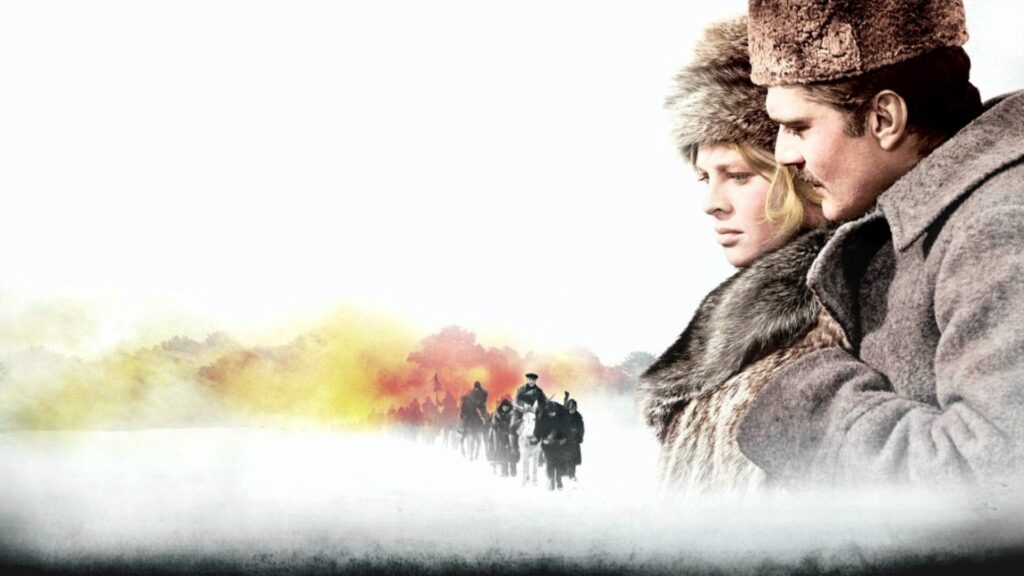
Kundura Sinema holds its first screening of the year during Valentine’s week with Doctor Zhivago, which, with its moving love story set in wartime, has earned its place among the unforgettable films of cinema history. Ahead of the film, which will be screened on Sunday, February 13, in the special atmosphere of Kundura Sinema, we recommend reading the fascinating interview that Elif Tanrıyar conducted with Hülya Arslan, who translated into Turkish the famous novel of the same name on which the film is based, published on t24.com.tr.
(You can read the full interview via this link)
Doctor Zhivago, Boris Pasternak’s only novel, is regarded as one of the classic and most controversial texts of world literature. Hülya Arslan, who translated the work into Turkish in full for the first time directly from the original Russian, tells the story behind the novel Doctor Zhivago.
Doctor Zhivago is an epic novel spanning many years… Isn’t one of its most interesting features the many parallels it draws between its hero, Doctor Zhivago, and its author, Boris Pasternak? Both have romantic feelings in the early days of the revolution, but over time they become appalled by many things and turn into dissidents. Both are poets, and both are criticized because their poetry is individual rather than social. Both have to face the danger of exile at some point in their lives, yet because they are bound to their homeland by a very great love, they do not leave it despite everything. Do you think this is, to some extent, the author’s own life story?
Doctor Zhivago is the only novel that Boris Pasternak, a poet at heart, had dreamed of writing ever since his earliest years as a published author. At first he considered calling the work “Boys and Girls.” We know that he dreamed of writing a novel that he would build on his own experiences across different periods and strengthen with his personal life.
In 1945, against the backdrop of the social developments that followed Soviet Russia’s victorious emergence from World War II, Pasternak found the right conditions to fulfill this wish. Working from the draft he had made at the start, he planned to finish his novel in about six months. On February 1, 1946, he wrote to his cousin Olga Freydenberg: “I have started a long novel that I will write drawing on the ‘sources’ I accumulated in the most passionate years of my life. I am in a hurry to finish it by the time you come in the summer.” However, his plans and what life brought did not match up. Pasternak had to give priority to literary translations to earn a living, and his work on the novel was frequently interrupted. As events unfolded, he drifted to some extent from the main idea he had envisioned. The scope of the novel widened. The work opens with the last years of the Tsarist era. Through the eyes of the main characters, still students at the time, the events of 1903–1905, in which the Socialist revolution first made itself heard, are depicted against the backdrop of the Moscow of those days. World War I, the revolution of 1917 and the birth pangs of the Soviet Union that followed are presented as a vivid slice of life. The novel ends with the end of World War II. In short, a period of roughly 40 years, of great importance not only for the territory of the Soviet Union but also for the world’s political balances and social developments, is told through the life of Doctor Zhivago. Naturally, a work spanning such a broad stretch of time cannot help but parallel the life of its author. Like other writers and artists of his generation, Pasternak at first approached the revolution with faith. In later years, however, certain practices shook his trust. He never compromised where his identity as an intellectual was harmed. In my view, this is also the most fundamental point of overlap with the novel’s protagonist, Doctor Zhivago.
In fact, I think the title of the novel deserves to be examined in terms of the problem of loss of meaning in translation. Our hero’s surname, “Zhivago,” comes from the Russian verb “to live.” In an interview, Pasternak says that as a child, in a hymn they sang at church, Jesus was referred to as the eternally living (jivago) and that he kept repeating this to himself in his mind, adding that even back then he decided it would become the name of one of his heroes.
One of its greatest admirers, Italo Calvino, said: “In the middle of the 20th century, the great Russian novel of the 19th century has come back to visit us, like the ghost of King Hamlet.” Do you also think that Doctor Zhivago is a novel with qualities and a value comparable to the great Russian classics?
Pasternak was a writer who grew up with the 19th-century Russian authors. He is known to have attended gatherings at Leo Tolstoy’s home. The leading writers of the period in which he grew up came from the same circles as his father, a painter, and his mother, a musician. So he nourished his passion for literature in a rich environment.
It is possible to see traces of this in his work. In this context, we should emphasize that, contrary to what one might expect, he is closer to Dostoevsky than to Tolstoy. When talking about Lara, I mentioned her connection to Dostoevsky’s Sonya. We can continue from there. In Lara’s husband, Pavel Antipov/ Strelnikov, too, one can find strong parallels with the Raskolnikov of Crime and Punishment. Throughout the novel, our hero Zhivago is already under the influence of Blok. He constantly discusses him and quotes from him. The long winter nights deep in Siberia are spent reading Pushkin and Chekhov. Pasternak, who read passages from the novel to his friends while writing it, says that his understanding of religion differs from Tolstoy’s, and he stresses that he wants this to be understood in his work. If you look closely, his social stance in terms of individuality is also somewhat distant from Tolstoy’s.
Now let us come to the great love between Doctor Zhivago and Lara… Do you think this romantic love story is a theme placed in the foreground as a kind of setting, a device, so that the author could convey to the reader what he wanted to say about the Soviet revolution? Or is it a natural reflection of the well-known romanticism of Russian literature?
I believe love lies at the very center not only of Russian literature but of world literature as well. In my opinion, for a work to be immortal, it must not stray too far from real life. And for that, of course, love is needed. As I mentioned above, the love between Zhivago and Lara is so strong that they share with each other their responsibilities toward their spouses and try to help each other. What makes their love so powerful, and what allows the reader to be swept away by it without getting caught up in moral questions, is their relationship with life. Their overlapping philosophies of life. The fact that they never lose the ability to judge what is happening around them by their own values. The fact that they live their love unconditionally is very important in this sense. And of course, for a work covering a period of more than forty years, this is an extremely fitting framework for conveying many more messages.

What differences do you see between Pasternak’s prose and his poetry? And what was the process of translating the poems like for you?
Translating the poems of poets like Pasternak, who play a great deal with sounds and do so very successfully, is quite a challenging task. Unfortunately, in many places it is not possible both to capture the meaning and to convey the same sound and tone. I took care above all to avoid any loss of meaning. Güven Turan made extremely subtle corrections to my work and shaped the style of the poems. I think it was important at this stage that we worked together with a Turkish poet, and in the end it raised the quality. I must say that the poems I had the least difficulty translating were the love poems written to Lara, because by the end of the book I was already so immersed in those feelings that the poems became their crowning moment. But there are many poems with religious content, inspired by the Bible. I must say that a great deal of effort went into those.
The novel was also adapted for the screen in 1965 and won five Oscars. It also holds the title of one of the highest-grossing films of all time. What would you like to say about the film adaptation? As one of the people who knows the novel best, do you think it is a successful adaptation? Are there many changes, or is it faithful to the novel?
I pointed out that the book has many layers. Of these layers, the film is based on a love between two people, the love between Lara and the Doctor. With the music and other details, this was done extremely successfully. In short, it is fair to call the film a successful adaptation of the love story strand of the novel Doctor Zhivago. However, it would be a mistake to watch the film and come away thinking, “I know the novel Doctor Zhivago inside out.”
***To read the full article CLICK HERE – Elif TANRIYAR / t24.com.tr (Source)