28 March 2023
Rimini Protokoll, the Berlin-based collective that has been developing different forms of storytelling around current issues and new realities ever since it was founded, comes to Beykoz Kundura with “Conference of the Absent.”
Ferdi Çetin*

“Theater” and “presence”: two fundamental concepts that have been mentioned in the same breath throughout the history of the dramatic tradition… The experience built around the idea of the “now” and the “here,” meanwhile, has always been shaped by an emphasis on the presence of the actor, owing to the central position of the play text. For the aim is for the actors to bring the characters – who emerge from the fictional world set out by the playwright and, in turn, by the play text – face to face with the audience in the present moment of the stage. Bringing the concepts of “theater” and “absence” together therefore appears to us as a relatively new approach. The idea of “absence,” which the theater theorist Gerald Siegmund theorized through dance, has been masterfully put into practice by the German director and composer Heiner Goebbels in works that blur the boundaries between theater, dance, opera, installation and concert. Alongside his artistic practice, Goebbels discusses the idea of absence in detail in his essay Aesthetics of Absence – How It All Began. Among all the dimensions of absence the director points to, the idea of “removing the performer from the stage” is the most striking. First moving the performer away from the center, and then gradually removing them from the stage altogether, are the most fundamental strategies we encounter in the director’s pieces. In this sense, Heiner Goebbels has taken his place among those who have made the best use, in stage practice, of the avant-garde experiments that emerged in various periods of the 20th century. It would now be fitting to follow this thread further, keeping in mind above all the “dehumanization of the stage.”
When we add to the point I made at the outset the idea of the “posthuman,” which is being hotly debated in every field of art and in philosophy, we will see an extremely practical ground opening up before us for making sense of many of the works we see these days. To draw a brief connection and move on: when the avant-garde explorations of the 20th century are read through the philosophical perspectives of the “posthuman,” we realize that works in the performing arts in which the human is not at the center are not so far away from us after all. Especially at a time when, with the outbreak of the pandemic, the destruction humans have wreaked on the planet and our relationship with nature have begun to be questioned faster than ever before, the performing arts, too, continue to contribute to this debate with current practices.

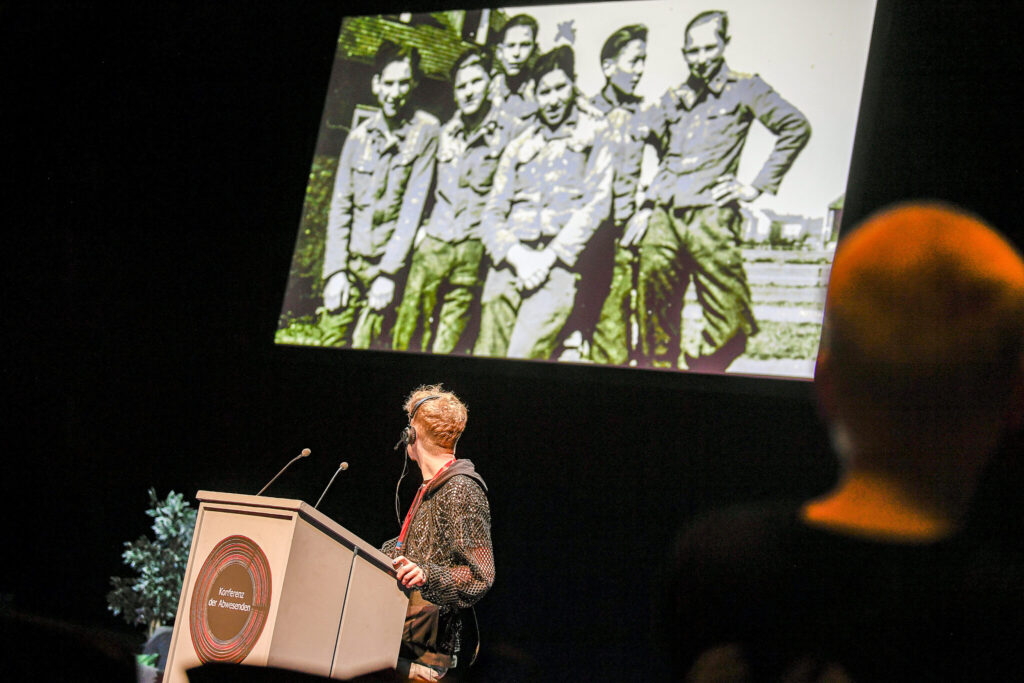
At this point, even a brief look at the works Beykoz Kundura has brought to audiences in Istanbul is enough to follow the debate in question. For example, Rimini Protokoll’s Uncanny Valley, which Beykoz Kundura presented to audiences online via a digital platform during the pandemic, put a robot controlled by artificial intelligence in front of the audience. Chilean writer and director Manuela İnfante’s play How to Become Stone, on the other hand, was concerned with how an aesthetic could be created by “imitating” an issue rather than “representing” it. Now we are about to see another play by Rimini Protokoll: Conference of the Absent. In this play, too, we encounter all the debates and practices touched on so far. The concept, text and direction of the play are by the collective’s founders, Helgard Haug, Stefan Kaegi and Daniel Wetzel. Setting out from a position that inverts the ideas of representation and presence, Conference of the Absent puts not actors but audience members on stage in front of the audience. The speakers who “could not attend” the conference have been chosen from real life, and in this sense the talks also have a “documentary” quality. Among the speakers, alongside people from various professions such as a doctor, a lawyer and an engineer, historical figures who survived genocide are also “absent.” Let’s take a closer look at the play.

Parallel to the idea of the posthuman, which is debated on a conceptual level, another widely discussed issue is the carbon footprint. Performing artists traveling thousands of kilometers, and the international circulation of productions with enormous sets in order to give just a few performances in a city, have become a current problem that, with the pandemic, is now open to debate in the performing arts. Among the practices that people want to adopt, or have begun to adopt, are the idea of artists creating work with local artists instead of traveling with a large team, and the idea of a production being made by local creators with local materials rather than a ready-made show being sent on tour. Conference of the Absent is almost the embodiment of these debates. The play sets out from a crisis and rejects the idea of transporting both the speakers who are to take part in the conference and the play’s set. This means that the speakers featured in the conference have to be represented on stage, and it falls to the audience to meet this expectation. The set, meanwhile, is put together from whatever scenery already exists at the venue where the play is staged.

Beyond its response to these debates, Conference of the Absent has another striking feature: the idea of absence is met formally by the fact that the speakers of the “fictional” conference in the play are not present “there” and “now.” This idea of absence, explored at the level of form, is also present in the content of the conference speakers’ talks. To give an example, one speaker’s inability to move is cited as the concrete reason why they cannot travel. In other words, the speaker has a body they cannot move and needs a moving body to represent them on stage. Another speaker, for instance, turns out to be a lawyer, who comes to the fore in cases concerning the ‘absence’ of justice. Once again, in this situation ‘bereft’ of justice, they need a performer to represent them. And the list goes on… In short, Conference of the Absent addresses the idea of absence on the levels of both form and content.
In Conference of the Absent, which manages to bring together all of the debates mentioned above in the performing arts in an age of global crises and to embody them exceptionally well, the audience has to go on stage and “play” in order to be able to watch the play. In this way, the problem of the conference speakers’ absence is resolved “through a displacement,” and the absent bodies on stage are replaced by the bodies present in the auditorium. It is a formula that also calls into question the sharp boundaries between performer and audience. From the moment audience members go on stage to give a talk at the conference, their speech texts are handed to them in envelopes, and the technical equipment they will need during the talk is provided with the help of a technical desk that is also set up on stage; all that is left is to listen to the instructions and deliver their talks. In this sense, Conference of the Absent is a play that is renewed with every performance. It is an opportunity not to be missed to experience the play from the stage.
*This article was originally published on Argonotlar.com.