06 February 2026
An Evening at Beykoz Kundura is an event series that unfolds over Sundays, where food, conversation and music come together in a single flow. In these gatherings, which begin as the day slows down, audiences move on to the concert hall after dinner and come together to the sound of jazz.
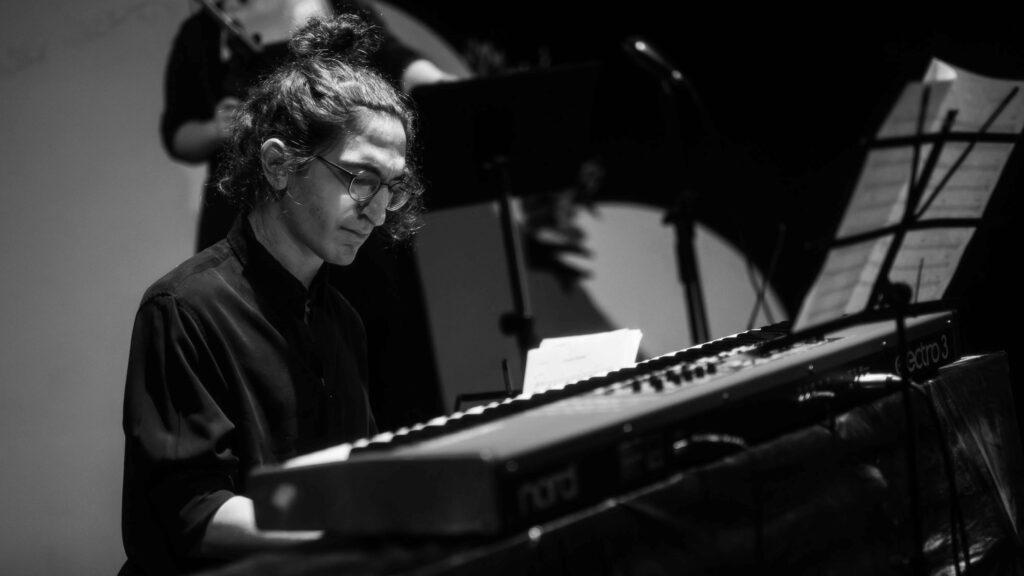
Taking shape amid the natural atmosphere of Beykoz and the industrial heritage of Kundura, the series places sharing, listening and time spent together at its center. Every Sunday, An Evening at Beykoz Kundura welcomes different musicians and projects, making music a part of the evening’s natural flow. Cenk Bonfil Trio, who will take the stage as part of the program on Sunday, February 22, answered our questions.
What need gave rise to Cenk Bonfil Trio? Was it only a shared love of certain songs that brought this trio together, or was there also another search that nourishes you musically? Do you think this partnership becomes more visible in venues that slow music down a little and make room for listening?
We could say our main motivation was to play songs we all love together. Or rather, we are curious to see what we can do with these songs together. Although Efe and I (Cenk) have performed before, both at Kundura and elsewhere, with other musicians, this will be our first time on stage as this trio. We have put together our setlist, and everyone brought something to it. We are curious to see what will come out of these in rehearsals and on stage, and how the audience will react. And yes, as musicians, playing in a venue that makes room for listening to music and slows down the moment definitely gives us a special kind of pleasure.
The three of you have very different musical backgrounds: conservatory, academia, orchestra, theater, composition… What kind of space do these differences open up for you when you play together?
Naturally, these different musical backgrounds mean that each of us has things we do better and things we don’t do quite as well. Speaking for myself (Cenk), for instance, I have always felt that I think more like a composer than a pianist, and that I approach performing that way too. This means an environment where we can push one another, where we will sometimes feel space opening up and sometimes perhaps feel constrained, but where in the end something new and uniquely ours will emerge.
When you play as a trio, how does leadership circulate in the music? Do the moments guide you, or is there a silent agreement between you that has formed over time?
Rehearsals usually involve discussing things and deciding together how we will play each part. Of course, during this process we fix some things and decide that we will do them a certain way. For other parts, we prefer to leave them more open and hand the lead to one of us. That decision is usually made in rehearsal as well. But because of all sorts of factors, such as our mood on the day of the show, how we feel about our own performance, the technical setup and the audience’s reaction, we always let the moments lead us too. Naturally, there are many times when this produces much better results.
When building your repertoire, what do you pay attention to beyond “playing well”? What is it about the songs you choose that holds you together as a trio?
As we said earlier, it’s about all of us enjoying the songs and finding room in them, to a greater or lesser degree, to add something of our own, along the lines of “what if we did this part like this?”
How planned is improvisation for you, and how truly “unknown”? How would you describe those moments on stage when you catch an idea coming from one another?
To be honest, unless we’re talking about “free improvisation” in the full sense, improvisation is never one hundred percent “unknown.” After all, we improvise over the existing structure of the song we’re playing. But that definitely doesn’t take away from the fun and curiosity of it. On the contrary, surprising one another while moving within a given musical structure can be even more enjoyable. Otherwise, you could do “anything” anyway; but here, when we hear something new from one another within a structure everyone knows, it comes as a real surprise. And the moments when the others catch that surprise and respond to it are simply delightful.
The trio’s founding statement speaks of “colliding very different musical backgrounds.” Which collision has surprised you the most so far?
As we said, this will be our first time playing together as a trio. To be honest, we haven’t really had the chance to experience that yet, but we are very excited about what might emerge and about sharing it at Beykoz Kundura!
You perform in different venues; sometimes music, food and conversation come together in a single flow. How is playing in a venue with a strong historical memory like Beykoz Kundura reflected in the trio’s music? Can the same piece take on a different character here?
Of course. From the moment we arrive at the venue for the soundcheck, to the first moment we step onto the stage after the audience has come in, or at any point after we start playing the set, we can make spontaneous new decisions depending on the atmosphere. The historical atmosphere and the audience of a repurposed venue like Beykoz Kundura excite us too. When playing in venues like this, unplanned things can happen; what we do in a piece we weren’t all that excited about can end up surprising us. Seeing that happen is probably one of the most enjoyable parts of what we do.
Since you are still at the beginning as a trio, what is the most exciting part of this partnership for you?
Are there things you would describe as “we don’t know yet, but we want to find out”?
So far we have always played well-known jazz standards that we love. As we keep playing them, we are very curious to see the new forms these songs will take, the new ideas that may emerge as we perhaps grow tired of the way we play them now, and the stylistic directions we will go in, as well as the dynamic that will emerge when we work on original compositions; and we can’t wait for the stages that will come our way to try these out.
What could a listener who is new to jazz pay attention to while watching this concert at Beykoz Kundura in order to connect more easily with your music?
The best way might be to shift the focus away from the instrument in the foreground at that moment to what the other instruments are doing. For example, listening to the double bass while the piano is soloing, or to the piano while the vocalist is singing the song. Since we can grasp what is in the foreground more easily even while focusing on something else, this way they may better hear the music as a whole and the interaction within the group. We think this is a practice that always offers a much more rewarding listening experience. By the way, let us give a little hint about the concert by sharing each band member’s favorite song in the set. Since these are the songs where we have the most potential for fun, listeners might want to pay particular attention to them. For Efe, it’s Sunny Side of the Street; for Cenk, You’d Be So Nice To Come Home To; and for Güneş, Green Dolphin Street.
Interview by: Zeynep Özbakış, Beykoz Kundura