18 June 2023
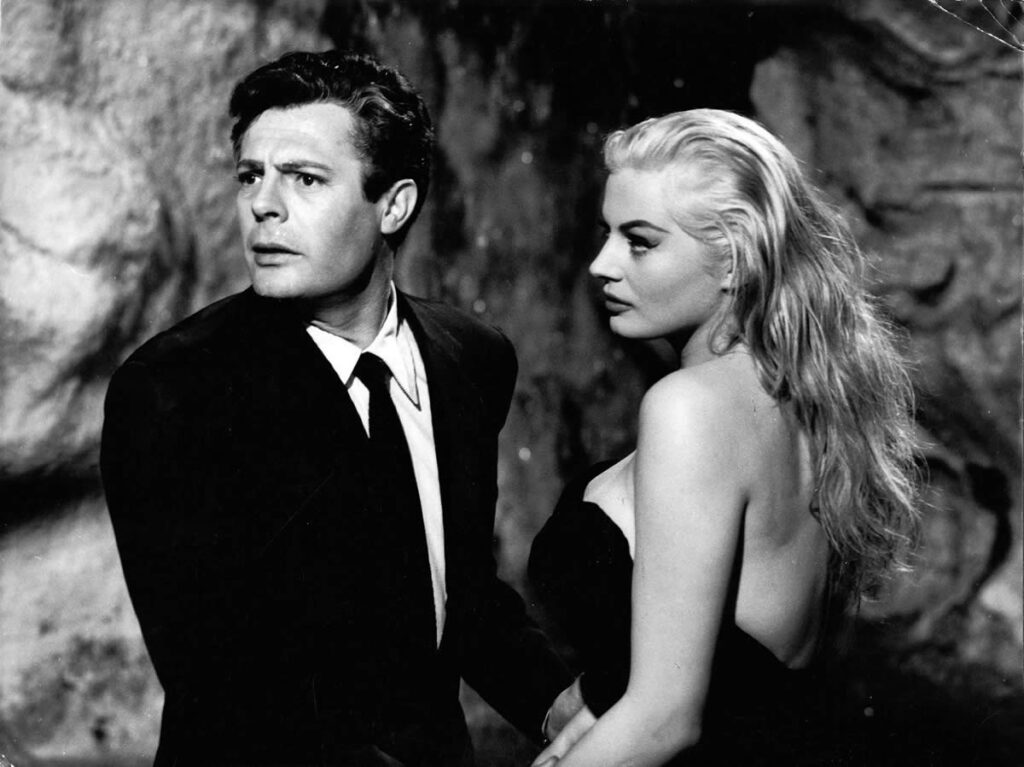
Fellini’s Palme d’Or–winning masterpiece “La Dolce Vita” (1960) is, as audiences and critics alike agree, “Not just a film, but a true work of art.” Pushing the boundaries of cinematic art with its filming techniques, dream sequences and extraordinary characters, the film screens in a restored print on August 4 and 20 at A Summer Night Festival.
KUNDURA BLOG | LENS

7 Days and 7 Nights in 1960s Rome
Federico Fellini’s characteristic magical realism finds an unforgettable example in “La Dolce Vita”, which takes us on a 7-day journey through the city’s nightlife in the footsteps of Roman journalist Marcello Rubini. Encountering people from all walks of life—artists, aristocrats, journalists, models and sex workers—Marcello soon begins to question both his own values and the complexity of human nature.

A BOLD LOOK
The term “La Dolce Vita” means ‘the sweet life’ in Italian and refers to a lifestyle that emerged in Italy in the mid-1950s. Taking viewers on a journey through Roman nightlife and hedonistic passions, the film criticizes the decadence and emptiness of modern society, while not mincing words about the worlds of media and art either.
Capturing the social and moral transformation of 1960s Italy with a bold eye, Fellini—through long tracking shots, striking compositions and inventive editing—also heralds a new aesthetic sensibility and an experimental approach in cinema. Combining visual richness, powerful scenes and symbolic storytelling, the film offers viewers a visual feast.

THE VATICAN FOUND IT FILTHY
Causing a major scandal on its release in 1960, the film, with its critique of Roman nightlife and the luxurious life, was accused by some conservative groups of undermining moral values. The Catholic Church condemned the film and its director, claiming that it mocked the coming of the Messiah, and branded it “La sconcia vita” (the filthy life). Facing censorship, the film was shown in cut versions in some countries.

LONG SHOOTS, METICULOUS PLANS
The film is also famous for shoots that were quite lengthy for the time; some of its scenes were filmed over weeks and planned with great care. In particular, the scene in which Anita Ekberg frolics in the water of the Trevi Fountain, also known as Rome’s Fountain of Love, took 7 days to shoot.

THE MAGIC OF THE CAST
Its star-studded cast is unforgettable, too. Italian actor Marcello Mastroianni reaches the peak of his career in the role of Marcello Rubini, while the film’s magic is heightened by Anita Ekberg as the seductive film star Sylvia, Anouk Aimée as Maddalena and Yvonne Furneaux as Marcello’s former lover Emma.

THE BEGINNING OF A LEGENDARY PARTNERSHIP
“La Dolce Vita” also marks the beginning of one of the most famous director–actor partnerships in film history. The chemistry between Fellini and Mastroianni worked so well that the duo went on to work together on “8½” (1963), “Juliet of the Spirits” (1965), “Fellini Satyricon” (1969), “Roma” (1972), “Amarcord” (1973), “City of Women” (1980), “Ginger and Fred” (1986) and “Intervista” (1987).

LUMINOUS IMAGES
Its visual storytelling and Otello Martelli’s luminous black-and-white widescreen cinematography are among the film’s most striking elements. Demonstrating the power of cinematic art through its images, compositions and symbolic imagery, the film holds an important place in film history thanks to its aesthetic visuals, profound characters, social critique and inventive storytelling.
Regarded as a national treasure of Italy, “La Dolce Vita” is home to many unforgettable scenes and cultural icons. The statue of Christ suspended above Rome and, above all, the scenes at the Trevi Fountain are considered among the most iconic and powerful moments in cinema history.
MUSIC BY NINO ROTA
“La Dolce Vita” is a classic remembered not only for its visual splendor but also for the enchanting music of Italian composer Nino Rota. As the film explores the nightlife and bohemian existence of Rome’s high society, Rota’s compositions perfectly capture this atmosphere. Imbued with melancholy, romance and a spellbinding mood, his music accompanies Marcello’s complex emotions and the inner worlds of the characters. The famous theme that shares the film’s title captures an enchanting melody and draws viewers into the magical world of Rome. Evoking the film with just a few notes, this iconic theme showcases the genius of Nino Rota.

FROM CANNES TO THE OSCARS
Winner of the Palme d’Or at the 1961 Cannes Film Festival, the film also won the Academy Award for Best Costume Design (Black-and-White). At the David di Donatello Awards it was named Best Italian Film and won Best Director, and it took home the awards for Best Actor, Best Original Story and Best Production Design from the Italian National Syndicate of Film Journalists.

“Both mesmerizing and disturbing”
Critics, too, have showered praise on “La Dolce Vita”. Here are a few…
“‘La Dolce Vita’ represents the beginning of a new era in cinema. Fellini’s creativity and visual aesthetics make the film unforgettable.” – The Guardian
“The world Fellini created with ‘La Dolce Vita’ is both mesmerizing and disturbing. The film explores in depth the emptiness and spiritual collapse of modern society.” – The New York Times
“‘La Dolce Vita’ offers a mesmerizing dreamlike experience. Fellini’s visual storytelling and Marcello Mastroianni’s performance place the film among the unforgettable works of cinema history.” – Empire
“Fellini’s ‘La Dolce Vita’ is not just a film, but a work of art. The visual compositions, symbolic storytelling and depth of character in this film push the boundaries of cinematic art.” – Sight & Sound

SOURCE OF INSPIRATION
“La Dolce Vita” is also one of the emblems of the dawn of a new era in cinema. It is cited as one of the leading examples of the Neorealist movement, and it has inspired many classics, from “Blow-Up” (1966) to “Midnight Cowboy” (1969), and from “The Passenger” (1975) to “In the Mood for Love” (2000).