25 May 2022
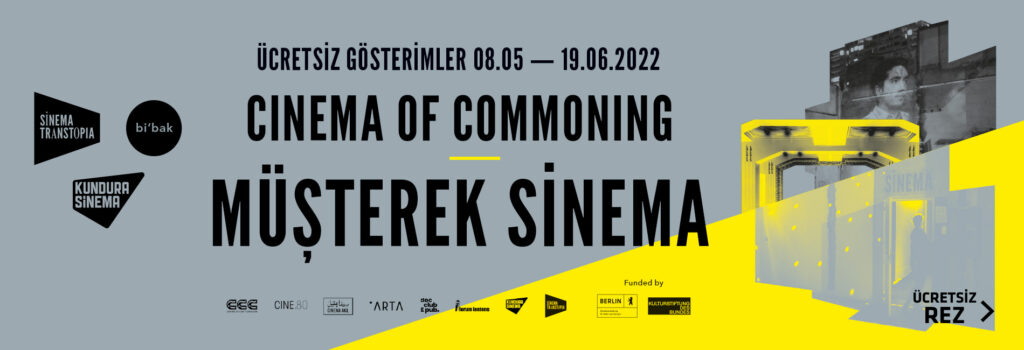
As the Türkiye screenings of Cinema of Commoning, the project bringing together 8 alternative cinemas and cinema centers from 8 countries, take place at Kundura Sinema, how about getting to know these 8 cinemas up close?
As part of the project, initiated under the leadership of the Berlin-based cultural project space bi’bak and bringing together Kundura Sinema from Türkiye, Sinema Transtopia from Germany, Documentary Club from Thailand, Cinema ARTA from Romania, Forum Lenteng from Indonesia, Cinema Akil from the United Arab Emirates, CCC from Chile and Cine Geração from Angola, the 8 films selected by the cinemas’ curators are meeting audiences simultaneously in Istanbul, Berlin, Dubai, Chile, Cluj, Jakarta, Bangkok and Luanda. Here are those cities and cinemas…
SİNEMA TRANSTOPIA
How can a new kind of cinema be created collectively in a transnational society? Bi’bak’s cinema experiment SİNEMA TRANSTOPIA explores cinema as a space of social discourse, exchange and solidarity. Its curated film series brings together diverse social communities and connects places both nearby and geographically distant; it links past, present and future and, moving away from a Eurocentric gaze, embraces transnational, (post-)migrant and postcolonial perspectives. SİNEMA TRANSTOPIA is a different kind of cinema, one that belongs to both local and international communities at once and understands cinema as an important public space of sociality; it regards film history as highly important for cultural memory work and is oriented toward diversity in film culture and film art. SİNEMA TRANSTOPIA builds a bridge between urban practice and film in order to create a space at the Haus der Statistik on Berlin’s Alexanderplatz that makes access possible, sparks debate, and educates, mobilizes, provokes and encourages.
KUNDURA SİNEMA
Kundura Sinema, a venue in the north of Istanbul that has been transformed into a creative space and film studio, sits at the heart of Beykoz Kundura, a significant industrial heritage site. With our first project, Kundura Hafıza, we carried out an excavation into the past in order to build a new cultural identity. In our programs, by finding and creating new stories with an explorer’s approach and by reconstructing narratives of the past, we also maintain a critical distance. This cultural space of ours is surrounded by film sets and building facades, so when audiences come to the cinema, they pass by film crews, lighting equipment and groups of extras wandering around.
DOCUMENTARY CLUB
Documentary Club was founded in 2014. We are a community working in the field of visual media, bringing great documentaries from all over the world to the Thai market. We strongly believe that through film, people can gain a better understanding of the world around them, and that this will ultimately inspire creative social change. Documentary Club is not only a project that aims to introduce people to documentary films; it is also a club where people can share their diverse interests in art, culture and society. We focus on hosting entertaining and inspiring documentaries as well as talks and events that broaden participants’ perspectives. We also run a cinema called Doc Club & Pub. We opened it in 2021 and hope it will create a space not only for films but also for art and culture.
CINEMA ARTA
Cinema ARTA is an independent cinema in Cluj-Napoca, Romania, that shows non-mainstream films. Opened in 1913, it is one of the oldest cinemas in the region. It is a cultural center focused on audiovisual content, acting as a catalyst for an independent and creative sector and aiming to create cultural experiences that unite and inspire the people who attend its events and become meaningful to them. Its mission is to promote cultural values, tolerance and diversity by showcasing various art forms and encouraging interaction between them and people.
FORUM LENTENG
A non-profit organization based in Jakarta, Forum Lentengwas founded in 2003 by artists, academics, cultural activists and students. The collective focuses on alternative education, using audiovisual media as a tool for learning about and raising awareness of socio-cultural issues. Our programs, created together with local collectives in other cities and on other islands across Indonesia, are about empowering media in order to decentralize the production of narratives and to place these narratives in the hands of the public itself, through many local, interdisciplinary programs such as Akumassa (community-based media education), 69 Performance Club (strengthening the performing arts), the ARKIPEL International Documentary and Experimental Film Festival, and more.
CINEMA AKIL
Cinema Akil is an independent cinema platform that brings quality films from around the world to audiences in the UAE. Showcasing directors and filmmakers across the decades, Cinema Akil aims to spark awareness of and interest in film and the cinematic arts. Starting out as a nomadic cinema in 2014, Cinema Akil has organized more than 60 pop-up cinemas in Dubai, Abu Dhabi and Sharjah, attracting more than 65,000 attendees. In September 2018, Cinema Akil opened its first permanent venue in Al Quoz, Dubai, becoming the first non-mainstream cinema in the GCC. Cinema Akil is a member of the Network of Arab Alternative Screens (NAAS), whose members from the MENA region include Metropolis in Beirut, Zawya in Cairo and Cinematheque du Tangier in Morocco.
CENTRO DE CINE Y CREACIÓN CCC
CCC is a non-profit organization that disseminates culture through cinema and intersecting disciplines and fosters dialogue between local and international arts and neighboring communities. It is based at Raulí 571, in the heart of downtown Santiago. A large, restored old house, it is home to a 30-seat cinema and an open-air space dedicated to screenings, premieres, and festivals and collaborations. The house also has offices and spaces devoted to production and education, workshops and seminars, as well as a gallery and a coffee/bar meeting point. By bringing closer to us worlds that do not otherwise intersect with our country, we encourage the democratization of networks, and we want to have a positive impact on the city of Santiago and its local surroundings.
CINE GERAÇÃO
At Cine Geração, we screen Angolan and African films every Thursday at 18:30 in the backyard of Geração 80, an independent production company in Angola. Sharing Angolan and African stories and celebrating their cultures, as well as bringing the community together through cinema, is the main goal of Cine Geração. Cine Geração is also a way to network with creative professionals in the film industry and other art fields, be they university students, up-and-coming filmmakers or cinephiles. At the end of each screening, we hold an open-mic conversation with the cast, director and/or film crew, on site or via Zoom, or we show a short video with a message from the filmmakers. Cine Geração is a place where people learn from one another’s stories by asking questions about the current state of cinema in Angola and on the African continent. The program is curated around a theme that changes every month.
bi’bak and various international partners are behind Cinema of Commoning, a project that aims to build a network and to gather knowledge about cinemas and cinema initiatives all over the world. Through mixed conversations, it hopes to create a statement that puts forward a future model of an alternative cinema facing the “public” in terms of accessibility, artistic freedom and financial sustainability. The project consists of two steps: starting in March, a collectively curated film program will be screened at partner cinemas in Bangkok, Jakarta, Istanbul, Dubai, Santiago de Chile, Cluj and Luanda. In June, a three-day symposium in Berlin will bring together partner initiatives, film professionals and cinephiles, with the aim of developing further concepts and strategies for sustainable spaces dedicated to film culture. In light of all this, Cinema of Commoning regards cinema as a transnational space for artistic and social practice, a space of public discourse, an agent of cultural memory and urban heritage, and a space where rarely accessible film and video formats are preserved and distributed.