05 July 2023
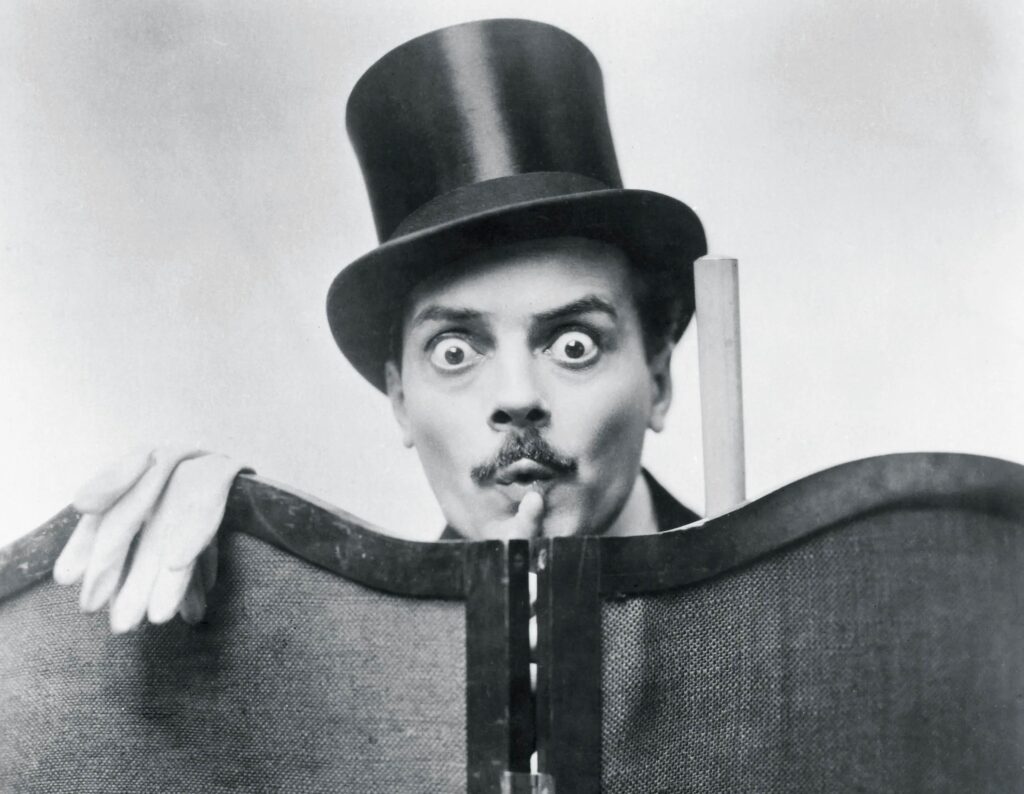
The last film by Max Linder, cinema’s first international star and the unforgettable French actor of slapstick comedy, “King of the Circus” (1924) comes to A Summer Night Festival in a comprehensive restoration. Screened with a live performance by Islandman, the film is also considered a forerunner of Charlie Chaplin’s comedy classic “The Circus”, made four years later.
KUNDURA BLOG | TRANSLATION

Pamela Hutchinson – silentfilm.org*
In “King of the Circus”, which he completed before his suicide, Max Linder fulfills a childhood dream. From a very young age, he had been expected to take over the family business and become a winegrower. Years later he would write, “Nothing could have been sadder to me than the idea of a life full of vineyards.” What fired his imagination was the thrill of performance. He adored the big-top circuses and traveling theater troupes that only rarely came to town. He especially loved the gruesome Grand Guignol shows at the annual festival. And finally, at the age of 40 and in a film studio in Austria, Linder got his chance to run away from home and join the circus.
Shooting on “King of the Circus” began in December 1923 at the Vita-Film studios in Vienna, the Austrian capital. In the film, Linder plays a young aristocrat who falls in love with a trapeze artist, but in order to win the chance to marry her, he must master the skills of the circus. He devises an elaborate trick to impress the crowds with a heroic stunt, but at the last minute circumstances require him to do it for real.

At this point, comparisons with Charlie Chaplin’s later film “The Circus” (1928) are inevitable – swap Linder’s drunken count for the Little Tramp and you will find that the stories have a great deal in common. The films, however, are very different from each other in tone and in action. Where these two big-top films really invite comparison is in the behind-the-scenes turmoil and the delays during their production. While Chaplin’s film was overshadowed by a highly complicated and very public divorce, Linder’s troubles foreshadowed a far darker fate.

Linder had married Hélène “Ninette” Peters that summer, and Ninette was pregnant before the couple arrived in Vienna for the shoot. Although the news seemed to soothe Linder’s fits of jealousy, neither their relationship nor work at the studio was going smoothly. Toward the end of January 1924, a local newspaper reported that not a single scene of the film had yet been shot, and wrote that the delays were caused by Linder disliking the apartment he was staying in and refusing to work in a studio that was a degree colder than he had expected – which may well have been a necessity stemming from an accident he had suffered the previous year. Another concrete reason was that the original director had suffered a heart attack and returned to Paris, and was replaced by Édouard-Émile Violet. There was also a report that the leading lady, Vilma Bánky, had been pushed through so many retakes that her arms went into spasm. The reporter in question would later have to retract the claim that Linder had resorted to “trickery” to delay the film, but more serious troubles lay ahead.
On February 23, 1924, the press reported that Max and Ninette had attempted suicide by taking an overdose of barbiturates. Both were taken to a local sanatorium for treatment and survived, and the police did not even consider it necessary to file a report on the incident. Twenty months later, the couple attempted suicide in a similar way, leaving their infant daughter Maud an orphan.

That is why “King of the Circus” is Linder’s last completed feature film. His previous film had been somewhat different. Directed by Abel Gance, “Au Secours!” (1924) is unusual in many respects, not least in that it is not, strictly speaking, a comedy. This two-reeler is essentially built around horror-film elements combined with a few comic and spine-chilling touches. In it, Linder plays a newlywed who takes a bet that he can stay in a haunted house from 11 p.m. until midnight. It was also the project with which Linder chose to return to France after his second, and somewhat disappointing, stint in Hollywood.
“King of the Circus”, on the other hand, is a longer film that promises, and delivers, a more straightforward script. It gives Linder ample opportunity to slip into his famous “Max” persona and show off his slapstick skills. Linder plays the playboy aristocrat Comte de Pompadour, the “hopeless nephew” of the domineering uncle whose ward he is. The young count defies his uncle, who insists that he marry, and tricks him so that he can slip away to a party, which leads us into the first long comic sequence as Linder wreaks havoc in a nightclub. The jokes are usually at Pompadour’s expense. Even before he leaves his hotel room, he is in trouble with a coat hanger caught inside his dinner jacket, and at the end of the scene he exits by sliding off a hanger from which that same jacket is hanging. The implication is clear: Linder will not be playing an elegant gentleman in this film.

At the end of the night, Linder, very drunk and disoriented, tries to get into bed, or launches into a hilarious routine in which he cannot manage to hang up his hat. The final joke on Pompadour is one we have been in on all along – he is not in a bedroom at all, but in the display window of a furniture store. Pompadour wakes up hungover to find a crowd on the other side of the glass looking at him with contempt. Fortunately, the moment of humiliation is brief, because the count is too drunk to grasp his situation. With this scene, Linder’s discomfort with being in front of an audience, or with becoming part of one, emerges as a theme.
The count’s first encounter with the trapeze artist Ketty is one of Linder’s dark jokes – and he was known for them. Struggling to choose among three prospective brides selected by his uncle, Pompadour decides to fire his pistol at their photographs, and whoever’s photo he hits will become his wife. Instead, he shoots Ketty, who happens to be passing by, and the bullet grazes the young woman’s arm. Once Pompadour’s romantic mission has been established, the film shifts into a more conventional comic mode. The comic highlights include Pompadour’s bashfulness among the crowd at the circus, his mishandling of a flea circus (an accidental act of revenge on the audience?), his run-in with a troublesome troupe of clowns and, best of all, the circus training camp he improvises in his hotel room.

This last consists of a rope, some precariously balanced furniture, a stepladder and the deft assistance of his tall manservant. Every move seems to carry great risk yet is executed with deceptive skill. This is pure clowning, only without an audience. The place where Pompadour performs his final feat, meanwhile, is behind the scenes – by “defeating” the lion, he earns the respect of the ringmaster and finds the courage he needs to impress the girl of his dreams. Greeted with applause by the audience, he will take his bow under the lights and, at last, feel that the spectators are firmly on his side.

But the film ends in silence. Left alone together in the circus ring, the lovers sit absorbed in each other, sawdust running through their fingers, unaware even that the audience has left. The film is telling us that after Max’s moment of triumph, after the courtship and the wedding, life must go on, and two people must move forward by spending time together in private. In this final scene there is a melancholy that offers a moment of reflection: on the film, on Linder’s screen career and – with the dubious benefit of hindsight – on his marriage. It is an unexpected deep breath from one of the kings of silent slapstick, after an hour of elastic comedy.
This article was originally published on silentfilm.org.