11 October 2022

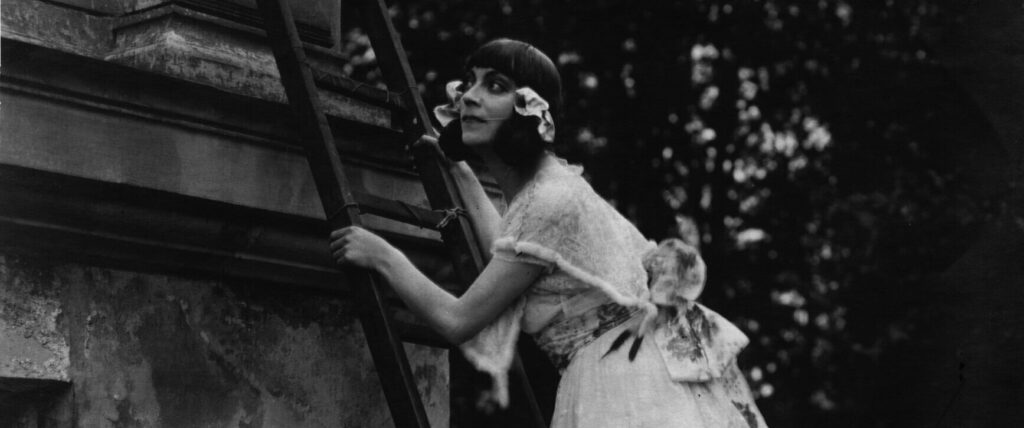
Unidentified actress [Léontine] in Bateau de Léontine (Léontine’s Boat) (Pathé Comica, France, 1911). Courtesy of EYE Filmmuseum/Desmet Collection (left). Publicity photo of Texas Guinan, 1919. Courtesy of the Guinan Family Archives, Stayton, OR (right).
Project
Cinema’s First Nasty Women is a 4-disc DVD/Blu-ray set that brings you rare silent films about feminist protest, anarchic destruction built on slapstick comedy, and suggestive gender play. Gathered from 10 international film archives, the collection contains 98 European and American silent films produced between 1896 and 1926 that spotlight slapstick comediennes and cross-dressing women of silent cinema. The women featured are truly “nasty” – they organize labor strikes, bake unspeakable pastries (and use them as weapons), shoot out of exploding chimneys, electrocute the police force, and take on a series of identities that gleefully shatter traditional gender norms and sexual propriety. The films span a wide range of genres, including slapstick, genteel farce, trick film, Western drama, and adventure-thriller.
Kino Lorber’s estimated release date is 2022.
Co-Curators: Laura Horak, Maggie Hennefeld, Elif Rongen-Kaynakçı
Producer: Bret Wood (Kino Lorber)
Music Supervisor: Dana Reason (Oregon State University)
Project Coordinator: Kate Higginson (Carleton University)
Contracts Officer: Aslı Eran (Carleton University)
Research Assistants and Translators: Daniel Aufmann (University of Minnesota), Aurore Spiers (University of Chicago), Vanessa Cambier (University of Minnesota)
Participating Archives: Eye Filmmuseum, Library of Congress, Jérome Seydoux-Pathé Foundation, British Film Institute, Blackhawk Films, George Eastman Museum, Library and Archives Canada, National Library of Norway, Swedish Film Institute, San Francisco Silent Film Festival, Museum of Modern Art
Musicians and Composers: To be announced.
Project Partners: Jay Weissberg (Giornate del Cinema Muto – Days of Silent Cinema), Kate Saccone and Jane Gaines (Women Film Pioneers Project), Carleton University (Ottawa).
“Cinema’s First Nasty Women” is supported in part by the Social Sciences and Humanities Research Council.
Disc Summaries
Disc 1: Terrible Maids and Anarchic Tomboys

Mary Jane’s Mishap (G.A. Smith, UK, 1903), starring Laura Bayley. Courtesy of the BFI (British Film Institute).
Spiteful kitchen maids and madcap teens join forces to turn the home into a chaotic battlefield. Housemaids shoot out of chimneys and fiancées wield inedible baked goods as weapons against patriarchy, while headstrong girls flood and burn down their family homes. This disc also unearths the forgotten films of Léontine, the internationally popular French comic character and star of the Pathé Comica series, which released more than 21 films between 1910 and 1912. (That said, Léontine’s identity remains unknown even today!) The disc also features anarchic, rowdy and hilarious performances by Lea Giunchi, Bertha Regustus, Laura Bayley, Florence Lawrence, Berthe Dagmar, Gilbert Saroni, and Lili Zeidner.
Disc 2: Queens of Destruction

La Fureur de Madame Plumette (Madame Plumette’s Fury) (Eclipse, France, 1912), with an unidentified actress. Courtesy of EYE Filmmuseum/Desmet Collection.
The Queens of Destruction are not so different from their anarchic adolescent predecessors. They wreck the house, torment their spouses and launch a feminist rebellion in the streets. This disc presents three French female comic characters: Cunégonde (Little Chrysia), and Rosalie and Pétronille (both played by Sarah Duhamel). The actress who appeared as Cunégonde was recently identified by Elif Rongen-Kaynakçı as Little Chrysia, an itinerant stage performer and skilled film comedian who also starred in Cunégonde’s spin-off series Arabella and Zoé. Duhamel’s films similarly embrace the uproar of social protest and anarchic physical destruction, as can be seen in Rosalie Has Sleeping Sickness, Rosalie and Her Phonograph, and Pétronille Wins the Big Race (Pétronille, Winner of the Big Race). Duhamel’s body is a natural disaster, and in her film world absolutely anything is possible. This disc also includes a section built around “Tyranny at Home,” which showcases to the fullest the mischievous antics of Florence Turner, Alma Taylor, Chrissie White, and Indigenous actress Minnie Devereau.
Disc 3: Gender Rebels

A Range Romance (Bison, USA, 1911). Courtesy of the Library of Congress.
Gender Rebels explores the highly porous nature of gender in American silent films, from cross-dressing girl spies to the gender-bending slapstick of the Wild West and the frozen North. This disc includes the surviving films of writer/director/actor Gene Gauntier’s girl spy series, along with Edna “Billy” Foster’s finest performance in a Biograph film, in which the young actress was cast almost exclusively in male roles. On the Western frontier, young women disguise themselves as boys and set off on adventures to strike it rich, while other films show the gun-toting, madcap femininity of the West. This disc also includes performances by actor-producer Texas Guinan, Indigenous star Lillian St. Cyr (Winnebago), lesbian comedian Fay Tincher, and Japanese American sensation Tsuru Aoki.
Disc 4: Female Tricksters

Katherine Grant stars in What’s the World Coming To? (Hal Roach, USA, 1926).
This disc shows the dangers and pleasures that boyish, boisterous young women encounter in urban and modern spaces. While cross-dressing creates countless opportunities for accidental same-sex attraction, women look to men’s clothing as the way to brave the merciless streets of an early 20th-century metropolis. In Phil-for-Short, Evelyn Greeley appears as a Latin professor by day and a lesbian dancer by night, while in the frontier BDSM fantasy Snowbird, stage star Mabel Taliaferro plays a headstrong society girl who disguises herself as a man to rescue her father’s land from a “woman-hating” French trapper. The final set of films plays with the rapid changes in gender and sexuality unfolding in this era, from a topsy-turvy comedy set 100 years in the future, where “men are like women” and “women are like men,” to the confusing rituals, disguises and mistaken identities unleashed by a sorority initiation ceremony in She’s A Prince. It also features the rowdy, joyful performances of Renée Sylvaire, Dorothy Bernard, Louise Glaum, and Alice Ardell.
Upcoming Events
“Nasty Women 3,” Giornate del Cinema Muto (Days of Silent Cinema) (Pordenone, Italy), October 2-9, 2021.
Past Events
“Girls Will Be Boys,” Giornate del Cinema (Pordenone, Italy), October 2015.
“Nasty Women,” Giornate del Cinema Muto (Pordenone, Italy), October 2017.
“Nasty Women 2,” Giornate del Cinema Muto (Pordenone, Italy), October 2019.
“Nasty Women,” Day of Silent Cinema (Days of Silent Cinema) (Indiana University Cinema), October 2019.
“Feminist Laughter,” Festival Internacional de Cine Silente México (Mexico International Silent Film Festival) (Puebla, Mexico), November 2019.
Related Scholarship
For related scholarship and further resources, see the Nasty Women Bibliography!
Image Gallery


Cunégonde Femme du Monde (Cunégonde, Woman of the World) (Lux, France, 1912), starring Little Chrysia. Courtesy of EYE Filmmuseum/Desmet Collection.
Cunégonde Jalouse (Jealous Cunégonde) (Lux, France, 1912), starring Little Chrysia. Courtesy of EYE Filmmuseum/Desmet Collection.
“Cinema’s First Nasty Women” comes to Kundura Sinema March 8-28. Stay tuned to watch it at www.beykozkundura.com