01 January 2020
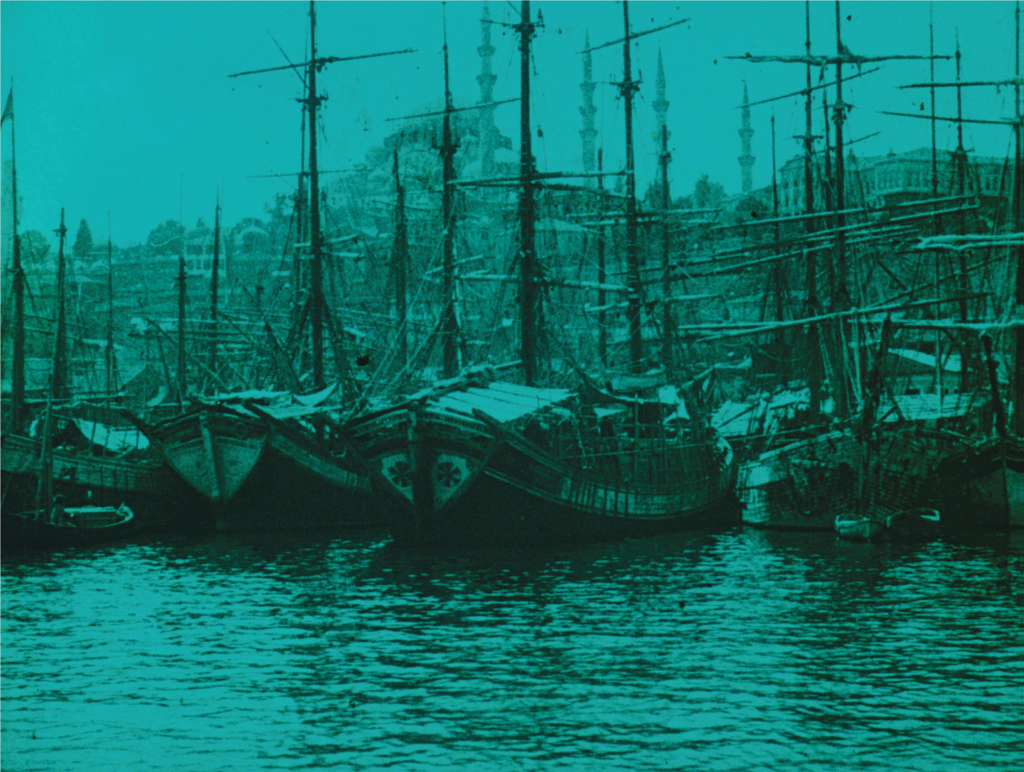
Elif Rongen-Kaynakçı’s curated program of Istanbul films, which has begun screening at Demirane, consists of short found-footage clips shot by European camera operators at the turn of the century, in the style of a travelogue. Accompanying the screenings, this article by film writer and academic Aslı Özgen, published in Toplumsal Tarih magazine, recounts the fascinating history of how Istanbul and the Bosphorus were captured on film.
Aslı Özgen
This article reflects on the translation of urban space into a cinematic element, underlining the strong role of the “fluid frame” in shaping the cinematic image of Istanbul in particular. At the same time, it sets out to trace the aesthetic precursors of fluid frames before the advent of cinema. Let us also note here that, although it falls outside the scope of this article, one of the essential steps in researching the aesthetic precursors of fluid frames is to reach into the little-known and hard-to-discover corners of film history.

Istanbul is known to have been filmed for the first time in 1896 by Alexandre Promio, the camera operator sent to the Middle East by the Lumière brothers, the inventors of the cinematograph. [1] Perfected in 1895 by Auguste and Louis Lumière, two brothers who worked as photographers and manufactured photographic supplies in France, the cinematograph could record onto a 17-meter strip of film, develop the exposed film, and, with the help of a light source, project the developed film onto a wall to show it to a large audience. Light and multifunctional, and therefore easy to carry, the cinematograph was operated by a hand-cranked lever, which made it possible to film in the streets, in crowded places, at public events and in distant lands. The Lumière brothers asked each of the photographic supply agencies they already had in various cities around the world to assign an operator, and urged them to film everyday life in every corner of the globe. Promio, too, had come to Istanbul in the footsteps of the travelers who preceded him. The bond between cinema and travel was a strong one from its very earliest days.
To put it more precisely, it is impossible to think of cinema independently of the technological inventions that transformed the perception of space and time in the 19th century: trains, steamships, bicycles, elevators, moving walkways, accelerating trams and, later, automobiles and even airplanes also gave birth to new ways of seeing.
As an art with the power to change the perception of space and time, cinema became a medium in which these new ways of seeing were put into practice, tested, and pushed to their limits to produce aesthetic experimentation. While its closeness to reality was praised because it showed what the human eye cannot see, its power to shape perception was also being discovered (it emerged, for example, that a train that was actually slowing down as it entered a station would, because of the lens effect, suddenly grow disproportionately larger as it approached the camera, thereby creating the sense that it was speeding up, and that this had the power to throw audiences into a panic). Alongside motives such as letting people experience a place or archiving an event, the Lumière brothers also used the new perspectives, that is, the new points of view, brought by modernity as sources of inspiration in shaping the aesthetics of cinema: in the films of the Lumière catalog, one notices at first an aesthetic aim of fitting maximum movement within a fixed frame; later on, one sees them setting out to explore the possibilities of the moving perspective by placing the camera on trains, on ships and on elevators.
[1] Burçak Evren, “Les Premiers Pas: 1895-1923”, Le Cinema Turc, Mehmet Basutçu, ed. (Paris: Centre Georges Pompidou Editions, 1996), p. 61.


The earliest known images of Istanbul in the history of cinema also fit into this context. In other words, the first filming of Istanbul is a moment in which, with the aim of letting viewers experience a place, the aesthetic boundaries of cinema, a new art, were pushed, and in which urban space itself gave rise to the production of a cinematic element. But that is not all: the first filming of Istanbul also makes possible a journey back to the roots of the modern culture of spectacle (temaşa) that permeates the art of the Lumières.
Promio, an operator who reflected on and experimented with the possibilities of this new invention, filmed Istanbul from the water, from the Golden Horn. With the images he recorded of the city from the water while riding in a boat moving along the Golden Horn, Promio made one of the first “tracking shots” in history. [1] According to some sources, shortly before this he had also made a similar tracking shot from a gondola moving along the Grand Canal in Venice. The fluidity of this deep, wide waterway running through the middle of both cities [2] seems to have inspired Promio to move his camera like these waters, too.
In the case of Istanbul, filming the city with a moving perspective flowing over the water would later echo in many films. For example, in the films of the French documentarian Maurice Pialat, who visited Istanbul in the 1960s, of Alain Robbe-Grillet, who shot his first feature in Istanbul with Lütfi Akad as his assistant, of Atıf Yılmaz and of many others, the shores of the city are contemplated from a boat gliding along the Bosphorus or the Golden Horn. All these long tracking shots share a common feature: they have a “fluidity” that comes from being filmed on the water. In these shots, the gentle or at times turbulent movement of the water also determines the aesthetics of the images that move in and out of the frame. Another element is that the image in the frame flows past just like the waters flowing beneath the camera. The new regime of time and the new perception of space that come with the moving perspective gain a strong foothold in cinema. What is distinctive here, however, is that water is the most decisive element. In light of all this, it seems possible to define this aesthetic element, born of translating the movement of the waters that divide the city in two into cinematic movement, as the “fluid frame.” This article reflects on the translation of urban space into a cinematic element, underlining the strong role of the fluid frame in shaping the cinematic image of Istanbul in particular. At the same time, it sets out to trace the aesthetic precursors of fluid frames before the advent of cinema.
[1] A tracking shot is a shot in which the camera moves while filming. A pan, by contrast, is the movement the camera makes by rotating from one side to the other around a vertical axis. Source: Ralph S. Singleton, Amerikan Film Terimleri Sözlüğü (İstanbul: Es Yayınları, 2004).
[2] The concept of the “Fluid Frame” was first written up as a short entry for Altyazı’s Unofficial and Illustrated Dictionary of Turkish Cinema. See Altyazı’nın Gayrı Resmi ve Resimli Türkiye Sinema Sözlüğü: Special Issue 150 (June-September 2015): 21-22.
Viewing in motion: temaşa
An important feature characterizing the new ways of seeing brought by modernity was their relationship with the notion of “movement”: new recording devices had made it possible to represent movement flawlessly, while the central, all-commanding, fixed perspective of the Renaissance had given way to the relative perspectives of a subject in motion. In Techniques of the Observer, his book on vision and modernity, Jonathan Crary notes that the rupture in classical modes of vision in the early 19th century involved far more than a visual change in images and works of art or a break in conventions of representation. According to Crary, this rupture in ways of seeing is inseparable both from social practices that altered the productive, cognitive and desiring capacities of the subject in all kinds of ways and from a sweeping reorganization of knowledge. [1]
[1] Jonathan Crary, Techniques of the Observer: On Vision and Modernity in the Nineteenth Century (Cambridge, MA: MIT Press, 1992), p. 3.
The bond between cinema and travel culture is likewise inseparable from this newborn way of seeing/watching/looking, from the subjectivity prone to change that it triggered, and from the celebration of movement underlying them. The Paris arcades that inspired Walter Benjamin’s Arcades Project are among the places where this bond found its clearest expression. In Window Shopping, her book examining the seeds of cinema and postmodernity, Anne Freidberg emphasizes that the arcades, spaces built for the “mobile subject,” always housed a “panorama” or a “diorama.” [1] These places of entertainment, in a sense precursors of cinema, usually featured large-scale paintings that made visitors feel as though they were standing in a famous square of a city, in front of one of its famous monuments, or in the midst of an admirable pastoral landscape. Visitors could thus travel in a single step to Paris, London, New York, a spot in the Alps or the Lake District. Benjamin notes that the spread of arcades in Paris coincided with the spread of panoramas. According to Benjamin, panoramas, which played with the perception of space and time and transported visitors in an instant to another time and another place, paved the way for both the art of photography and silent and sound cinema. By the time of the Lumières, the presence in cinematograph footage of cities’ busiest streets and squares, their monumental buildings, and their historical and natural beauties was an extension of this culture.
Walter Benjamin argues that panoramas were also the expression of a newly emerging attitude toward life. In panoramas, the city or nature is transformed into a view, a “sight to behold,” a “temaşa.” [2]
In an interview with the monthly film magazine Altyazı, the historian Cemal Kafadar, while looking at Istanbul across the Golden Horn, made the following observation about the city’s culture of spectacle: “One feature of the centers that, in the long run, shaped and defined the modernity that took form in the 16th century is that they created a new culture of spectacle or brought new interpretations to the existing arts of spectacle: there is Karagöz, there is the meddah, and elsewhere there are other arts. But since we are talking about architecture, we should also talk about the elements of spectacle in architecture. For Sinan, the Süleymaniye is a place of spectacle, but from the Süleymaniye the city, too, is a place of spectacle. As one walks here, one takes pleasure in the spectacle from a host of surprising, playful perspectives. It was conceived with the idea of creating a pleasure of spectacle not only for a foreigner looking from Pera or a visitor entering the city from the sea, but for every person walking in the city.” [3]
The close link that Kafadar draws here between “viewing” and “strolling,” as he speaks of the pleasure of viewing that city dwellers derive from their everyday walks, is present in the word temaşa itself. Having come into Turkish from Arabic, the word “temaşa,” besides meanings such as watching, looking and observing, is also related to the word “walk” and carries the meaning of “stroll”; it can therefore be said that movement and viewing are inherent in temaşa. In other words, temaşa involves moving (strolling), watching while in motion, or watching what is in motion. Kafadar’s observation reminds us that the roots of modernity’s culture of spectacle, that is, of the ways of seeing of the subject in motion and of the new regimes of knowledge born of relative perspective, go back much further, to the 16th century: “There is a modern pleasure that we call seeing and being seen, which, although it was named in the 19th century, existed before then without a name,” says Kafadar. Interestingly, the seeds of the “fluid frame,” the hallmark of Istanbul’s image in cinema, or of the panoramic shots flowing over the water along the Golden Horn or the Bosphorus, also go back several centuries, and the pre-cinematic fluid frames in which the city becomes a “sight to behold” are remarkably numerous. A kind of pre-cinematic cinematographic style stands out in historical accounts, in travelers’ prose and in paintings alike.
[1] Anne Freidberg, Window Shopping: Cinema and Postmodern (Berkeley: University of California Press, 1994), p. 4.[2] Walter Benjamin, The Arcades Project (Cambridge, MA: The Belknap Press, 2002), p. 6.[3] Kamera Öncesi bir Kamera Gezisi” (interview with Cemal Kafadar), Altyazı, no. 109, September 2011, pp. 52-55.
Kömürciyan’s pre-camera camera
In reaching back to the pre-cinematic precursors of the fluid frame, we should first look, again drawing on Cemal Kafadar’s observation above, at a work he discusses: Eremya Çelebi Kömürciyan’s History of Istanbul. In an entry he wrote for the Official and Illustrated Dictionary of Turkish Cinema prepared by Altyazı, Kafadar writes that the traveler Eremya Çelebi Kömürciyan, a contemporary of Evliya Çelebi, takes his readers on a boat trip on the Bosphorus, and that this trip is constructed in a cinematographic style. In the entry titled “Eremya Çelebi Kömürciyan’s Pre-Camera Camera,” Kafadar states:
“In his work titled History of Istanbul, he starts from Yedikule and puts his reader in a boat. ‘Come, let us board a boat,’ he says. He rows out a little and says, ‘now let us look at the city from here.’ After that, he writes the entire history of Istanbul by talking with that reader he takes around in the boat and by shaping their perspectives. He says: ‘To the west, Yedikule, the farthest end of the city, can be seen. Let us not get out of the boat. Following the shore and advancing slowly toward the east, let us carefully contemplate our surroundings.’” [1]
Kafadar sees here a mode of narration reminiscent of cinematic editing. He notes that Kömürciyan wrote “the entire history of Istanbul by talking with that reader he takes around in the boat and by shaping their perspectives”; in other words, he suggests that Kömürciyan made “a camera tour before the camera”: “He pans, he stops, he zooms. He pulls out, pans again, or switches between close-ups and long shots.” According to Kafadar, this is “an indication of how the pleasure of spectacle was internalized in the culture of that period.” [2]
[1] Cemal Kafadar, “Eremya Çelebi Kömürciyan’ın Kamera Öncesi Kamerası”, Altyazı’nın Gayrı Resmi ve Resimli Türkiye Sinema Sözlüğü: Special Issue 150 (June-September 2015): 78-79.[2] “Kamera Öncesi bir Kamera Gezisi” (interview with Cemal Kafadar), Altyazı 109 (September 2011): pp. 52-55.