16 June 2021
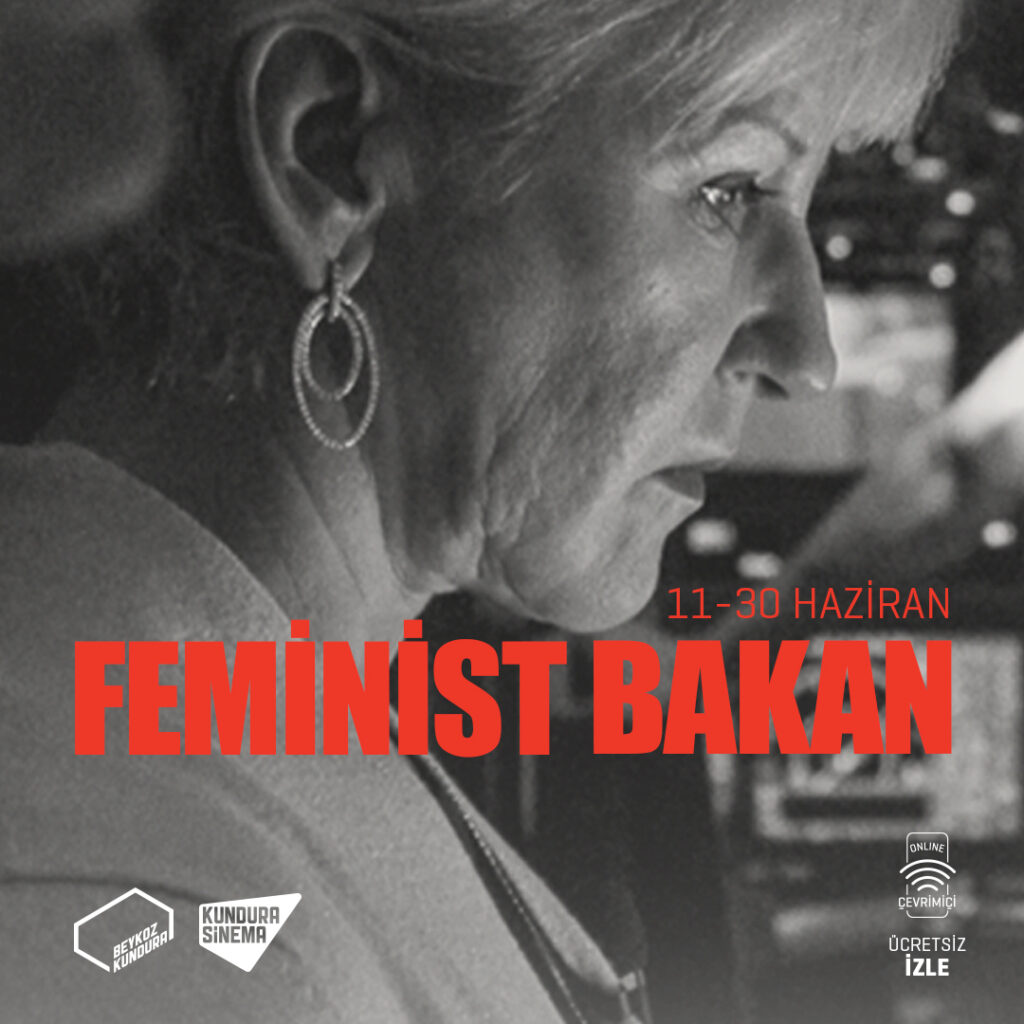
The Feminister traces the years that Margot Wallström, Sweden’s former Minister for Foreign Affairs, spent at the center of world politics as a feminist woman minister. Wallström, who introduced the concept of a ‘feminist foreign policy’ as soon as she took office and whose rhetoric and actions sparked controversy both in Sweden and around the world, is one of the most intriguing figures on the recent international political stage. Viktor Nordenskiöld, who followed Wallström closely with his camera for four years for this film, has a background in journalism covering foreign news. He moved into documentary directing as he became interested in stories too deep to fit into newspaper reports. The Feminister is one of the works in which the director successfully carries his journalistic experience over into cinema. Above all, Nordenskiöld’s background in journalism must have played a major role in building the relationship of trust needed for Wallström, a seasoned politician, to agree to being followed by cameras for years.
The Feminister builds a narrative structure that moves forward by marking time: it first counts back from day 1,461 of the ministry of Wallström, who served from 2014 to 2019, to the very first day, when the government was formed. It then moves forward, marking the major turning points of her term on the calendar. In this way, while reminding viewers chronologically of important recent developments in the world, it interweaves this tableau of well-known historical events with its protagonist’s journey. We follow a series of developments, from the Charlie Hebdo attack to the US presidential elections, the tensions between North Korea and the US, the MeToo movement and the abortion ban in Poland, through Wallström’s experiences as minister. But the documentary devotes more space to a few historical events that profoundly affected Wallström’s career. One of them is Sweden becoming the first European country to recognize the State of Palestine during Wallström’s time as minister, the harsh reaction this decision drew from the Israeli government, and the accusations of antisemitism leveled at Wallström. Another is the major crisis triggered by the minister’s statements about the denial of women’s rights in Saudi Arabia and by her reaction to the punishment of blogger Raif Badawi. In the wake of this crisis, Saudi Arabia withdrew its ambassador from Sweden, the speech Wallström was to give as an invited guest at the opening of the Arab League Summit in Cairo was canceled at Saudi Arabia’s request, and most Arab countries then took a stand against Wallström, accusing her of being anti-Islam. This diplomatic crisis also made the minister the target of harsh criticism within Sweden; some spoke of the amateurishness of her stance, while others harped on the damage the crisis had done to the Swedish economy (although it is not stated openly in the documentary, it is known that the economic damage in question really concerned the arms trade from Sweden to Saudi Arabia under the military cooperation between the two countries).


As for Wallström’s private life, we see almost nothing of it until a very late stage of the documentary. It is only as the film nears its end that we witness a personal grief of hers, step inside her home and meet her husband. In this sense, the film has no intention of being a biography of Wallström, or even of constructing her as a well-rounded character with all the different aspects of her life. Rather, it is interested in drawing her portrait as a minister. And in drawing this portrait, it gives very little room to direct interviews with her. The documentary camera follows her as she prepares speeches, works with her aides, gets dressed and does her makeup. We hear very little of what she says in various diplomatic talks, meetings and speeches. Instead, we mostly witness the tense preparations before those speeches and the assessments behind closed doors afterward. In this sense, the film is interested in the character portrait that emerges in the moments before and after her public appearances. At the same time, in a few small moments when Wallström opens up her inner world, we also witness her vulnerabilities. Besides seeing the stress she endures, her sleeplessness and the effects of the thyroid disease that disrupts her daily life, we hear her memory of the violence she suffered at the hands of a boyfriend when she was young, and we watch her cry after reading a newspaper article containing threats against her.
The Feminister is a film that values and sympathizes with Margot Wallström’s rhetoric of a “feminist foreign policy”; in this sense, it keeps its distance from any approach that sees, or seeks to expose, the contradictions in the minister’s political stance. Even so, it does allow small tensions to surface, for example in her encounters with FEMEN leader Inna Shevchenko and Yemeni journalist Afrah Nasser. It could be said that the moments in which Wallström, who injected the concept of feminism into the world of men and masculinity and achieved a series of successes throughout her career, appears most vulnerable in the film arise in her encounters with these two women.
Ayça ÇİFTÇİ
*This article was written for the Kundura Blog by ALTYAZI MAGAZINE writer Ayça Çiftçi.
