15 January 2021
We tend to think of robots mostly as working machines, as efficient doers that carry out their tasks with precision. Unlike in Asia, where humanoid robots have long been developed for roles such as sex partners and service staff, in German industry these robots look far less like humans, in order to avoid emotional complications. Physical resemblance to humans also makes machines easier to accept. But if a machine resembles a human too closely, we begin to feel unsettled: what is human, and what is machine? Japanese robotics researchers call this strange resemblance the “Uncanny Valley.”


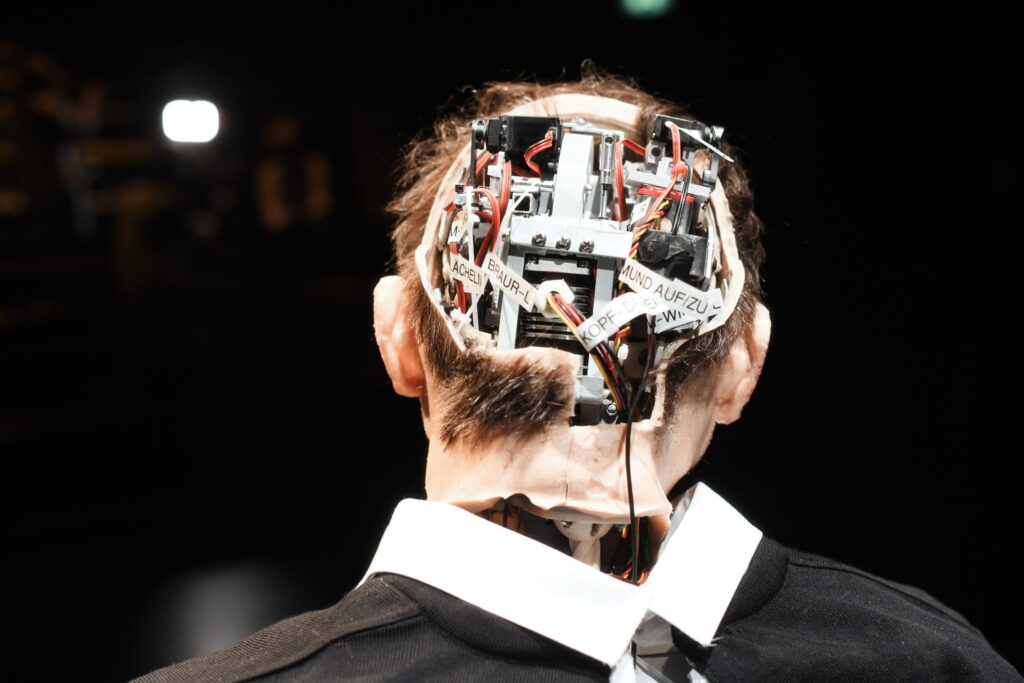
For his new play, Stefan Kaegi is working with an author and playwright for the first time: Thomas Melle agreed to have an animatronic copy of himself made. This humanoid copy stands in for the author and raises a series of questions: What does it mean for the original when the copy takes its place? Does the original get to know himself better through this electronic double? Do the copy and the original compete with each other, or do they help each other?
Kundura Sahne brought a special online screening to audiences from January 15 to March 1, 2021: Kaegi’s performance with a humanoid robot, “Uncanny Valley,” which was much talked about when it was staged in 2018 and took the use of artificial intelligence in theater to a new threshold. In the play, we watch a humanoid robot, copied and built with reference to Thomas Melle, one of the most unconventional writers in German literature, alone on stage as it recounts the author’s literary journey from his childhood onward, along with his experiences of manic depression. Taking as its starting point the concept of the ‘Uncanny Valley,’ first used in the 1970s by Japanese roboticist Masahiro Mori to describe the uncanny zone of existential uncertainty people experience when they encounter humanoid machines, the play offers the audience a viewing experience that is as unsettling as it is intriguing, in this uncanny space where the questions ‘what is human’ and ‘what is machine’ blur into one another. You can find detailed information about the play, which drew great interest when it was streamed with Turkish subtitles on the Culture Blog, on Rimini Protokoll’s page linked below, and read articles and interviews about Uncanny Valley on our blog.