19 October 2020
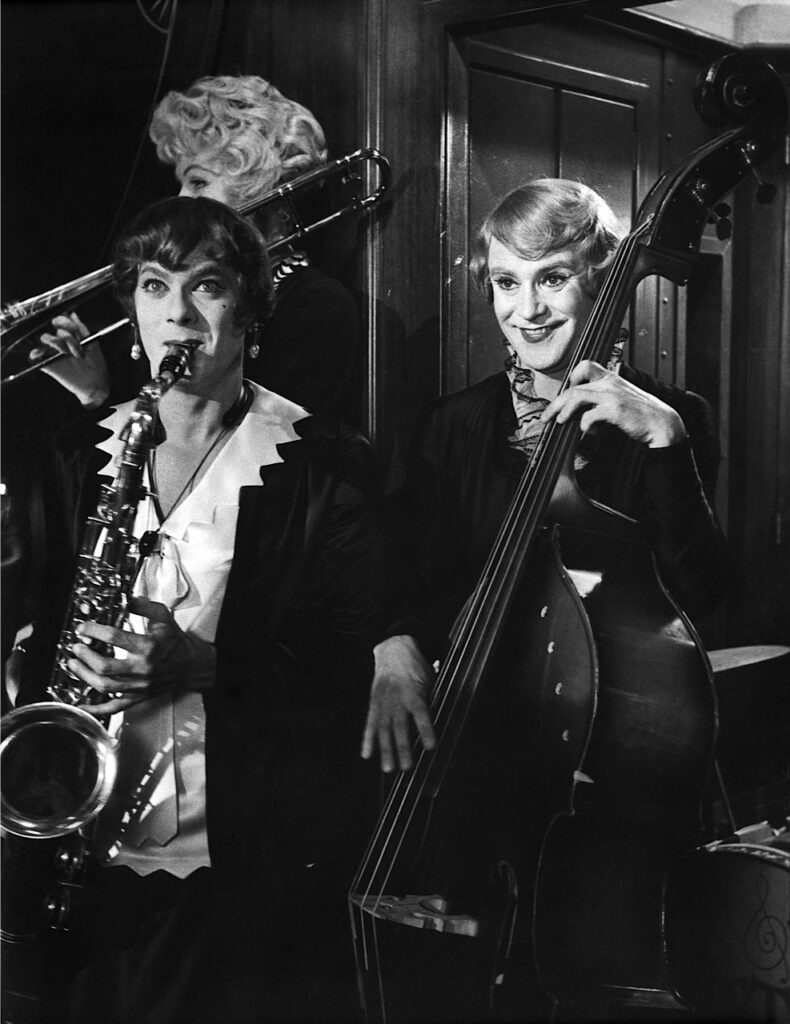
In 1958, Tony Curtis was at a Hollywood party when Billy Wilder took him aside. Wilder was planning to make a film about two musicians who dress as women so they can join an all-female band, and he asked Curtis to play one of the musicians. Curtis was delighted to receive the offer but wasn’t sure why such a celebrated writer-director wanted to use him. “You’re the prettiest boy in town,” Wilder replied. “Who else am I going to use?”
Faced with the question of why Some Like It Hot came first in BBC Culture’s poll of the greatest comedies in cinema, it is very tempting to answer in much the same way. Wilder’s sparkling masterpiece uses not only the prettiest boy in town, but also the dazzling sex symbol Marilyn Monroe and Jack Lemmon, one of the most gifted comedians of his day. The film has beautiful women, sinful gangsters, the glittering seaside setting of the ’20s, and a magnificent collection of songs.
It is so meticulously structured that it glides from moment to moment with the grace of an Olympic figure skater, and Wilder and IAL Diamond’s screwball dialogue is so superb that every line not only carries a joke or a second meaning, but also echoes a line from another moment in the film. To quote one of its characters, it is a feast of “thrills, laughs and fun.” To quote another, it deserves to be “the best thing that’s happened to us since the Graf Zeppelin.” So why was it chosen as the greatest comedy ever made? The answer is simple. Which other film would we have chosen?

There is more to Some Like It Hot than its glittering surface. Among its main themes, alongside romantic comedy, friendship and crime, the film celebrates tolerance, acceptance and the possibility of transformation. That is something we need now more than ever.
Wilder took the film’s basic premise from a French farce, Fanfare d’Amour (1935), and from Fanfaren der Liebe (1951), which he described as a third-rate German film. Its heroes, saxophonist Joe (Curtis) and bass player Jerry (Lemmon), are struggling to scrape a living in the cold climate and harsh conditions of Chicago when they witness the 1929 St. Valentine’s Day Massacre, or a version of that legendary event.
To escape the city’s most ruthless gangster, Spats Colombo (George Raft), they hide out for three weeks at a hotel in Florida with an all-female jazz band, Sweet Sue’s Society Syncopators, disguising themselves as Josephine and Daphne (“I never did like the name Geraldine,” says Jerry). On the sleeper train heading south, both of them fall for the band’s sexy ukulele player, Sugar Kane (Monroe). When Sugar Kane tells Joe/Josephine that she hopes to seduce a millionaire in Florida, Joe, once they arrive at the Seminole-Ritz Hotel, steals the band manager’s clothes and, with an accent borrowed from Cary Grant, passes himself off as Junior, heir to the Shell Oil fortune.

One of the film’s many turning points comes when Sugar Kane meets Junior on the beach and he doesn’t pursue her too eagerly. He plays hard to get and keeps her at arm’s length. When Sugar tells him that her band specializes in “hot jazz,” Joe smirks: “I guess some like it hot. But I personally prefer classical music.” Sugar doesn’t miss a beat and comes out with the lie that she “spent three years at the Sheboygan Conservatory of Music,” a claim Joe/Josephine overheard the night before. “Good school,” murmurs Joe/Junior. Sugar is every bit as skilled a liar as he is. Meanwhile, Jerry/Daphne has been asked out by Osgood (Joe E. Brown), an elderly and probably short-sighted businessman, and their enchanted night leads to yet another thrilling development. In the morning, Jerry announces to Joe that he is engaged to Osgood. But Joe objects, saying there are “laws, conventions” that must be observed. When Jerry finally confesses to his fiancé that he is a man, Osgood responds with the film’s exemplary closing line: “Nobody’s perfect.”
“Sweet or hot”
In short, Some Like It Hot is the story of people who lie and cheat in order to bed or swindle others. Wilder is famous for dark, cynical films (see Sunset Boulevard and Double Indemnity), and Some Like It Hot could be filed alongside them. Yet it warms the audience’s hearts so much that it lifts them skyward as if in a hot-air balloon. Rather than condemning its unscrupulous antiheroes, it treats them with respect and sympathy, daring to look radical in 1959, as it still does today.
Think about how the film’s script would be handled in a Hollywood comedy today. Joe and Jerry would be punished for their schemes. Sugar would catch Joe out and make him apologize, and the audience would have to watch the misery the two inflict on each other before she forgave him. Then he and Jerry would use their talents to wring a confession out of Spats Colombo. And, no doubt, the heterosexuality of Jerry and Osgood would be firmly reaffirmed. Think of Judd Apatow’s comedies, for example. They all conclude that breaking the “laws, conventions” for a while is fun, as long as they are firmly put back in place just before the closing credits roll.
For all its meticulousness, Some Like It Hot is too carefree to force anyone to face the facts. When Sugar learns that Joe has deceived her, she runs straight into his arms. When Osgood learns that Jerry has deceived him, he doesn’t react at all. The message here is that there is nothing wrong with faking it until you make it. Experimenting with a new identity can lead you to become a better, happier person. It can help you survive. And if you are lucky, you might even find someone who accepts you as whoever you want to be, perfect or not.
This production, with its inclusive and daring message, was also close to the hearts of the film’s creators. After all, just like the characters, they too had reinvented themselves: emigrating from Germany (Wilder) and Romania (Diamond), getting away from California foster homes (Monroe) and the streets of the Bronx (Curtis), they had left their pasts behind. For a madcap farce about two cross-dressers, Some Like It Hot is a strikingly personal, even semi-autobiographical film.
Let’s look again at Joe and Sugar’s beach scene. It was written by two men once called Samuel Wilder and Itec Domnici, and performed by a man and a woman once called Bernie Schwartz and Norma Jeane Mortenson. Schwartz, who renamed himself Tony Curtis, plays Joe pretending to be Junior, using the accent of Cary Grant, who was once called Archibald Leach. Mortenson, who renamed herself Marilyn Monroe, plays Sugar Kowalczyk, who renamed herself Sugar Kane and uses the very words Joe used while pretending to be Josephine. Not even Twelfth Night or The Importance of Being Earnest had this much fun with their characters’ identities.
Names, genders, social status… everything can change in Some Like It Hot. That is the American way.
In his memoir about the making of the film, Curtis confirms that Wilder and Diamond deliberately built this theme into the title. People, he argues, can be as changeable as the pop songs of the 1920s, which came in different styles, “sweet” or “hot,” with the choice left up to the audience. “The concept was very important to our film,” he writes. “A person could be more than one thing, depending on the time, the place, and whatever. Sweet or hot.”
Nicholas Barber
Translation: Nil Ege Özden
This article originally appeared on the BBC Culture website.