15 October 2020
This is an extended version of a paper that I gave at the British Silent Film Festival Symposium at King’s College London on April 7, 2017.
G. W. Pabst’s Die Büchse der Pandora (Pandora’s Box, 1929) is an adaptation of Frank Wedekind’s Lulu plays, but in many places a very loose one. Those German plays are about thirty years older than the film, a Weimar-era classic that marries traces of Expressionism with the late-1920s sobriety of the Neue Sachlichkeit (New Objectivity) movement. Pandora’s Box was filmed in Berlin – or at least in a former zeppelin hangar in Staaken – and its American star Louise Brooks identified its depiction of divergent sexualities and the sex trade with the city’s glamorous, permissive nightlife. Her evocative description of the city during the shoot, when she was staying at the famous Eden Hotel, begins: “Sex was the business of the town…”
“At the Eden Hotel, where I lived in Berlin, the café bar was lined with the higher-priced trollops. The economy girls walked the street outside. On the corner stood the girls in boots, advertising flagellation. Actors’ agents pimped for the ladies in luxury apartments in the Bavarian Quarter. Race-track touts at the Hoppegarten arranged orgies for groups of sportsmen. The nightclub, Eldorado, displayed an enticing line of homosexuals dressed as women. At the Maly, there was a choice of feminine or collar-and-tie lesbians. Collective lust roared unashamed at the theater.”
There is only one named location in the film, however, and it is in this place that the fictional narrative bumps into historical circumstance – so in this case, geography carries crucial meaning. Just like the final act of Wedekind’s play, the final act of Pandora’s Box takes place in London, in a slum district most likely in the east of the city. Our heroine Lulu, reduced to prostitution, encounters Jack the Ripper on these streets, with fatal consequences. This murder is her dramatic destiny – and to understand more fully this film, possibly the first screen adaptation to give Jack the Ripper a role, we need to think about the British capital rather than the German one. To explore this topic, I am going to examine three disappointing “misadventures” in London: the visits made to the city by Frank Wedekind, by Louise Brooks and by the film itself.
Frank Wedekind as Schön and his future wife, Tilly Newes, in the title role in a stage production of the Lulu plays.
Wedekind spent the years from 1887 to 1895 writing his Lulu plays – Erdgeist and Die Büchse der Pandora, to give them their German titles. This period, which he spent largely in Paris and Munich, is covered by his journals, published as Diary of an Erotic Life, which generally offer far more detail about his social and sexual activities than about his working practices. Toward the end of the writing process, though, he went to London, in January 1895. His entry for January 24 gives an unprecedented level of detail about his work. In the British Museum, he writes, “I find masses of material for my Divine Birth.” Divine Birth was his working title for the plays. Despite a relatively early night, the next day follows a more familiar trajectory for Wedekind:
“After lunch I get on the Underground at Charing Cross and travel to the Tower, look around the museum, the most boring and tasteless I have ever seen, travel under the Thames via London Bridge and come back up out of the underworld, dine at seven o’clock and take the omnibus to the London Pavilion. Apart from a couple of authentic English children, I find nothing new and very little that’s congenial. I spend some time in a bar amid a pack of frightful whores, and go to bed at twelve o’clock.”
We can really only speculate on what “masses of material” Wedekind found in the British Museum reading room, but we can reasonably assume that he read about Jack the Ripper. This unidentified murderer, thought responsible for killing several female sex workers in the Whitechapel area between 1888 and possibly 1891, was to become a character in Wedekind’s play. The Ripper’s killings had been in the news only fairly recently – in fact, they happened after Wedekind began writing his plays – but a trip to the British Museum would have given him more detail about the nature of the crimes. In particular, the material widely shared in the newspapers included letters offering a supposed insight into the killer’s psychology, as well as accounts of the distinctive mutilation of the bodies – which gave the killer his gruesome nickname. Most of the victims were disemboweled, with organs including hearts and uteruses removed from the scene.
If his description is correct, then Wedekind’s trip to London’s “underworld” – that is, its red-light district – probably took him further west than the Ripper’s patch. As so often in the journal, Wedekind here mixes enthusiasm with disgust in his accounts of paying or seeking to pay for sex, and the contrast between his disdainful sex tourism and his rather jaded review of the Tower of London is almost funny. At this point we could speculate on how far his encounters with sex workers in two different districts fed into his depiction of Lulu’s clients: this strange mix of rich and poor men is designed to mirror the suitors she has had earlier in the plays. Jack the Ripper, her final client, is the mirror image of Schön, and the two characters were often played by the same actor.
“The Maiden Tribute of Modern Babylon,” Pall Mall Gazette, July 10, 1885
Another source Wedekind may have read on the city’s sex trade was the Pall Mall Gazette’s sensational 1885 investigation into child prostitution, “The Maiden Tribute of Modern Babylon.” This highly controversial piece included a sting in which a mother was caught by the editor W. T. Stead agreeing to sell her own 13-year-old daughter for £5. Sex may have been the business of London, but, as the second diary extract implies (“authentic English children”), Wedekind was no stranger to this particular sector. Child prostitution is a theme that reverberates through both his journal and his plays. Lulu, who was “rescued” from the café scene as a young girl by Schön, is frequently described as not just sexy but also childlike, and as closely resembling her own mother. In a grotesque scene that appears in the play but not in the film Pandora’s Box, a group of investors in Jungfrauaktien – shares in a funicular railway running up the Jungfrau or, more literally, “virgin shares” – stand by while one of the women among them is persuaded to offer her 12-year-old daughter to a group of older men. Schön’s patronage of Lulu and common-or-garden child prostitution are linked throughout the drama.
Did Wedekind use his “masses of material” in the finished plays? Here we must remember that Wedekind was forced to edit and tone down the material in the Lulu plays to get them published and performed. But by naming his murderer as the Ripper, he introduces the idea of evisceration. There appears to be no explicit reference in the play to Jack mutilating Lulu’s body – unless you look for it. At the opening of the play’s final act, Lulu empties a basin of rainwater. Her death, when it comes, takes place just offstage, and when Jack re-enters the room he is carrying the same basin – ostensibly to wash his hands. The first implication is that it was a bloody murder; the second, that he has removed something from the scene. Edward Bond’s 1980 English translation chooses to make this explicit. Lulu cries, “He’s slitting me up!” and then Jack emerges with a newspaper parcel, saying: “When I am dead and my collection is put up for auction, the London Medical Society will pay three hundred pounds for the prodigy I have conquered tonight.”
There is no such hand-washing or parcel-carrying in Pabst’s adaptation of Pandora’s Box. Dismayed by this, Brooks said: “The movie should have ended with the knife in the vagina.” However, the basin makes an appearance at the outset of the film’s final act, and I think there is in fact a suggestion of the Ripper’s bloody deed – which we will discuss after pudding.
Some thirty years later, Louise Brooks found herself dancing at the Café de Paris, just around the corner from where the old London Pavilion stood. Brooks arrived in London in December 1924, worked as a dancer at the club on Coventry Street, and returned home in February 1925. At first glance, her trip may sound glamorous – especially if you read Barry Paris’s biography, which provocatively states: “Louise Brooks was the first girl to dance the Charleston in London.” Unfortunately, there is little evidence to support this claim, apart from a few offhand remarks by Brooks herself and Paris’s unsourced description of her: “…She enchanted the crowds who packed the club until late at night to watch her shimmy and knock-kneed dancing. No one in England had ever seen anything like it. She was a sensational success.” Whether or not Brooks was the one who introduced London to the Charleston is a question both fascinating and beside the point of this article. I have looked into it, however, and the results of my research will be published on SilentLondon.co.uk shortly.
We know that Brooks arrived in Paris in December and was abandoned there by her traveling companion, Barbara Bennett. Then the American film and theater producer Archie Selwyn – a flamboyant character whom Tallulah Bankhead dubbed the “Criminal-at-Large” and even remembered in her autobiography as “a fascinating rogue” – brought Brooks to London and found her a job at the Café de Paris, a relatively new club. According to Champagne and Chandeliers: the Story of the Café de Paris, a history of the club that is frustratingly sparing with dates, the cabaret budget was tight, especially in the early years. Brooks, who until then had been appearing in the revue George White’s Scandals, is not mentioned among the venue’s notable performers, and she may well have been the lead dancer in a few small numbers rather than a headliner. So when Brooks recalls, “I lived beyond my means in a flat at 49A Pall Mall – who doesn’t at 17?”, we should remember that, despite the grand address, her means were rather slim, and – of course – that she was in fact 18.
What was inside the flat on Pall Mall? A Christmas pudding (although she told Close Up magazine that she “lived on it for a week,” this delicacy, an unusual one for an American teenager, was probably pilfered from the Café de Paris kitchen), the January 1925 issue of Photoplay magazine (probably brought over from New York – its print date was December 15, 1924) and a maid named Nellie.
That issue of Photoplay had Betty Bronson on its cover. Brooks and Nellie went together to see her in Herbert Brenon’s Peter Pan, which opened in London on January 22, 1925. Before going to the cinema, they read the item that Brooks called “Photoplay’s fairy tale of Betty’s rise to fame.” Here it is in full:
“Betty Bronson, a little-known seventeen-year-old screen actress, is as excited as every other film fan about the release of ‘Peter Pan.’ Her future depends on her success in this picture. She believes the fairies will be kind to her.”
It really was a fairy tale, but I suspect the story stirred something like jealousy in Brooks – after all, by the end of that month she would give up on London and turn for help to the father figure she regarded as the fairy godfather of her own life. According to Paris, Brooks was in a rather melancholy frame of mind in London, which is why she was so susceptible to fairy tales. If you ask me, however desperate Brooks may have been, she had begun to turn this disappointment to her advantage, calculating how she might build her own “fairy-tale success.”
Louise Brooks in stage costume for George White’s Scandals, 1924. Photo: Alfred Cheney Johnston
According to Paris, when Brooks’s engagement at the Café de Paris came to an end, the owner “generously continued to pay her” – which tells us that, although Brooks was liked by her boss, she was neither the star of Piccadilly nor on a high salary. Her real fairy godfather was the German-born Wall Street financier Otto Kahn, known for the risqué parties he threw in New York, at which chorus girls and wealthy businessmen came together for their mutual benefit. With her last pound, Brooks called Kahn, who in turn called the British-born director Edmund Goulding. Depending on which source you believe, Goulding was in London either on the set of Gerald Cranston’s Lady or visiting his mother. Like Kahn, Goulding hosted many racy parties, and Brooks was one of a handful of young women chosen to entertain his rich and famous friends at them. Goulding paid Brooks’s overdue rent on Pall Mall and arranged and paid for her ticket home. Back in New York, thanks to her connections, Brooks landed a place in the Ziegfeld Follies. In May of that same year, she began shooting her first film, Street of Forgotten Men, directed by Herbert Brenon. Rather than downplay this period of Brooks’s life in London as chronicled by Paris, I wanted to use the anecdote to reveal a crucial moment in her career – and, with it, to draw attention to the patronage system and the support Brooks received, as well as to the determination she showed in turning that support into a career on stage or screen.
Brooks wrote of Pandora’s Box: “I knew two millionaire publishers very like Schön in the film, who backed plays in order to keep themselves supplied with Lulus.” She probably knew more than two such men. Brooks was quite candid about her relationship with Kahn, in which they both had sex and shared investment tips. With the same candor, she wrote of her relationship with Goulding: “…this carefully chosen group of beautiful girls was invited to parties given for successful men from the worlds of finance and politics. Walter Wanger and Eddie Goulding screened them. We had to be well bred and absolutely trustworthy – never attempting to expose or blackmail these great men. At these parties we were not obliged, like common whores, to go to bed with every man who invited us, but when we did, the profits were very good. Money, jewels, mink coats, a part in a film – you name it.”
As Brooks told Kenneth Tynan in 1979, “I was always somebody’s kept woman.”
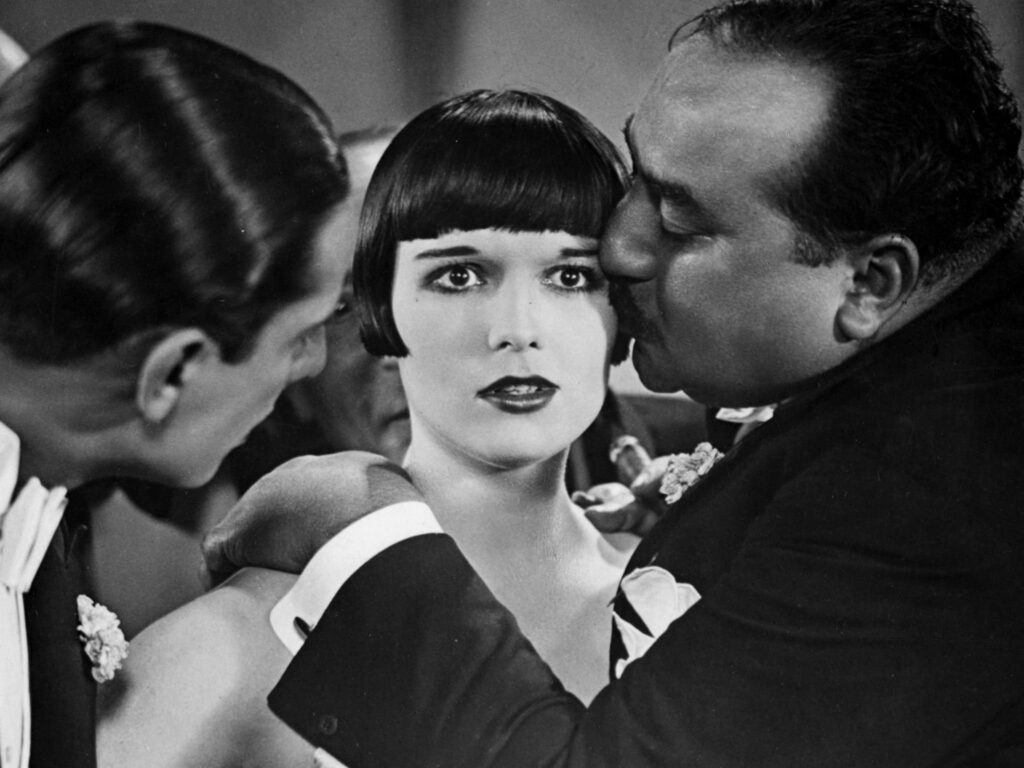
Lulu (Louise Brooks) and Jack (Gustav Diessl) in Pandora’s Box (1929)
Brooks was far happier during her time in the studio version of London than in the weeks she spent on Pall Mall. Although Pabst subjected one of her favorite outfits to tearing and staining for the scenes in which she walks the streets as a prostitute – a rather cruel psychological game that produced wonderful results – Brooks enjoyed shooting the final act of Pandora’s Box. She also found Gustav Diessl, who played the Ripper, very attractive. While the band played Charleston music on set, Brooks and Diessl kissed and caressed each other under the table. “It was more like a Christmas party,” the actress told Richard Leacock of those moments. Brooks even threw a beer party for the cast and crew on the London set to celebrate her 22nd birthday.
By the time Pabst made Pandora’s Box, Jack the Ripper might have seemed rather out of fashion, but in 1920s Germany sexually motivated murders, known as Lustmord, were a frequent presence in both newspapers and fiction. To consider just one example, Fritz Haarmann, known as the “Butcher of Hanover,” sexually assaulted at least 24 boys and young men between 1918 and 1924,
murdering them and dismembering their bodies. Jack the Ripper also appears in Paul Leni’s 1924 horror anthology Waxworks. Brecht and Weill’s The Threepenny Opera, which was playing in Berlin while Pandora’s Box was being shot, won acclaim for its antihero Mack the Knife and its depiction of London’s seedy underworld. The Neue Sachlichkeit artists Otto Dix and George Grosz also took up this theme, Dix creating “Lustmord” (1922), which deals directly with the Ripper’s murders, and Grosz “John the Lady Killer” (1918).

The Threepenny Opera (G. W. Pabst, 1931)
In Pabst’s adaptation of Wedekind’s play, authentic Victorian elements – the Ripper himself, the Salvation Army with its mission to rescue sex workers, and the Christmas tree – blend with the early-20th-century ideas that dominate the rest of the film. Traces of Freudian psychology can also be seen: the killer’s fixation on the knife echoes the themes of the same director’s Secrets of a Soul (1926), while the killer’s torment recalls the mysterious lodger played by Ivor Novello in The Lodger (1927), Hitchcock’s take on the Ripper mythology. So although the London scenes are wholly anachronistic, they succeed in reflecting the artistic, intellectual and social milieu in which the film was made.
This section is also the most Expressionist part of the film – as if an earlier style of cinema were better suited to this nostalgic material. In the Staaken version of London, Günther Krampf’s cinematography built the East End out of the sparest of spaces, with light from extremely low and high angles creating deep shadows and the diagonal lines of the stair banisters cutting across silhouettes – and, of course, a dense and ominous fog rising alongside it all. According to those who worked with Krampf on his later films, the cinematographer was a master at manipulating fog and shadow. In the finished version of the film, Lulu is killed without bloodshed – her death represented only by her falling hand – while Schigolch, her father and pimp, goes into a local pub to eat Christmas pudding. This is exactly what he promises to do in Wedekind’s play. In a rather strange interview with Pabst conducted for Close Up magazine, the poet H. D. recalls the editor Kenneth Macpherson boasting of his contribution to this pudding business:
“The costumier insisted it should be on a flat plate, I said it should be a basin, but they brought a jelly mold… So I drew what it should be on the architect’s table. And Pabst said, ‘That is what I wanted. Round. Isn’t it so, Herr Macpherson?’”
Apparently Pabst also listened to Macpherson on the proper garnish for this traditional English dish – a sprig of holly. So far, so good, but the pudding in Pandora’s Box looks a little odd. The bowl is as it should be, but the round in question is flatter, looking more like a hand-washing basin than a pudding basin – and what’s more, the plant we see on top is not holly but mistletoe, with its poisonous berries, which the Ripper dangled over Lulu’s head before killing her. Having sent his ward into the arms of a murderer, Schigolch dips his spoon into this peculiar pudding without batting an eye. In this way Schigolch, the true villain of the story, also gets a taste of the Ripper’s horrific crime.
This may be Pabst’s attempt to sublimate the Ripper’s methods of murder through symbolism, just as it may be an effort – as Wedekind had made before him – to get around the censors. But by the time Pandora’s Box was released in London, the censors had already done their worst. The version shown at a trade show in April 1930 – more than a year after the Berlin premiere – was very likely the same one shown in New York in December 1929. There, as Mordaunt Hall noted in his review:
“At the beginning of the film, the management apologizes for what it terms the ‘extra sugary ending,’ explaining that the censors would not permit the whole of this production to be shown.”
The shortened version cuts the lesbian character Countess Geschwitz, as well as harmless, uncontroversial details such as Siegfried Arno’s comedy routine backstage at the revue. It also removes the very reason Lulu and her companions find themselves in London – Jack the Ripper himself. In this version there is no murder at all; instead, what inspires Lulu and Alwa to make a fresh start is listening to a Salvation Army band.
London critics greeted Pandora’s Box either with bewilderment or with polite indifference – their reactions varied depending on their preconceived expectations and on whether or not they had seen the original in Berlin. It seems the film’s apologetic intertitle had not managed to cross the Atlantic with it. Robert Herring vented his anger on the subject in Close Up:
“A brilliant idea – Pandora’s Box with the lid off! Yes, that is how it is in England. You would have thought the censor would keep the lid firmly shut on Pandora’s box. But it did better than that. It took the lid right off, let out everything inside, and then showed us the film so that we could see there was nothing in it. As a result, everyone thought it a duller film than the scenario, and the trade papers could not recommend it… In the version in which it is to be released in England, Pandora’s Box gives no idea of the film Pabst made when he finished it. Pabst’s gift is a sense of wholeness and completeness, both literal and psychological. To alter it, to disturb even the slightest vibration, is to ruin this fine workmanship.”
Herring made similar – if less impassioned – comments in the Manchester Guardian before and after the trade show. Condemning the cuts, he described the scenario as “foolish” and Brooks as “lifeless.”
Robert Herring, The Manchester Guardian: April 12, 1930 (left), April 19, 1930 (right)
Other critics, meanwhile, did not know what they were missing. Kine Weekly wrote of Pandora’s Box that “the film cannot be expected to appeal to the average audience.” The Bioscope summed it up as follows: “The misadventures of a coquettish girl and the men whose paths cross hers. The film starts off well enough but gradually fizzles out toward the end.” After both these reviews had been published, with no release date in sight, the film had a second – and equally unsuccessful – trade show in May. The film does not appear in a single 1930 issue of Film Weekly or Picturegoer. Although Brooks appeared in Lux Toilet Soap advertisements in the national newspapers, and although the Daily Mail was ready to use her image on the slightest pretext, Pandora’s Box is mentioned only once more in the print media that year.

The Bioscope, v83 n1228, April 16, 1930, p. 34 (left); Kine Weekly, April 17, 1930 (right)
While the cuts dealt an almost fatal blow to the film’s chances of success, the fact that London’s leading cinemas were installing electrical sound systems during this period, and that the city’s filmgoers could not resist the talkie revolution, made Pandora’s Box, a silent film, even less appealing. Herring mentions a proposal to synchronize the cut version “to make it pay,” but fortunately this never happened. What’s more, if Pabst and Brooks did appeal to British filmgoers, they could satisfy their wish to see the two elsewhere. They could watch Brooks in The Canary Murder Case (1929), directed by Malcolm St. Clair and Frank Tuttle – albeit with her voice dubbed by Margaret Livingston. Those wanting to see a Pabst film could opt for the hugely popular The White Hell of Pitz Palu (1929), directed by G. W. Pabst and Arnold Fanck. The film was shown with live sound accompaniment at the West End cinema known as the Rialto, and its plot was adapted as a short story in Film Weekly magazine.
The Daily Telegraph, August 4, 1930, p. 4
If audiences wanted “A Ruthless German Film” about a beautiful young woman who lures men and then ruins them, they could certainly see one. Josef von Sternberg’s The Blue Angel (1930), an English-language sound film, was playing at the huge Regal cinema at Marble Arch – that is, just over 1.5 kilometers from the relatively small venue where Pandora’s Box finally opened.
C. A. Lejeune, “The poor man’s holiday,” The Observer, August 24, 1930, p. 6
Writing in The Observer in August 1930, C. A. Lejeune reported that Pandora’s Box was playing at the Gaiety cinema on Tottenham Court Road – a venue with which she was evidently not very familiar. Describing the film quite beautifully, yet fairly, she summed up her view as follows: “tense and clever in idea, emotional in photography, but reduced by the chaotic form of its presentation – to the British public, at any rate – from entertainment to study.” Pandora’s Box was being shown on a double bill with Georg Asagaroff’s The Age of Seventeen (1929). Lejeune found things to admire in both films (“a programme worth considering”). Film Weekly, on the other hand, had earlier been unable to recommend The Age of Seventeen (“I don’t think you will like this German film”), yet the review it published makes clear why this film was chosen to accompany Pandora’s Box: it refers to “morbid Teutonic psychology” and to a love triangle between a young woman and a father and son.
Film Weekly, June 14, 1930, p. 24
The Gaiety Picture House, which opened on December 4, 1909, and was one of the first cinemas in Britain, stood at the southern end of the street, very close to the British Film Institute’s present-day offices. By 1916, the police had learned that the darkened auditorium of this rather small venue was popular with gay men, who used it for sex. The Metropolitan Police sent representatives of the National Union of Women Workers to inspect the Gaiety, along with other cinemas of “doubtful reputation.”
By 1930 the cinema, which had come to seem a curiosity as one of the few venues in London still showing only silent films, also lacked an orchestra pit capable of supporting major productions. When the building reopened as a newsreel cinema after a refurbishment in 1933, Ralph Bond marked its new beginning with a short piece in Close Up on the death of the Gaiety. Describing the venue’s out-of-tune piano, its dusty seats and its frequently breaking-down projection equipment, Bond wrote that at this cinema “black-hatted highbrows would rub shoulders with the habitués of the Tottenham Court Road back streets to watch the genius of Pabst.”
It is unfortunate that Pandora’s Box was not shown as it deserved to be in a city that plays such an important role in its narrative. Even in 1968, the National Film Theatre was presenting a version billed as almost complete – which it was not. What it actually showed was a partially corrected print of the version released in France as Loulou – itself just as heavily censored. And yet there is something unsavorily fitting about the fact that, at the Gaiety, the film played to a crowd as select as it was mixed, made up of both cinephiles and pleasure seekers. Just as Jack the Ripper emerges from Günther Krampf’s Expressionist fog, Pandora’s Box arrived in London as a misplaced and untimely anachronism. In the same way, as we celebrate the uncanny modernity of this classic made toward the end of the silent era, we would do well to remember that its roots reach back into the grimy history of Victorian London.
Pamela Hutchinson
Turkish translation: Gizem Ünsalan
To read the original article, please click here.