29 March 2021
The four-part selection ‘Cinema’s First Nasty Women’ is a kind of historical “excavation” that all but rewrites the history of early cinema. A project in which Laura Horak, Maggie Hennefeld and Elif Rongen-Kaynakçı search the—quite literally—dusty shelves of film history, it introduces us to the unconventional female characters of silent cinema. Rebelling against sexual violence, against the exploitation of domestic labor, or against the gender roles and assigned sex imposed on them, these exceedingly “funny” women masterfully work the slapstick genre, which draws especially on physical comedy, and at times use humor as a political tool. Alongside comedy, the selection also includes westerns and thrillers, and the echoes of its “rebellious and disruptive” women can at times be seen in today’s films as well. Taking a look at the “modern versions” of these characters—which, unfortunately, can still be counted on one hand—also shows us what a disruptive potential all this “nastiness” still carries a century later. The fact that one of the events that inspired the project was the word “nasty” Donald Trump used for Hillary Clinton is further proof of this historical continuity. Here is what these remarkable women, calling out to us from the depths of history, evoke when viewed from today…
Léontine and the Mischievous Girls of Anime
One of the films in the first part of the selection, titled “Terrible Maids and Anarchic Tomboys,” is La pile électrique de Léontine (1910). In the film, we witness Léontine, star of the Pathé Comica series, whose real identity is unfortunately unknown, wreaking havoc with a kind of “electroshock” device. Reminiscent of the mischievous girls of Studio Ghibli, Léontine defies everyone thanks to her “special power,” in spite of all the adults who try to “tame” her. Hayao Miyazaki’s Ponyo, the mischievous mermaid who turns an entire town upside down; Isao Takahata’s “uncontrollable” little princess Kaguya; Hiromasa Yonebayashi’s adolescent heroine Arrietty, who flouts all the rules and throws herself into danger… With the way they use slapstick and physical comedy, the heroines of these animated films, whose visual possibilities open up a great deal of room for “disruptive comedy,” recall the “anarchic tomboys” of the early era.


Bringing Down the System from Within: Terrible Maids
Another striking film in the first part of the selection is La Greve des Nouricces (1907), in which a group of nannies rebel against their employers. Reminiscent in some ways of the suffragette movement of its time, and in others a revolt against the exploitation of domestic labor and the precarity of service workers, the film is a kind of comedy that could almost be called absurd. Claude Chabrol’s La Cérémonie (1995), one of the first films that comes to mind when it comes to rebellious maids, deals with a similar political revolt, even though it is not a comedy. Taking on a humorous tone at times, particularly thanks to Isabelle Huppert’s extreme performance, the film is like a modern version of early cinema’s disruptive maids who poked fun at class boundaries. The adjective “terrible” chosen for these maids in the selection is a highly meaningful choice, considering that the maid/nanny figure is generally one of the favorite motifs of the horror/thriller genre. The “terrible maids,” a staple of many horror films from The Omen (1976) to The Babysitter (1980), reappear in recent series such as The Handmaid’s Tale and Servant and “bring down the system from within.”

In the Name of the Power of Clumsiness: “Let the House Go to Hell!”
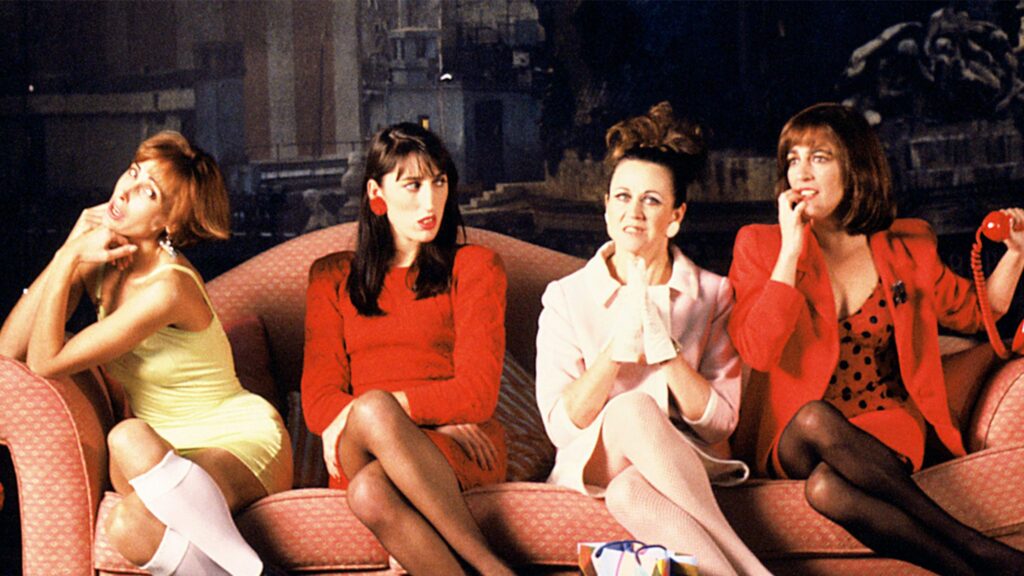
The second part of the selection, which follows a similar thread, focuses on “Queens of Destruction” and angry housewives. It is impossible to watch La fureur de Mme Plumette (1912), which centers on Madame Plumette, who flies into a rage when her husband leaves her to go fishing, without recalling Pedro Almodóvar’s Women on the Verge of a Nervous Breakdown (1988), starring Carmen Maura. Maura, a favorite actress of the director’s early films, plays a housewife who raises the flag of feminist revolt in the black comedy What Have I Done to Deserve This? (1984).
Another film in the second part of the selection is Zoé et le Parapluie Miraculeux (1913), starring the comedian known as Little Chrysia. Zoé, who can make anything she wants rain down from the sky with the help of a magic umbrella, uses this power, which she cannot fully control, to physically wreck everyone around her, including her employers—and even herself. The theme of “clumsiness” or lack of control that emerges here at times brings to mind a kind of physical comedy we associate with the films and performances of Greta Gerwig in recent years. Frances Ha (2012), Lady Bird (2017) and Mistress America (2015) feature heroines who are never fully in control of their bodies and who wreck their surroundings with their “clumsiness,” constantly in a state of “shaking off” the gender roles assigned to them.


Neither Lady Nor Gentleman: The Female Cowboys of the Wild West
A refusal to fit into molds similar to that of the second part forms the main theme of the third part of the selection as well: “Gender Rebels.” In this part, made up of characters who reject the role of “lady” imposed on them and challenge gender norms, we watch a western called Rowdy Ann (1919). Ann, who wears cowboy clothes, carries a gun on her hip and is always galloping around on horseback, is forcibly sent to a “finishing school” by her family after a fight with some men. Although the school files down Ann’s “sharp edges” here and there, the rebellious spirit inside her loses none of its former self. While even today it is hard to find examples of the western, historically a highly masculine genre, with female leads, Ann from 1919 winks at us with all her mischief. In this sense, Meek’s Cutoff (2010) by Kelly Reichardt, who returned to the western with her latest film First Cow, is one of the rare examples that come to mind. Placing a young woman named Emily Tetherow at the center of the western, a genre in which women appear only as archetypes, the director follows in the footsteps of western predecessors with female leads such as Calamity Jane (1953) and Johnny Guitar (1954).
The Masked Heroines of the City: “Playing the Man”
The final part of the selection, ‘Female Tricksters,’ tells the stories of modern urban women who resort to various “tricks” so as not to get lost in the chaos of the metropolis. The “science fiction comedy” Amour et Science (1912), which we have the opportunity to watch in this part, is about the revenge game that a young woman named Daisy plays on her fiancé, who has invented a kind of “Zoom/Skype” prototype. In the film, in which the screen is split into parts with a surprisingly innovative editing technique, we witness a dream of “video calling” that speaks to us across more than a hundred years. Daisy dresses her best friend as a man and plays a joke on her fiancé to make him jealous when he video calls her. Women like Daisy, who find their solution for adapting to city life in dressing as men, bring to mind many characters, from Jo March of Little Women (2019), who has to present herself as a male writer, to Mulan (1998), who goes to war in her father’s place, and from Game of Thrones‘ “gender rebel” Arya Stark to Enola Holmes, Sherlock Holmes’s mischievous younger sister. Forced to become “invisible” in order to make themselves visible, these “nasty” women undermine male-dominated society with their sharp minds and cunning, making room for themselves by breaking, disrupting, shouting and making a fuss.
Aslı ILDIR
*This article was written for the Culture Blog by Aslı Ildır, writer for ALTYAZI MAGAZINE.