21 December 2020
However freely they work with documentary material, Rimini’s works have required extensive research, most of which will never be reflected on stage, and, above all, lengthy interviews with the experts. This additional material has sometimes found its way directly into the performances as video clips or as quotations in the text. Sometimes it has given the directors a feel for how a particular theme might be developed. In fact, it has been less about constructing a coherent story or simply tackling a theme than about exploring potential, about stories being captivating, about the subject being worked like fine embroidery.
The main themes of a work may be there from the outset, before the actual research is done. Sometimes, however, as in Sonde Hannover and Brunswick Airport, a particular location is decided on first, and then specific stories connected to that place have to be found. The local environment is not only significant in projects that are so explicitly site-specific. It is often very important in stage projects too, as with the senior residence at the Künstlerhaus Mousonturm (Boxenstopp), the social milieu in Brazil (Chácara Paraíso), or Mannheim regarding itself as Schiller’s town (Wallenstein). A theater stage itself can also be a site-specific location, as at the Pfauen Theater in Zurich, where the world premiere of The Visit took place: the stage managers’ instructions, the set changes, even the audience are all material that can be used…
Stefan Kaegi often recounts that he once spent a year working as a local news journalist in Solothurn, Switzerland. Rimini Protokoll’s research may resemble journalism, but it has a different aim. “In the end, we’re not really interested in whether someone is telling the truth, but rather in how they present themselves and what role they play.” (Wetzel) Facts cannot be separated from fiction; for Rimini Protokoll, documentary technique (not so different from Alexander Kluge’s narrative approach) focuses on the telling of the story rather than on the truth itself. The truth is often hidden not in the big picture but somewhere else, in the small details. “Our research is often about atmosphere. Or maybe we remember a poster hanging behind an expert’s desk, and that can spark something. What matters is often the small details. (Haug)
From this point on, a striking detail becomes material that reflects reality. This material, like a ready-made, serves as a prop that on the one hand underlines the documentary character of the work and on the other unsettles its balance, since its authenticity is always uncertain. In Das Kapital, the Marx expert Kuczynski contributed to the piece with the meter and a half of rare editions of Das Kapital that sat on his desk at his first meeting with Rimini Protokoll. Once the insurance arrangements had been finalized, he brought two suitcases full of books to every rehearsal and every performance. In the end, though, copies of most of the books were made by the prop makers: authenticity is merely a feeling.
Just as the human stories in the piece intermingle and shift, and one person’s text can be taken over by another, the authenticity of ordinary objects deemed to have artistic value is also variable. In Uraufführung , the antlers that decorate Alfred Ill’s house in Dürrenmatt’s play actually belong to the hunting enthusiast Johannes Baur, who partly takes on that role. Just as fiction often drifts into reality, authenticity is also constructed.


Photo: ©RiminiProtokoll
Scripted Reality
Although the 2007 Mülheimer Dramatikerpreis awarded to Helgard Haug and Daniel Wetzel for Das Kapital came as a shock to some groups of writers, the prize was not awarded by mistake. Watching a Rimini Protokoll work may first of all mean watching the experts, but the perceived authenticity of these characters, who are in fact only characters, is not merely something the performers create physically themselves; it is also the result of dramaturgy, the outcome of a production and the product of a text that did not arise spontaneously, and it is not simply words tumbling out of people’s mouths. People here rarely relate the subject as it is, and the text rarely comes about through improvisation, as it does in Midnight Special Agency. Rather, the texts used are specific theatrical works by Haug/Kaegi/Wetzel that give rise to a particular kind of text. Reality has to be scripted.
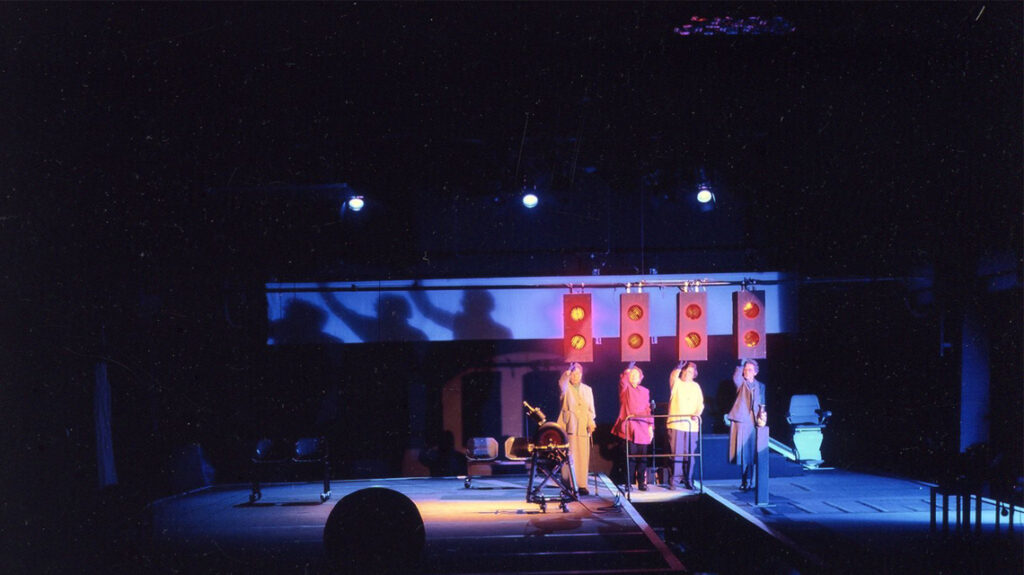
And that is what Rimini Protokoll does: as the name suggests, they essentially use the techniques of the protocol (Protokoll) and of diary writing. In Kreuztworträtsel Boxenstopp, Mrs. Falke sat on a raised chair and unrolled the text from a large ball of paper in which it was wound; the records of the mock Formula 1 race were also a chronological history of the events leading up to the premiere. The story of the race was interwoven with experiences from rehearsals, with the making of the piece and, though to a somewhat lesser extent, with the women’s stories. Even if this particular structure would rarely be shown so openly in the future, the logic of the protocol makes itself felt in almost all of Rimini’s texts.
Questions about how it is still possible to speak on stage at all, who it will be when someone speaks, and in what form this speech can exist outside the vast territory of narrative, psychological, dialogue-based drama have been at the center of experimental and non-conceptual theater since the 1980s. Rimini has found its own answers to these questions. The form of the protocol, playfully transformed with reference to the avant-garde theater tradition of strictly formalized or ritualized language (for example, lists, question-and-answer games, or summary descriptions and theses), offers the opportunity to arrange a wide variety of narrative layers within an invented or real chronology. The actual rehearsal process, the participants’ biographical material and the broader overarching fictional or factual narrative become intertwined. This creates a micro-macro structure in which one can move easily between the close-up, detailed anecdotes, and the wide shot, the concepts that make up the big picture: in Boxenstopp, this appears in the slowness of old age contrasted with the speed of motor racing. Shooting Bourbaki connected the violence of children’s computer games to the wider issues surrounding gun shooting. Mnemopark allowed railway enthusiasts’ passion for collecting and building to become questions of memory. Blaiberg set a successful heart transplant alongside romance at a twinned school. Wallenstein categorized former politicians, Vietnam veterans, astrologers and matchmakers according to Schiller’s themes.
The fractures that often arise from such stark contrasts give the audience the opportunity to make new associations. Engaging with the artistic creation in a sustained but often detached way creates a transparency that does not allow for unthinking identification with the events on stage.
The protocol is a monologue, and despite the many voices used, this is also the general form Rimini uses. These monologues are designed as statements and are addressed directly to the audience. Much like Brecht’s pedagogical plays, the experts face us, and they deftly avoid the problems of representation in acting-based theater, where dialogues are performed in order to openly enact conversations, to appear improvised, and to create psychological empathy or at least a belief in a functioning dialectical system. Rimini’s conversations with the audience (who really do feel spoken to and do not have to play the role of spectators), however one-sided, create the atmosphere of a conversation between genuine equals. The fact that their words do not sound improvised, but rather like somewhat vague presentations by untrained speakers, paradoxically makes them seem more honest. Brecht’s alienation effect, designed to prevent the audience from identifying with what is on stage, has long been regarded as a supposed guarantee of authenticity, and monotonous speech, which did not first appear in semi-documentary plays and contrived television talk shows, is automatically accepted as a characteristic of “real people.”
In recent years, face-to-face encounters, dialogue-like moments, have begun to appear in Rimini’s work as representations of different characters’ perceptions. In addition, disagreements between those on stage are nowadays also possible to a certain extent. In Boxenstopp, the sole representative of the “other” group, in other words the racing drivers, was dropped from the play during the rehearsal process because he did not fit the picture. As in Das Kapital or Wallenstein, different approaches and different cast configurations brought with them a wider range of perceptions and internal contradictions. The artificiality of these moments of dialogue (normally consisting of two or three people speaking to each other in full sentences or looking at each other disparagingly) is openly displayed, and it is not only the experts’ lack of stagecraft that makes it clearly visible. Different views, positions and also conflicts are made visible and kept visible. In Uraufführung, performed by children (reflecting the fact that The Visit is a popular play for school productions), one scene literally takes the form of a conventionally presented piece of theater: “We run the risk of appearing to take this form of theater seriously. But since we almost never bring dramatic dialogue to the stage, for us it is just fun.” (Wetzel)
Rimini’s texts come into being through a process of asking questions and listening. Before and during rehearsals, this material that has been heard is transformed into a form that must again and again be reconciled with the performer’s reality. How do the experts’ voices sound, and what feelings does the text evoke, as they read texts that began as their own and were then taken from them, refined and given back to them? The text has been reconciled with what they are both willing and able to say. What kinds of expression do the experts resist? Which grammatical structures do not sound right? Which pieces of content do they insist on changing?
Experts tend to learn the rules of this process quite quickly and to notice how what they say is incorporated into the text and transformed. It is not unusual for things said earlier to be denied: “This ‘I didn’t say it like that’ is often not true. But once it has been said, it is often unsettling, especially at the beginning, because they cannot predict what it will mean in the context of the piece.” (Wetzel)
That is why creating the text is often a process of negotiation that can later lead to marked reactions. An expert such as Marx expert Thomas Kuczynski in Das Kapital may, knowingly, replace the correct word (in this case “use-value”) with a more common but actually incorrect one (namely “value”) in order to assert his independence from the production and to draw a distinction between himself and his role. At times, the process of creating Rimini performances bears some resemblance to family constellation therapy.
Characters in Time
Ten years ago, the rehearsal stage in Giessen hosted what was perhaps the only stage performance of Mr. Heller, the poultry farmer. Martha Marbo, the striking boulevard diva of Kreuztworträtsel Boxenstopp, has since passed away. The children of Shooting Bourbaki have grown up. Amateur pilot Peter Kirschen is still not allowed to fly passenger planes, former mayoral candidate Sven-Joachim Otto has left the city where he was humiliated, and one of the Brazilian police officers is on trial.
Rimini Protokoll’s snapshots can capture the moment only briefly; they disappear along with the production. They focus on the present and store nothing up for the future. A museum of moments brings together characters from our time for a while, arranges them sometimes by field of knowledge, sometimes by occupation, age or fate, and then separates them again.
One of the essential elements of Rimini Protokoll’s success is that its theater depends neither on a manageable stock of existing or newly created dramatic characters, ultimately, nor on performers of the same age group that other independent theater-makers have to rely on. It shows you things you rarely or never see. Unlike reality TV and talk shows, it does not present people (real or artificial) in moments of crisis; on the contrary, it shows them calm and composed. Nor does it try to hide the fact that, on stage, their authenticity is only a role. Even if that role is the role of their lives.