21 December 2020
A Rimini performance is never perfect, nor does it have to be. At the point where the performers have practiced enough to feel safe, and begin to develop their roles and to act, the piece starts to lose far more than just its charm. Insecurity and fragility are the moments that define what most people understand by authenticity. Yet these moments, in which timing, tension, empathy and presence vanish, are also excruciating. This is what happens when retired master builder Johannes Baur briefly loses his way in Uraufführung, when Mrs. Düring, nearly eighty years old, strains her memory to recall her next line in Kreuztworträtsel Boxenstopp, or when you hear the performers whispering the text to one another in Sabenation; these are the moments when, as a spectator, you feel uncomfortable. Feeling embarrassed or moved by the efforts of performers who cannot protect themselves through acquired techniques, you too suffer for a moment.
What confronts us with the banal basic principle of theater are the moments when reality kicks in: being in a room with other real people, with the possibility of mistakes, breakdowns, failure (or even, as Heiner Müller might emphasize, the possible death of a performer or a neighbor). Theater is always flirting with the idea of being transient and fluid, and although it essentially places great value on repeating itself as identically as possible, it argues that these impermanent moments, this unrepeatability, are at heart what set theater apart from the other arts.
It is this paradox that drives many leading contemporary theater-makers, and it is an essential element of Rimini Protokoll’s work. Two years before Rimini Protokoll was formed, Stefan Kaegi and Bernd Ernst (still working as Hygiene Heute) stated that mistakes were their real area of interest. “Our favorite theater moments of 1998 are a fly buzzing aimlessly across the snow-white set of ATTIS, Norbert Schwientek as Krapp when his last tape won’t play, and the coughing fit of an audience member during Jürgen Flimm’s Uncle Vanya […]. We love the possibility that these small, human, devastating moments of embarrassment born of misunderstanding are not actually embarrassing at all but, on the contrary, universally human.”
The fact that those moments in Rimini productions do not give the impression that people are being objectified, or exposed to situations they are unsuited to or that work against them, has to do with the fact that precisely in these moments a sense of shared responsibility can often be detected. Because there is no prompter, the other performers rush to help; and even otherwise, room for flexibility is built into the dramatic structure of the piece itself. Rimini Protokoll’s work has always been a dramaturgy of care.
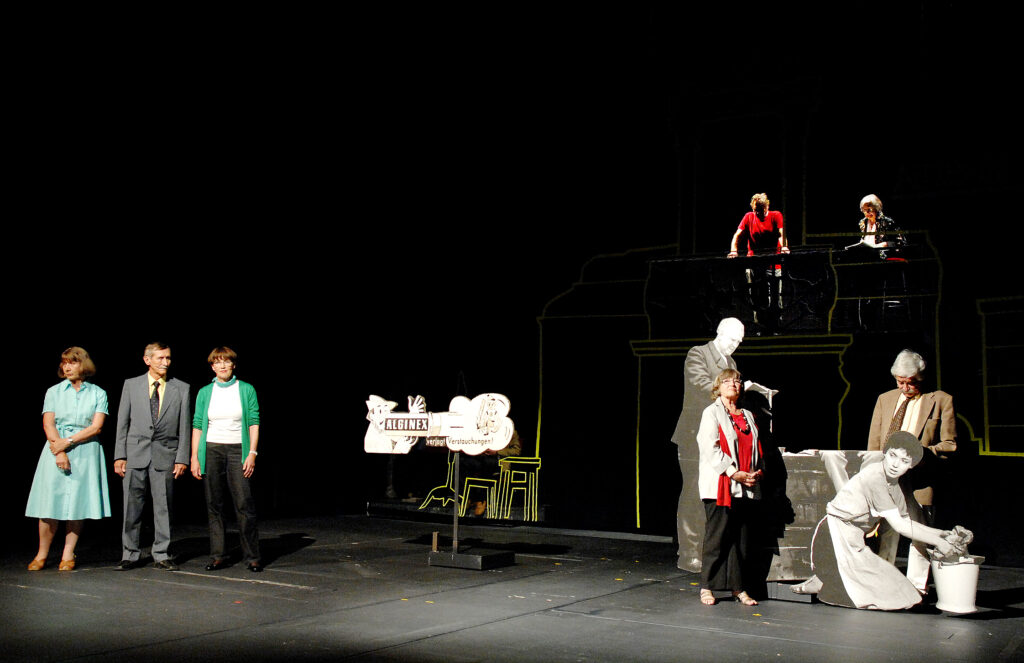
In Kreuztworträtsel Boxenstopp, they faced this situation as three directors who, without giving up their artistic concerns in favor of social necessities, had to actively assist their experts (four ladies in their eighties) throughout the evening. Because of the performers’ unstable physical condition and living circumstances, Boxenstopp showed more clearly than any other piece what lies at the heart of all their work.
Even the structure of the production process itself is shaped by the particular needs and possibilities of the available experts (and thus by the piece’s “content”). In Boxernstopp, for example, there were clear limits on how much rehearsal was possible each day. This stemmed not only from the ladies’ limited physical capacities but also from the fact that a retirement home’s schedule, given items such as light exercise, memory training, afternoon coffee, music-making and meals, is busier than people think, and that such institutions are rather protective of their residents. Apart from playing a few test rounds of Formula 1 on the PlayStation with the residents, simply walking in and talking to people or organizing a casting was clearly not an option. “Gaining access to the slowed-down world of the elderly” (Wetzel) ultimately became possible only with the help of the leader of the memory-training program, who at least had some idea of what the ladies could and could not do. One of the techniques used to exercise the memory is the crossword puzzle, a kind of pit stop for the brain.
Over this period, Rimini developed a logic that allowed their experts to act confidently during the performance and to integrate themselves into the theatrical system. For example, Helgard Haug gave flag signals from inside the prompter’s box, which on the one hand were an element of the piece’s Formula 1 narrative and on the other were, quite literally, a clear signal of what the next step would be. The reports read by Mrs. Falke were not only the text of the piece but also an explicit record of the race in which the elderly ladies took part (for reasons that were not entirely clear but had something to do with curious scientific research). The small stairlift was not only a real means of getting around but also a playful allusion to motorized technology. Necessity determined the stage events and elements, as well as steering new forms of narration and meaning. The logic of care resembles the logic of the piece’s subject. “Racing drivers survive only if they receive signals from outside. Otherwise they would just go and crash into a wall.” (Wetzel) Ever since that piece, these aids (sometimes overt, sometimes implicit, but never hidden) have found their place in almost all of their works, serving at the same time as support and as narrative. “When the children in Uraufführung get to wear costumes bearing the municipal coat of arms, it fits their understanding of theater and helps them in the same way the flag signals helped Mrs. Düring.” (Wetzel)
This dramaturgy of care applies not only to these aids but also to the nature of the texts. They need to stand on their own on the one hand and serve as support on the other. It is precisely from this origin that some characters in Uraufführung speak Swiss German while others do not, just as verbatim repetitions, cheat sheets and instruction signs appear in various forms. It is not only the performers’ feelings that are at play here. Sometimes they need to be protected from themselves or from being confronted with an unknown situation, and so Rimini Protokoll carefully “watches whether something worrying is developing, whether the play is somehow heading in the wrong direction, and you decide you don’t want to sit across from these people and listen to them this way. This way they don’t express what you want to show about them, from them and of them.” (Haug).
The trust the participants place in the directors has to be rebuilt with every production. The long runs and extensive tours of Rimini productions have meant that experts have often seen other Rimini works and built up a so-called parallel expert knowledge before starting work. “Uraufführung was extreme; everyone had already seen Das Kapital and so had a sense that ‘we’ve got this figured out.’ But even in the case of Das Kapital, a few people had seen Wallenstein and approached things much more comparatively. Basically, on the one hand they’re almost spoiled by it, and on the other it helped in times of crisis.” (Haug)
That said, the Rimini directors did not have to be nice people. They pushed their performers extremely hard, just as much as they protected them and met their needs every evening. During a performance at the International Summer Academy at the Mousonturm in Frankfurt, the experts in Physik had begun to feel very safe and could therefore babble away quite routinely throughout the show. Bernd Ernst and Stefan Kaegi then confronted them, just before the start of the show, with the idea that the performance would be in English because of the large number of international guests. At that point, the struggle with language became the theatrical experience.
Such spaces of insecurity, working against the performers’ daily routine, became part of the craft of Haug, Kaegi and Wetzel. Some experts were given small tasks to carry out and, from time to time, the chance to ask a different question or answer a question differently. They were encouraged to depart from the script for a moment and to set both themselves and the other performers in motion. They took this as far as having the students in Apparat Berlin and the children in Shooting Bourbaki actually start wrestling (stage direction: really fight, but don’t hit anyone wearing glasses).

Photo: ©RiminiProtokoll
These spaces must be clearly defined. “It’s fine to make a joke on stage that only the performers are in on, but it’s very important to understand that there is an audience off the stage too and that you can’t keep fooling around forever.” (Haug) On the third anniversary of the bankruptcy of the Belgian airline Sabena, the former employees who were the experts of Sabenation took the stage at PACT Zollverein in Essen and, naturally, wanted to make that particular historic date the focus of the evening. But reliving the day they had stood in bewilderment in front of the company’s locked doors was not something they could cope with. In a performance where former flight attendant Myriam Reitanos could not hold back her tears, the other performers also told excessively emotional stories, causing the piece to lose its form, which had been designed so that its sense of pathos was never hidden from the audience.
The care Rimini Protokoll shows its performers is professional in nature. They are there to make art, not to make friends. The connections they form have rarely been entirely severed, and although the experts make offers to meet, these meetings are limited to purely chance encounters. “Our complicity is temporary” (Wetzel), and the work has long since moved on elsewhere. At times there have been human reasons for turning a new page, as in cases where a show’s success masks the fact that the experts were chosen not for any fundamental talent for theater but solely for their expertise in this one piece.
Keeping a distance was especially important in Midnight Special Agency, part of the Kunsten festival in Brussels, in which each night another twenty-three experts spent five minutes on stage without much time for preparation or introduction. “They seemed very unprepared, and for many of them it was like bungee jumping. Afterward they immediately wanted to change their lives.” (Wetzel). As in other productions, it may not be easy for everyone to understand that the interest in their lives is limited to a single project. “The fact that we go our own way is often perceived as an insult.” (Wetzel) What was at stake was a partnership limited to a certain period, not a lifelong one.